
Austin Tree Cabling Services
Austin Tree Services TX installs ISA-compliant steel cabling systems that stabilize co-dominant stems, split trunks, and overextended limbs — reducing limb-failure risk without removing trees that can be preserved.
Austin Tree Services TX installs high-strength steel cabling systems to stabilize structurally compromised trees across Austin and Central Texas. Co-dominant stems, split trunks, and overextended limbs are secured using ISA-compliant hardware, reducing limb-failure risk without removing trees that can be preserved. Call (512) 729-9018 for a free structural assessment.
When does a tree in Austin need cabling?
A tree in Austin needs cabling when it has co-dominant stems with included bark, visible splitting at a branch union, heavy overextended limbs above structures, or previous storm damage that compromised structural integrity. These trees carry elevated limb-failure risk, particularly during Central Texas spring and fall severe weather.
- Co-dominant stems with included bark — Two or more stems of near-equal diameter growing from the same point with bark embedded at the union. Included bark prevents the tree from forming a strong wood connection. The union is the most common failure point in Austin's large live oaks and pecans.
- V-crotch growth pattern — A narrow-angle fork that creates mechanical stress at the junction. V-crotch unions split under load; U-crotch unions rarely fail. V-crotch trees with large canopies require cabling before the canopy mass exceeds the union's load capacity.
- Visible cracks or splits along the trunk or major limbs — Active splitting indicates the structural threshold has been reached. Cabling at this stage prevents further separation while the tree attempts wound compartmentalization. If you're not sure whether a cracked tree trunk is urgent, treat any crack that is widening season over season as one.
- Overextended horizontal limbs above structures — Live oaks in Austin frequently grow large lateral limbs over rooftops, driveways, and pool areas. When limb diameter exceeds 6 inches and the limb extends more than 15 feet horizontally, cabling reduces the drop risk.
- Previous storm damage — Trees that survived major limb loss or wind-induced leaning but remain structurally viable are strong candidates for cabling. Central Texas severe weather — particularly the spring and fall storm windows — exerts repeated load on already-stressed branch unions. See our guide to inspecting a tree after a storm for the full checklist.
- Significant lean toward structures — A tree leaning more than 15 degrees toward a home, fence, or vehicle requires assessment. Cabling is not always the correct intervention for lean — root condition and soil saturation are also evaluated. Whether a leaning tree is dangerous depends on that combination, but lean paired with crown asymmetry often indicates cabling will reduce tip-over risk.
What is tree cabling in Austin, TX?
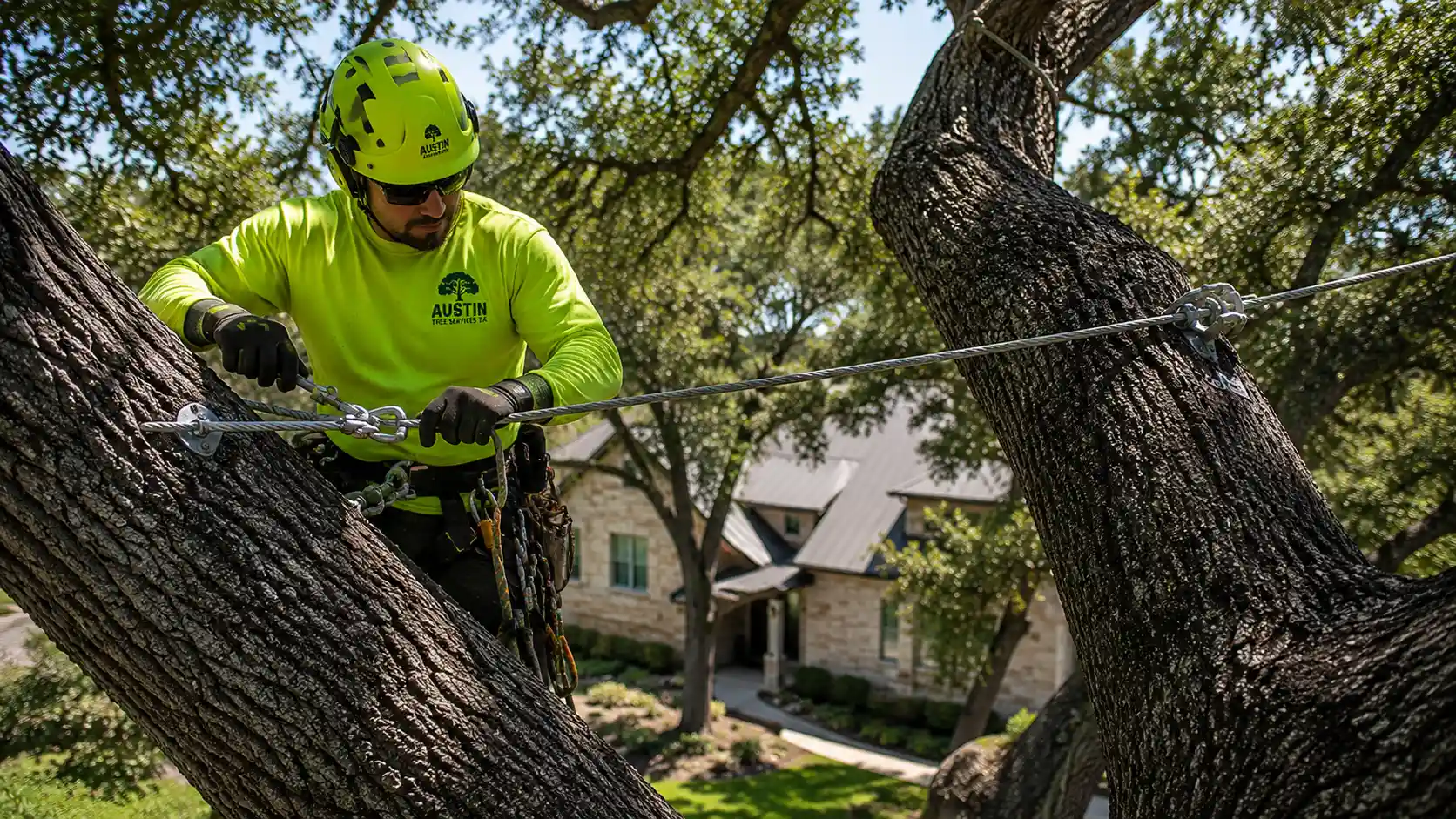
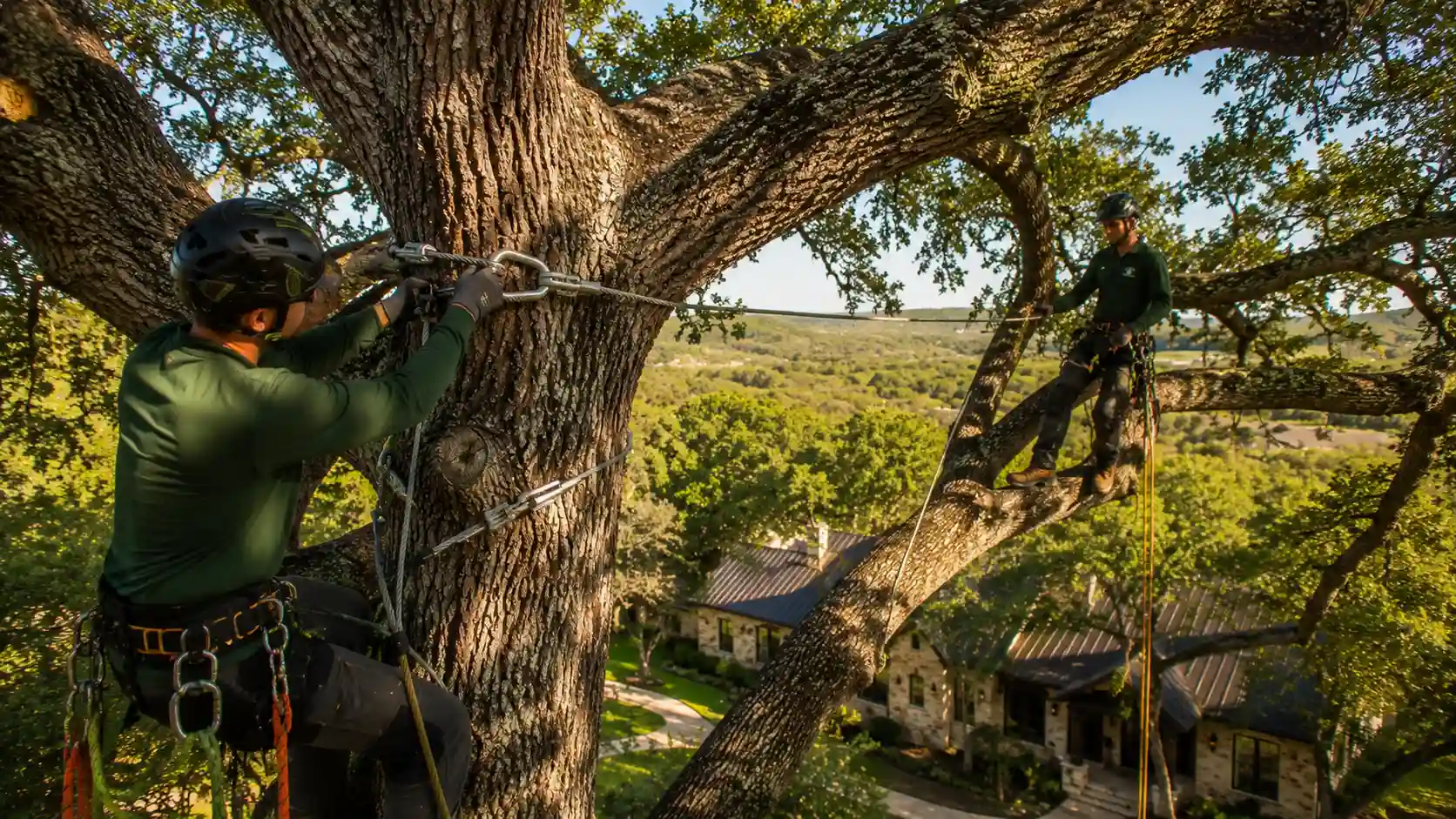
Tree cabling in Austin, TX is the installation of flexible, high-strength steel cables between major branches or co-dominant stems to redistribute structural load and reduce the risk of limb failure. A certified arborist positions cables in the upper two-thirds of the tree canopy using threaded eyebolts anchored through load-bearing branch wood.
Tree cabling differs from tree bracing in material and application. Cables are flexible — they allow natural branch movement in wind while limiting the range of motion that causes splitting at weak unions. Bracing uses rigid steel rods inserted through the wood of split or cracked trunks to hold two sections together while the tree compartmentalizes the wound.
Both systems are installed according to International Society of Arboriculture (ISA) standards. At Austin Tree Services TX, our Austin arborist team evaluates each tree individually before recommending a cabling system, a bracing system, or a combination of both. Not every structurally compromised tree requires cabling — some require crown reduction pruning, and some require removal.
Standard hardware includes EHS (Extra High Strength) steel cable rated for the diameter of the tree, threaded lag eyebolts or through-bolt assemblies, thimbles, and cable clamps. Installation depth, cable tension, and anchor point selection are calculated based on crown weight, branch diameter, and the distance between anchor points.
Which Austin tree species most commonly need cabling?
The Austin tree species most commonly requiring cabling are Live Oak, Pecan, Cedar Elm, Texas Red Oak, and Bald Cypress. Live oaks develop large co-dominant stems and heavy lateral limbs over decades. Pecans form wide, multibranching canopies prone to storm breakage. Cedar elms develop included bark unions that weaken with age in Central Texas urban soils.
| Species | Structural pattern | Cabling note |
|---|---|---|
| Live Oak Quercus fusiformis | Wide co-dominant canopies; lateral spans exceeding 50 ft in mature specimens. | Limbs over structures need cabling once diameter exceeds 5 in. Responds well; can be preserved 50+ years with proper support. |
| Pecan Carya illinoinensis | Multi-branching crown, heavy nut-season load, common V-crotch formation in nursery stock. | Wide canopy spread multiplies wind load at branch unions. Cabling recommended for mature specimens near structures. |
| Cedar Elm Ulmus crassifolia | Upright growth, narrow branch angles, often clustered stems from root sprouts. | Included bark develops in crowded multi-stem situations. Cabling stabilizes the cluster as a unit. |
| Texas Red Oak Quercus buckleyi | Asymmetric crowns on rocky, shallow limestone soils common in West Austin and Lakeway. | Shallow root anchorage increases tip-over risk. Cabling combined with crown reduction lowers wind sail. |
| Bald Cypress Taxodium distichum | Large lateral limbs in open-grown specimens along Barton, Shoal, and Bull Creek corridors. | Storm damage to lateral structure is common during spring flooding. Cabling preserves specimen trees in riparian settings. |
| Texas Ash Fraxinus texensis | Native, softer wood than live oak or pecan; more prone to wind damage and splitting. | Trees with large canopies over structures benefit from cabling, though decline from ash borers should be evaluated first. |
How is tree cabling installed in Austin?
Tree cabling installation in Austin follows a 5-stage process: structural assessment, anchor point selection in the upper two-thirds of the canopy, drilling through the branch wood, threading and tensioning the EHS steel cable, and a post-installation load test. The system is installed to ISA cabling and bracing standards.
-
Structural assessment
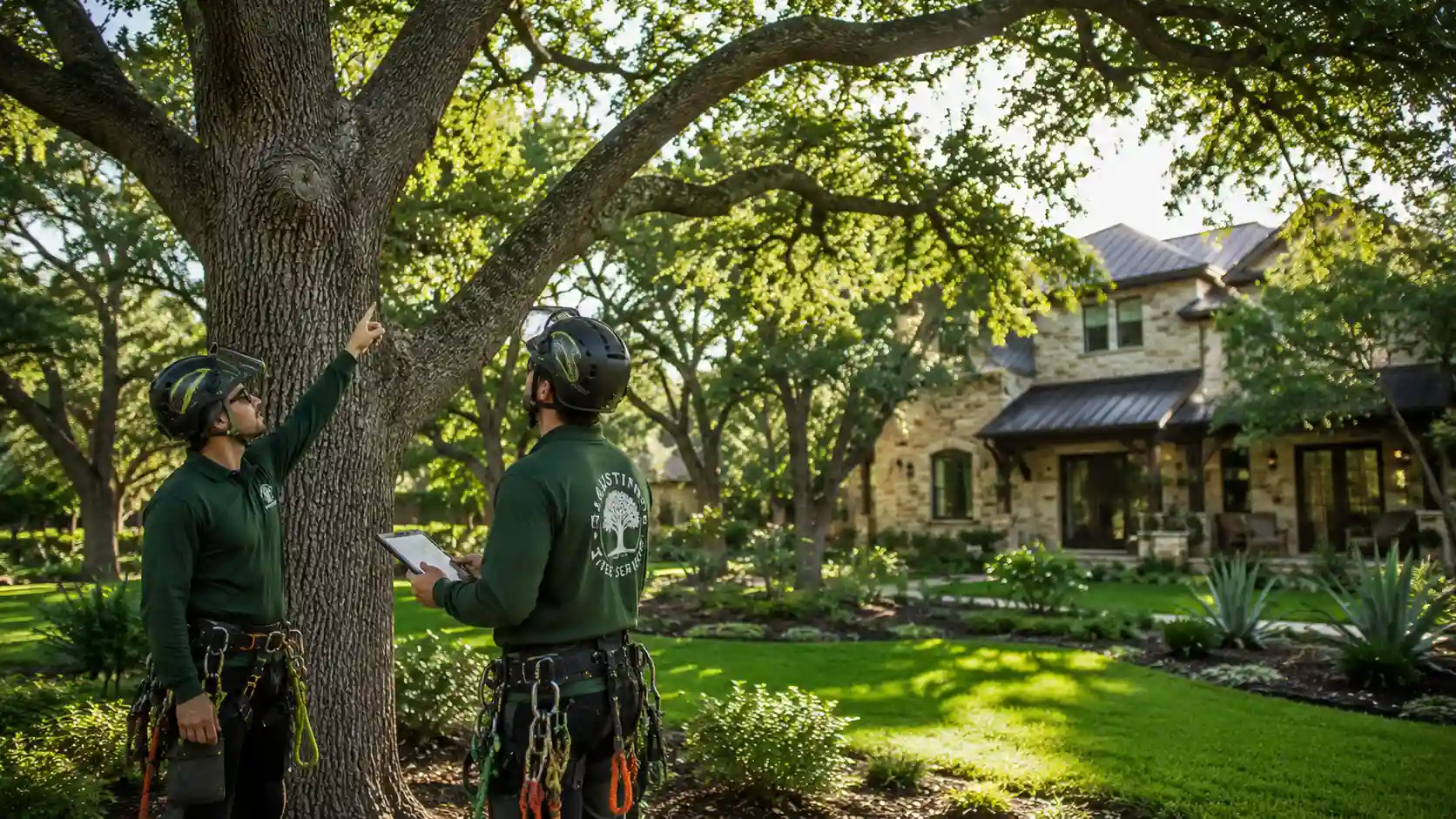
The arborist evaluates crown architecture, identifies weak unions and overextended limbs, measures branch diameters at proposed anchor points, and assesses root zone condition. Trees with less than 30% structural integrity remaining are evaluated for removal rather than cabling.
-
Anchor point selection
Cable anchors are positioned in the upper two-thirds of the canopy, at a distance from the union equal to two-thirds of the distance between the union and the branch tip — maximizing load redistribution without concentrating stress at the hardware.
-
Hardware installation
The arborist drills through the branch wood at the anchor point. Branches under 3 in. diameter receive lag bolts; branches over 3 in. receive through-bolt assemblies with backing plates on both sides.
-
Cable routing and tensioning
EHS steel cable is threaded through the eyebolts with thimbles at each end and secured with a three-clamp configuration. The cable is tensioned to take up slack without placing the system under active static load.
-
Post-installation inspection
The arborist load-tests the hardware, documents cable type, length, and anchor specifications, and sets the first inspection interval — 18 to 24 months in Austin's climate.
What is the cost of tree cabling in Austin, TX?
Tree cabling in Austin, TX costs between $200 and $1,500 per tree depending on tree height, the number of cables required, hardware type, and access conditions. A single-cable installation averages $200 to $500 on a smaller tree and $400 to $900 on a larger specimen requiring climber access. Multi-cable systems on large canopy trees average $600 to $1,500.
| Cost factor | Lower cost | Higher cost |
|---|---|---|
| Tree height | Under 30 ft | Over 50 ft (aerial lift required) |
| Number of cables | 1 cable system | 3+ cable system (multiple weak unions) |
| Hardware type | Standard lag eyebolt system | Through-bolt system with backing plates |
| Access conditions | Open lawn, standard climbing access | Tight fence lines, pool surrounds, slope terrain |
| Combination with pruning | Cabling only | Crown reduction pruning + cabling (most effective) |
| Emergency vs. scheduled | Scheduled installation | Post-storm emergency cabling |
Cabling cost should be evaluated against the cost of the alternative. A mature live oak removal in Austin ranges from $1,500 to $4,000 depending on size, location, and stump disposition. Cabling a tree that can be preserved is almost always the lower-cost outcome when the tree has structural integrity above 40% and does not pose an immediate hazard.
How long does tree cabling last in Austin's climate?
Tree cabling hardware in Austin, TX requires inspection every 18 to 24 months for the first 6 years after installation, then annually thereafter. EHS steel cable has a functional service life of 10 to 15 years — Central Texas UV exposure, 100°F+ summer heat cycles, and humidity variation trend installations toward the lower end of that range.
EHS steel cable — Rated service life of 10 to 15 years. Uncoated EHS cable is the standard specification for Central Texas installations, since vinyl coating traps moisture against the steel in Austin's wet seasons and accelerates corrosion at the clamp contact points.
Hardware (eyebolts, through-bolts, thimbles, clamps) — Galvanized hardware has a service life of 8 to 12 years in Austin's climate. Hot-dip galvanized hardware is specified over electroplated hardware because the thicker zinc coating resists corrosion through repeated wet-dry cycles.
Inspection schedule — Every 18 to 24 months for the first 6 years post-installation, then annually as the system approaches the 10-year mark. Each inspection checks cable tension, hardware integrity, cambium growth around the eyebolts, and the structural condition of the anchor branches, since branch growth changes load distribution over time.
Cabling inspection is paired with structural pruning at Austin Tree Services TX. Deadwood removal, crown thinning, and corrective pruning of crossing branches happen at the same site visit, reducing the total cost of maintaining a preserved tree over its lifespan.
Cabling installations across Central Texas
Does tree cabling prevent storm damage in Austin?
Tree cabling reduces limb-failure risk during Austin storms by limiting the range of motion at structurally weak branch unions. It does not prevent all storm damage — a direct strike or tornado-force wind can overcome any support system. Cabling is most effective against failure of co-dominant stems and overextended limbs under standard severe-weather loads.
Spring severe weather season (March–May) — Derecho events, thunderstorm lines with straight-line winds of 60 to 80 mph, and occasional tornado touchdowns across Travis and Williamson counties. Co-dominant stems fail most frequently during this window.
Late summer and fall storm season (August–October) — Gulf moisture produces extended heavy rainfall that saturates Austin's clay soils and reduces root plate anchorage. Trees with root damage from construction, drought stress, or oak wilt are highest risk during this window.
Cabling installed during Austin's winter dormant season (December–February) provides the most effective support by the time peak storm load arrives. Post-storm emergency cabling is available for trees that sustained partial crown damage but retain sufficient structural integrity to be preserved — see our guide to inspecting a tree after severe weather for what to check first.
For trees that have already failed or are beyond the threshold for cabling, our Austin tree removal service provides rapid response across all 15 service communities.
Is tree cabling better than tree removal for Austin homeowners?
Tree cabling is the correct choice when a tree retains more than 40% of its structural integrity, has no advanced decay at the union, and can be stabilized without creating unacceptable residual risk. Tree removal is correct when structural failure is imminent, root damage is severe, or the tree has less than 30% viable structural wood remaining.
| Criteria | Cable and preserve | Remove |
|---|---|---|
| Structural integrity | 40–80% viable structural wood; no advanced decay at anchor points. | Under 30% integrity. Advanced decay at union or root collar. |
| Proximity to structures | Failure would cause property damage but not personal injury risk. | Direct fall path over occupied structures or high-traffic zones. |
| Tree health and lifespan | Healthy or recoverable with fertilization; 15+ years projected. | Declining from oak wilt, canker, or root girdling; under 5 years projected. |
| Economic value | Mature specimen tree; replacement shade would cost $5,000–$20,000 and 20+ years. | Small or young tree; removal costs less than a multi-year cabling program. |
Understanding the line between a dangerous tree and one that can be saved is the core judgment call in every assessment. When removal is the correct outcome, Austin Tree Services TX uses controlled sectional lowering to protect surrounding structures, with stump grinding and replacement planting available as a single project.
Where does Austin Tree Services TX provide tree cabling?
Austin Tree Services TX provides tree cabling across Austin and 15 surrounding Central Texas communities across Travis, Williamson, and Hays counties, reaching all locations within 1 business day for standard assessments and offering priority scheduling for post-storm emergency cabling.
Large established live oak and pecan populations. Co-dominant stem cabling is the most frequent request in this corridor.
Texas Red Oak and Ashe Juniper on shallow limestone soils. Root anchorage assessments accompany every cabling evaluation here.
Growing residential development around established canopy. Cabling near new construction, where root compaction is common, is a frequent request.
Served with the same equipment and arborist expertise as central Austin properties.
Why choose Austin Tree Services TX for tree cabling in Austin?
Austin Tree Services TX performs tree cabling to ISA Best Management Practice standards using EHS steel cable and galvanized hardware rated for Central Texas climate conditions. All structural assessments are conducted on-site at no charge, with same-week scheduling for non-emergency installations.
- ISA-standard installation on every project — every cable, anchor bolt, and hardware component follows ISA Best Management Practices for Tree Cabling and Bracing, documented with cable specs, anchor depth, and recommended inspection interval.
- Free on-site structural assessments — every evaluation is conducted in person, including probing for included bark, checking root collar condition, and measuring branch diameters at proposed anchor points.
- Local species knowledge specific to Central Texas — direct field experience across soils from North Austin clay to Hill Country limestone informs anchor selection, tension calibration, and maintenance scheduling.
- Transparent, written estimates before work begins — every project is itemized for cable type and length, hardware specs, labor, and any complementary pruning.
- Fully licensed and insured — full liability and worker's compensation coverage on all cabling work. Read more about our licensing and insurance coverage on the About Us page.
Our full service offering extends beyond cabling to structural pruning, deep root fertilization, arborist consultations, and — when preservation isn't viable — professional tree removal followed by stump removal and replacement planting.
Common questions about cabling in Austin
Properly installed cables cause minor, localized wounding that the tree calluses around over time. Improperly installed hardware — too large, too tight, or misplaced — can girdle bark or create new stress concentrations, which is why ISA-standard installation and follow-up inspection matter.
Yes, with coordination. Routine trimming can proceed on a cabled tree, but the crew needs to know the cable locations — removing a limb a cable is attached to without consulting the installing arborist can compromise the whole system.
Cabling is a supportive, non-invasive intervention and does not require a City of Austin tree permit. Permits apply to removal and major pruning of protected-size trees, not to structural support installation.
Yes. Installing before Austin's spring storm season (roughly March through May) gives the system time to be load-tested and inspected before peak wind load arrives. Post-storm emergency cabling is available, but pre-season installation is the lower-risk option.
Other tree services in Austin
Get your tree evaluated before storm season
On-site cabling assessments are free, with no obligation to proceed. Same-week scheduling for standard installations, priority scheduling after storms.
Call (512) 729-9018