
Austin Stump Removal Services
Full extraction of the stump and root system with an excavator, stump puller, or hand tools — not just surface grinding. Every job includes a Texas 811 utility check, a written diameter-based estimate, and backfill.
Stump removal is the complete extraction of a tree stump and its full root system from the ground, using mechanical equipment, chemical decomposition, or manual digging. It differs from stump grinding, which chips only the visible portion of the stump and leaves the deeper roots in the soil.
A Full-Extraction Crew Serving Central Texas
Austin Tree Services Tx removes stumps from live oaks, post oaks, cedar elms, pecans, hackberries, mesquites, Arizona ash, Bradford pears, and any other species — after tree felling or as a standalone service.
- Every job is performed with excavators, stump pullers, or hand tools matched to the stump diameter, root depth, and site access.
- Removal eliminates the visible stump and the underground roots, restores the soil for replanting or new construction, and prevents sucker regrowth, termites, or root rot fungi.
- Property owners schedule removal when the area must be replanted with a new tree, when construction is planned over the stump location, or when a previously ground stump keeps producing regrowth.
What Is Stump Removal?
Stump removal extracts a tree stump together with its root system from the ground, using an excavator, stump puller, hand tools, or chemical agents to break the bond between roots and soil. The result is an open hole with no remaining wood or root mass below the surface.
Stump removal is a post-felling arboricultural service. After a tree is cut down and the trunk hauled away, the stump remains anchored by a network of roots. Removal severs and extracts these roots, lifts the stump from the soil, and clears the cavity for backfill.
A stump removal job produces three standard outputs: an open soil cavity that requires backfill, a removed stump and root mass for haul-away, and a clear surface ready for replanting, sodding, or hardscape. For a faster surface-level alternative, see stump grinding.
Stump Removal vs. Stump Grinding: What's the Difference?
Stump removal extracts the entire stump and root ball, leaving a large open hole that requires backfill. Stump grinding chips the stump 6 to 12 inches below grade, leaving the deeper roots to decompose naturally. Removal is more thorough; grinding is faster, cheaper, and less invasive.
| Attribute | Stump Removal | Stump Grinding |
|---|---|---|
| Method | Full extraction with excavator or puller | Mechanical chipping with grinder wheel |
| Depth reached | Entire stump and root ball | 6–12 inches below grade |
| Hole size after job | Large, requires backfill with topsoil | Small, filled with wood chips |
| Typical cost per stump | $200–$1,000+ | $75–$400 |
| Time per stump | 2–6 hours | 30 min–2 hours |
| Landscape disruption | Significant | Minimal |
| Replanting in same spot | Can replant immediately | Wait 12 months |
| Best for | Construction sites, deep planting | Most residential cases |
For a full breakdown of which method fits your situation, read stump grinding vs. stump removal: which is better.
Why Should You Remove a Tree Stump?
Tree stumps should be removed to clear the area for new planting, prepare ground for construction, eliminate stubborn regrowth, prevent termite and pest infestation, and stop fungal decay from spreading to nearby trees.
- Replant in the same spot — full root extraction allows a new tree to be planted where the old one stood.
- Prepare for construction — patios, decks, pools, fences, and additions require a clean soil base with no buried wood.
- Stop persistent regrowth — hackberry, mesquite, and Bradford pear send up shoots from leftover roots for years.
- Eliminate pest harborage — buried roots attract termites, carpenter ants, and wood-boring beetles.
- Stop fungal disease spread — root rot fungi like Armillaria and Ganoderma travel through the root system to nearby trees.
- Recover full property value — buyers and HOAs prefer cleared lots with no buried wood or visible stumps.
What Are the Problems With Leaving a Stump?
Leaving a stump creates seven recurring problems: termite and carpenter ant infestation, fungal decay that spreads to nearby trees, sucker shoots, mowing damage and trip hazards, reduced property value, slow natural decay over 5 to 15 years, and water pooling in soft decayed centers.
Pest Problems
- Termites — decaying stumps are a primary food source and entry point to nearby structures.
- Carpenter ants — colonize soft, decaying wood and migrate to homes.
- Wood-boring beetles — lay eggs in stumps and emerge in adjacent trees.
- Rodents and snakes — use hollow or rotted stumps as shelter.
Disease Problems
- Armillaria root rot — spreads from stumps to healthy nearby trees.
- Hypoxylon canker — produces airborne spores from decayed wood.
- Oak wilt residual transmission — oak stumps from oak-wilt-killed trees can harbor the pathogen.
- Ganoderma root rot — travels through underground root contact.
Property Problems
- Trip and fall hazards — especially for children and elderly visitors.
- Lawn mowing damage — bent blades, broken mower decks.
- Reduced property value — visible stumps signal deferred maintenance.
- Sprout regrowth — repeated cutting becomes a permanent chore.
- Foundation interference — large root systems can shift soil as they decay.
For a deeper look at why removal matters, read why leaving a tree stump can be a problem.
What Methods Are Used for Stump Removal?
Three methods are used for stump removal: mechanical extraction with an excavator or stump puller, chemical decomposition, and manual digging with hand tools. Mechanical extraction is the fastest and most common method for residential and commercial properties.
Method 1 — Mechanical Extraction
Uses an excavator, mini-excavator, or stump puller to physically pull the stump and major roots from the soil. The standard choice for stumps over 12 inches in diameter, finishing in 2 to 4 hours per stump.
Method 2 — Chemical Decomposition
Potassium nitrate or commercial stump-killer products are applied through drilled holes to accelerate decay. Full breakdown takes 4 to 12 months. Not appropriate near living trees, water features, or food gardens.
Method 3 — Manual Digging
Shovels, mattocks, root saws, and pry bars expose and cut the root system by hand. Reserved for stumps under 6 inches in diameter or tight spaces machinery can't reach — 1 to 3 hours of labor.
Method 4 — Burning (Restricted)
Occasionally used on rural Texas properties, but restricted by the City of Austin and surrounding municipalities. Austin Tree Services Tx does not offer stump burning as a residential service.
How Does the Stump Removal Process Work?
The process runs in six sequential stages: site inspection and utility check, root cutting and exposure, mechanical extraction, hole inspection, backfill, and debris haul-away. A typical residential job takes 2 to 4 hours per stump.
-
Site Inspection and Utility Locate
The crew measures stump diameter, identifies surface roots, and verifies Texas 811 has marked gas, electric, water, and communication lines at least 48 hours before digging.
-
Root Cutting and Exposure
Lateral roots are exposed with a shovel and severed with a chainsaw, root saw, or axe, freeing the central root ball so the stump can be lifted cleanly.
-
Stump and Root Ball Extraction
A mini-excavator, stump puller, or excavator bucket lifts the stump and main root ball out of the ground. This stage produces the deepest cavity of the job.
-
Hole Inspection
The open cavity is checked for residual roots, buried debris, and soil voids. Remaining large roots are cut and removed by hand to prevent future settling.
-
Hole Backfill
The cavity is filled in compacted 6-inch lifts using topsoil, native fill, or a soil-mulch mix, then leveled to match the surrounding grade.
-
Debris Haul-Away
The stump, root mass, and excess soil are hauled to a licensed disposal or composting facility. The area is raked clean and checked for equipment marks.
What Equipment Is Used for Stump Removal?
Four main equipment types are used: mini-excavators for most residential jobs, full-sized excavators for large or commercial sites, stump pullers for tight-access yards, and hand tools for manual digging.
| Equipment | Typical Use Case | Stump Size |
|---|---|---|
| Mini-excavator | Standard residential stumps | 12–30" |
| Full-sized excavator | Large yards, multiple stumps, commercial sites | Over 30" |
| Stump puller (winch-based) | Tight gates, narrow side yards | 6–24" |
| Chainsaw / root saw | Cutting lateral roots before extraction | All sizes |
| Shovels, mattocks, pry bars | Manual digging for small stumps | Under 6" |
| Skid-steer loader | Stump and debris haul-away | All sizes |
How Deep Does Stump Removal Go?
Removal reaches 18 to 36 inches below grade depending on species. Shallow-rooted species like hackberry are removed at 12 to 18 inches; deep-rooted species like live oak and pecan require 24 to 36 inches or deeper.
| Tree Species | Typical Root Depth | Removal Difficulty |
|---|---|---|
| Hackberry, Bradford pear, mulberry | 12–18" | Easy |
| Cedar elm, Arizona ash | 18–24" | Moderate |
| Live oak, post oak, pecan | 24–36" | Difficult |
| Mesquite | 36–60" (taproot) | Very difficult |
| Bald cypress (near water) | Variable, wide lateral roots | Difficult |
How Much Does Stump Removal Cost?
Stump removal in Austin costs $200 to $1,000+ per stump, averaging $300 to $600. Pricing depends on diameter, root depth, soil condition, and site access. Minimum charges of $200–$300 typically apply, and multi-stump visits get 10–25% volume discounts.
| Stump Diameter | Typical Cost Range | Notes |
|---|---|---|
| Under 12" | $200–$350 | Often subject to minimum charge |
| 12–24" | $350–$600 | Typical residential range |
| 24–36" | $600–$900 | Mature shade trees |
| Over 36" | $900–$1,500+ | Large oaks, pecans, cypress |
| Per-inch pricing | $5–$10/inch | Common pricing model |
| Multiple stumps (same visit) | 10–25% off | Volume pricing typical |
| Hard-to-access stumps | +25–50% | Tight gates, slopes, retaining walls |
| Imported topsoil backfill | $50–$150 | Per cubic yard delivered |
Considering the lower-cost surface option instead? Compare full pricing on the stump grinding service page.
What Factors Affect Stump Removal Cost?
Eight factors affect cost: stump diameter, root depth and species, soil and rock conditions, site accessibility, proximity to structures and utilities, backfill type, number of stumps, and debris haul-away.
- Stump diameter — primary cost driver, charged per inch.
- Root depth and species — live oak, pecan, and mesquite roots reach 30+ inches and add labor time.
- Soil and rock conditions — caliche and limestone slow excavation and can damage equipment.
- Site accessibility — narrow gates, slopes, retaining walls, or backyard-only access.
- Proximity to structures — work near foundations, septic lines, or pools requires careful manual extraction.
- Backfill type — leftover native soil is free; imported topsoil or planting mix adds cost.
- Number of stumps — multi-stump visits qualify for volume discounts.
- Debris haul-away — leaving the stump on-site reduces cost; full haul-away is a standard add-on.
How Long Does Stump Removal Take?
Most residential jobs take 2 to 6 hours per stump. Small stumps under 12 inches take 1 to 2 hours, medium stumps 12–24 inches take 2 to 4 hours, and large stumps over 30 inches take 4 to 6 hours or longer. Site setup, utility checks, backfill, and cleanup add 1 to 2 hours.
Total time depends on six variables: diameter, root depth, soil type, equipment access, proximity to structures, and the number of stumps. A two-stump visit takes less than twice as long as a single-stump visit because setup and equipment transport are shared.
Can a Stump Grow Back After Removal?
A fully removed stump cannot grow back, because the entire root system is extracted with it. Regrowth only happens when roots remain in the soil — typically after grinding or partial removal. Hackberry, mesquite, mulberry, Bradford pear, and live oak are known sucker producers if any roots are left behind.
- Hackberry — aggressive sucker producer; full root extraction is the only reliable solution.
- Mesquite — deep taproot and lateral roots can send up new growth from 60+ inches deep.
- Bradford pear — known sucker producer; difficult to fully eliminate without complete root removal.
- Live oak — extensive lateral roots can produce suckers up to 15 feet from the original stump.
- Mulberry — lateral roots near the surface sprout readily if not cut and removed.
Read more in can tree stumps grow back.
What Happens to the Hole After Stump Removal?
The hole is filled with topsoil, native fill, or a soil-mulch mix, then leveled and lightly compacted. Lawn restoration uses topsoil and grass seed; replanting uses a soil mix matched to the new species; hardscape uses compacted base fill graded to spec.
- Native soil refill — lowest cost, uses excavated soil, suitable for areas left to settle naturally.
- Imported topsoil backfill — clean topsoil delivered and compacted in lifts, ready for sod or seed.
- Engineered fill — compacted base material for patios, driveways, or building foundations.
The standard process: layered backfilling in 6-inch lifts, light watering to settle each layer, and surface leveling to match the surrounding grade. For lawn restoration over the cleared area, read 7 steps to grow grass faster after tree removal.
Can You Remove a Stump Yourself?
DIY stump removal is rarely worth the cost, time, or physical risk. Renting a mini-excavator costs $250–$500 per day and demands operator experience. Manual removal of a mature stump can take 8 to 15 hours and frequently fails to extract the full root system.
DIY makes sense in only three situations:
- The stump is small (under 6 inches diameter) and the species is shallow-rooted.
- The homeowner has prior experience operating excavating equipment.
- The site is fully accessible and free of buried utilities.
For all other situations, professional service includes the Texas 811 utility check, liability insurance, equipment matched to the stump size, and full debris haul-away — at a cost comparable to equipment rental plus your own time.
How Soon Can You Plant or Build After Stump Removal?
Planting or building can begin almost immediately, since the full root system is gone and the cavity is backfilled with stable soil. New trees can go in the same spot within 1 to 2 weeks — a major advantage over grinding's 12-month wait.
| Use Case | Wait Time | Notes |
|---|---|---|
| New grass or sod | 1–2 weeks | Settle backfill with watering, then sod or seed |
| Annual flowers, groundcover | 1–4 weeks | Plant after surface levels stabilize |
| Shrubs, small ornamentals | 2–4 weeks | Plant in topsoil-amended fill |
| New tree, same spot | 1–2 weeks | Major advantage over stump grinding |
| Patio, deck, paver hardscape | 1–4 weeks | Compact engineered fill before construction |
| Building foundation | 2–8 weeks | Engineered compaction and inspection required |
What Stumps Cannot Be Removed by Standard Methods?
Stumps inside foundation slabs, wedged against gas or water mains, inside septic fields, or from protected heritage trees require permits, utility coordination, or arborist-supervised partial removal instead of standard extraction.
Heritage trees in Austin are protected once trunk diameter exceeds 24 inches at standard breast height. Removing stumps from heritage species — live oak, pecan, bald cypress, Texas ash — requires city approval before work begins. Stumps within 5 feet of a foundation, gas line, water main, or septic field require utility coordination and may need partial grinding instead of full extraction.
Austin Tree Services Tx provides arborist-supervised assessment for any stump in a restricted location, coordinating with Texas 811 and obtaining city approval where required.
How Do You Choose a Stump Removal Company?
Choose a company that carries general liability insurance, calls Texas 811 before excavation, provides written diameter-based estimates, owns its own equipment, includes backfill and haul-away, and has verifiable local reviews. Avoid anyone who skips 811, demands cash upfront, or quotes without seeing the stump.
General Liability Insurance
Minimum $1 million coverage protects your property and underground utilities.
Texas 811 Compliance
Calls 811 at least 48 hours before excavation to mark utilities.
Owned Equipment
Companies with their own excavators and stump pullers are faster and more reliable than those subcontracting.
Written Diameter-Based Estimate
Clear pricing per inch with a stated minimum charge.
Backfill and Haul-Away Included
Full job scope stated in the quote, with cleanup and topsoil add-on availability.
Local Reviews
Verifiable Google or BBB ratings from Central Texas clients.
Every Job Carries the Same Four Guarantees
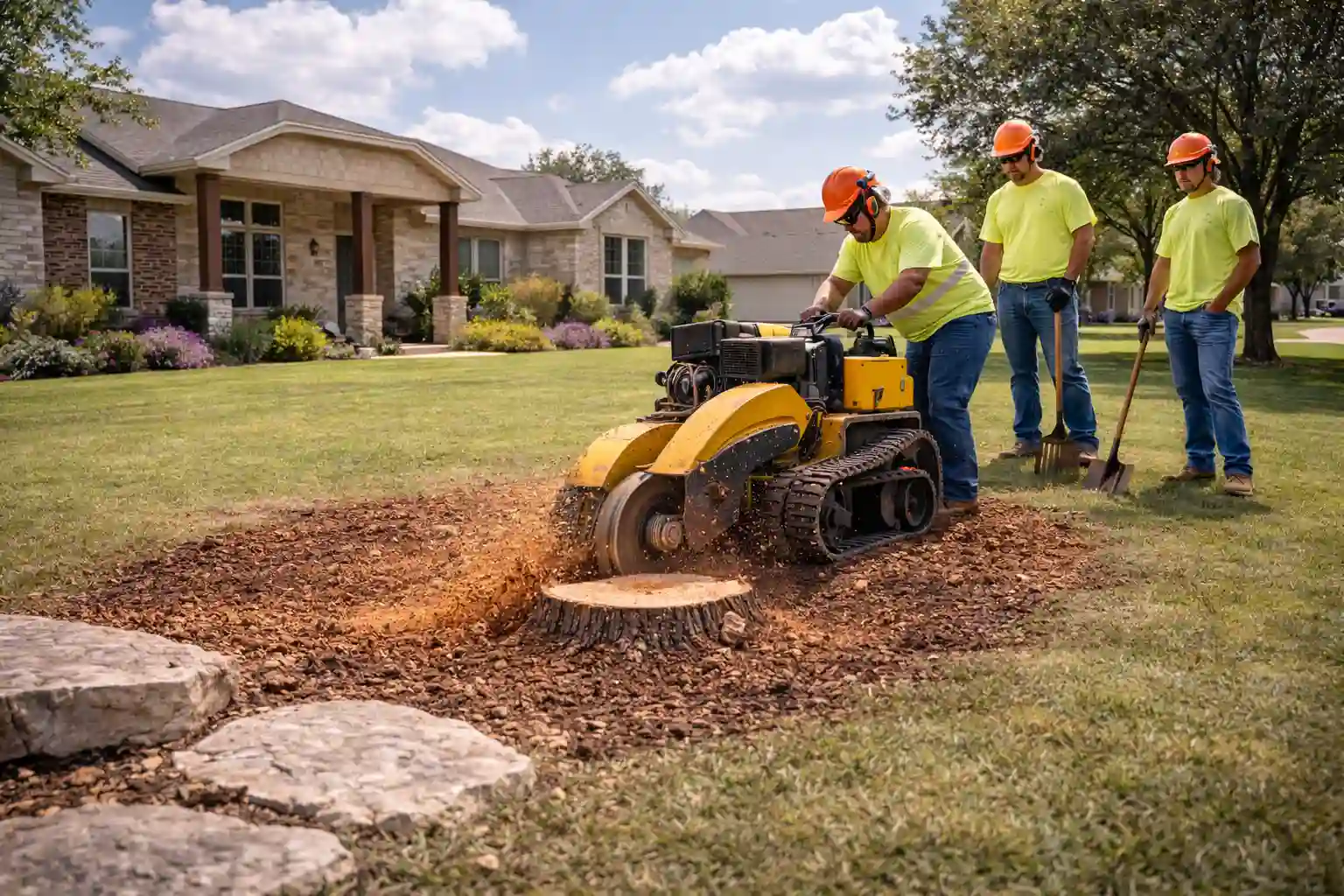
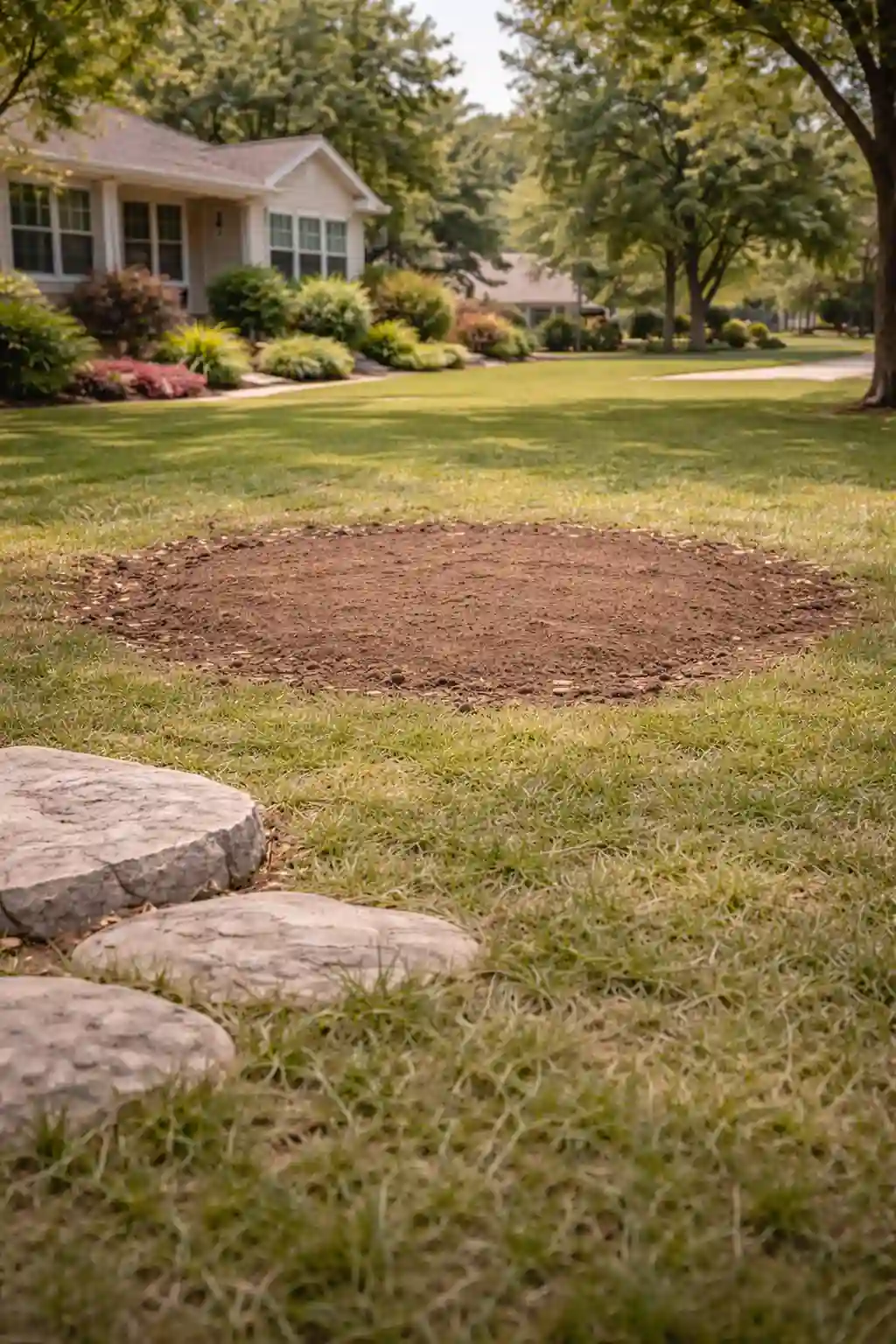
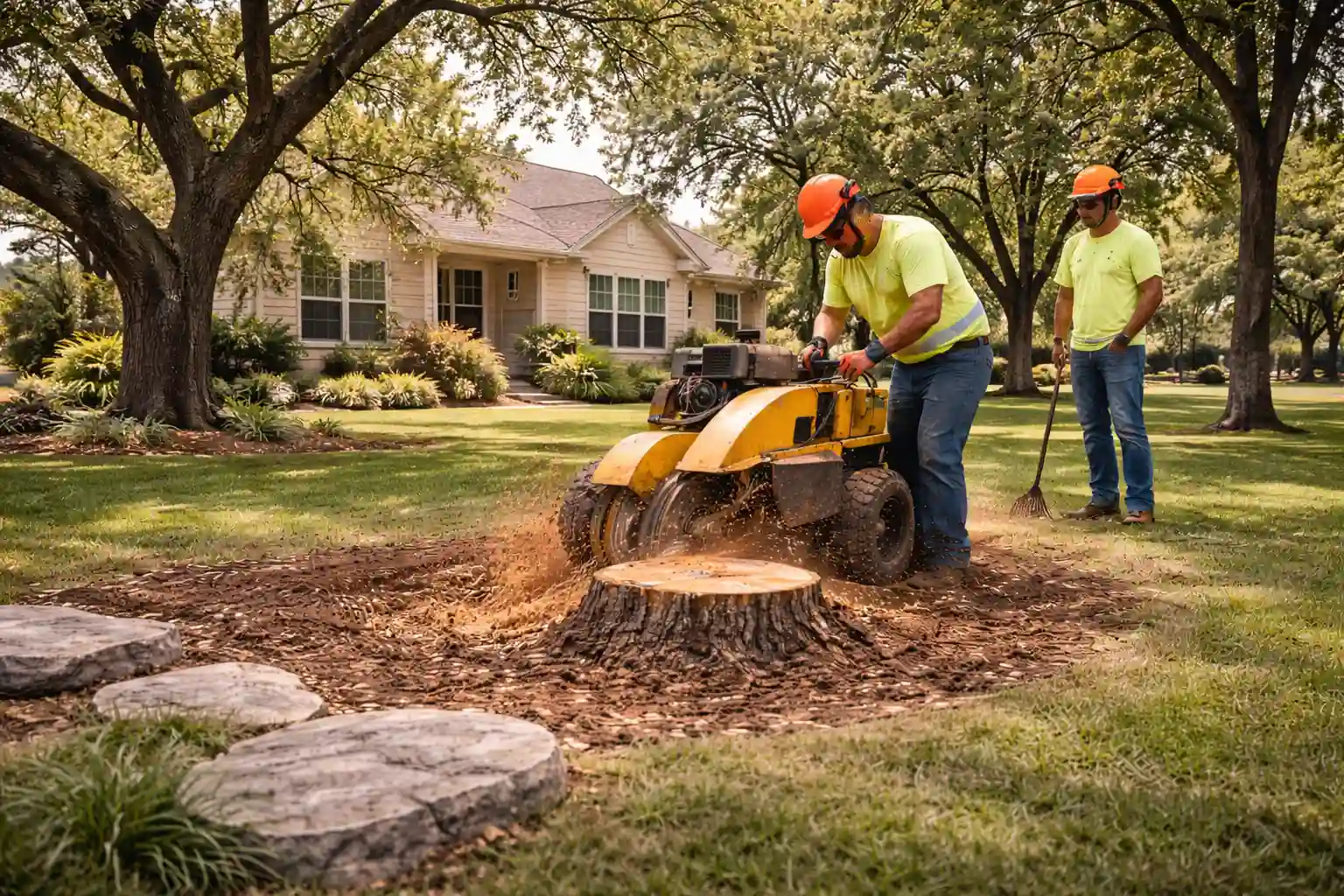
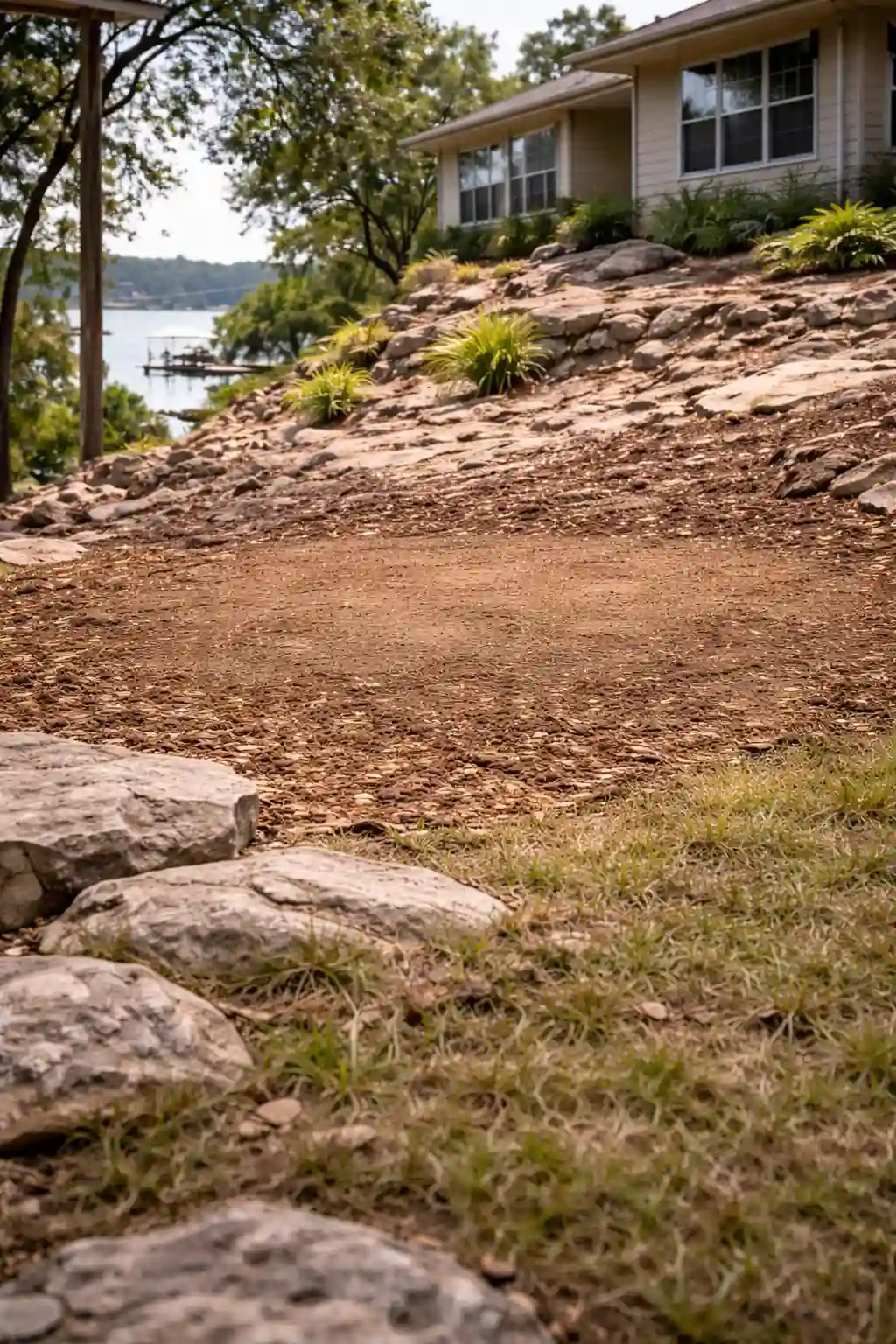
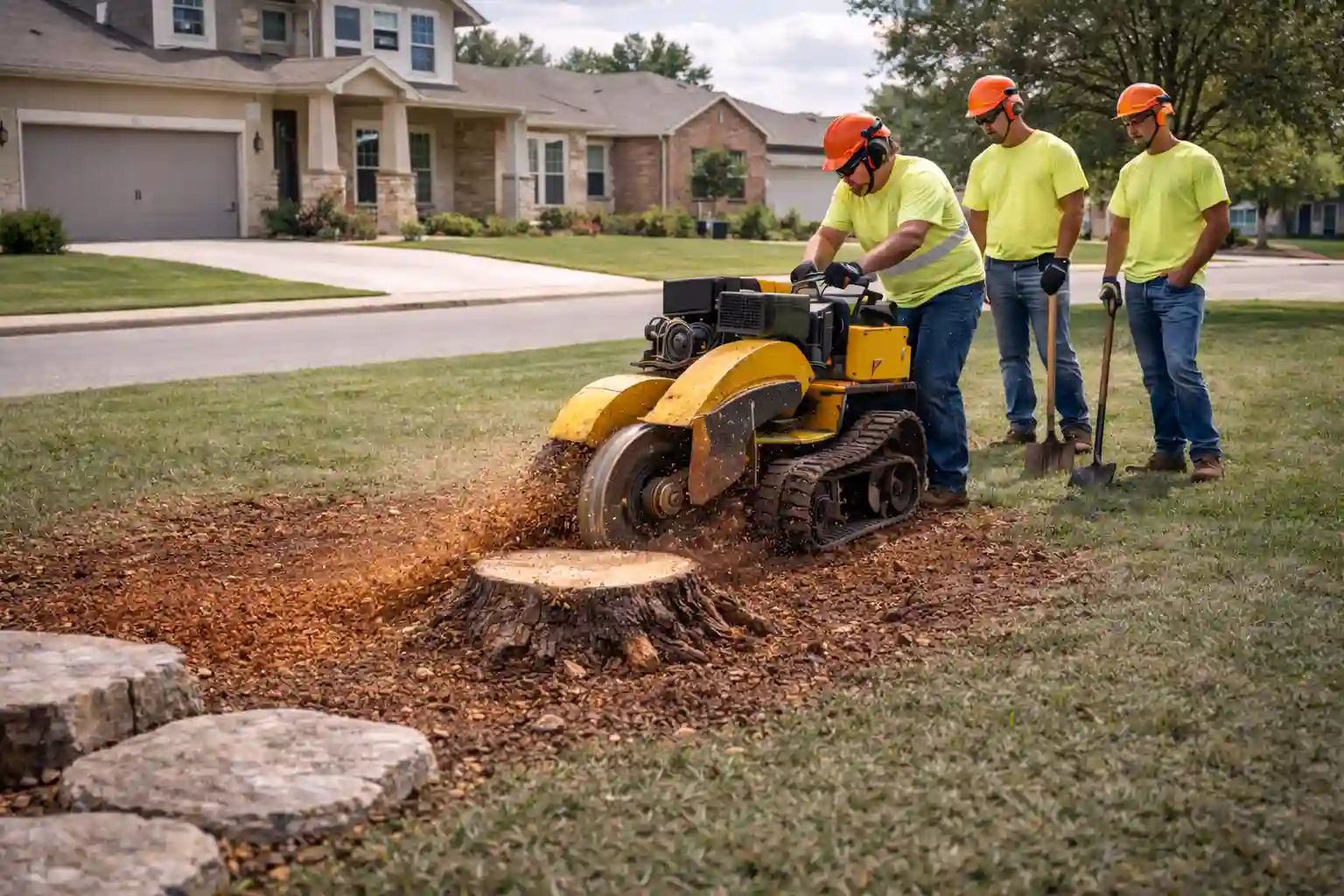
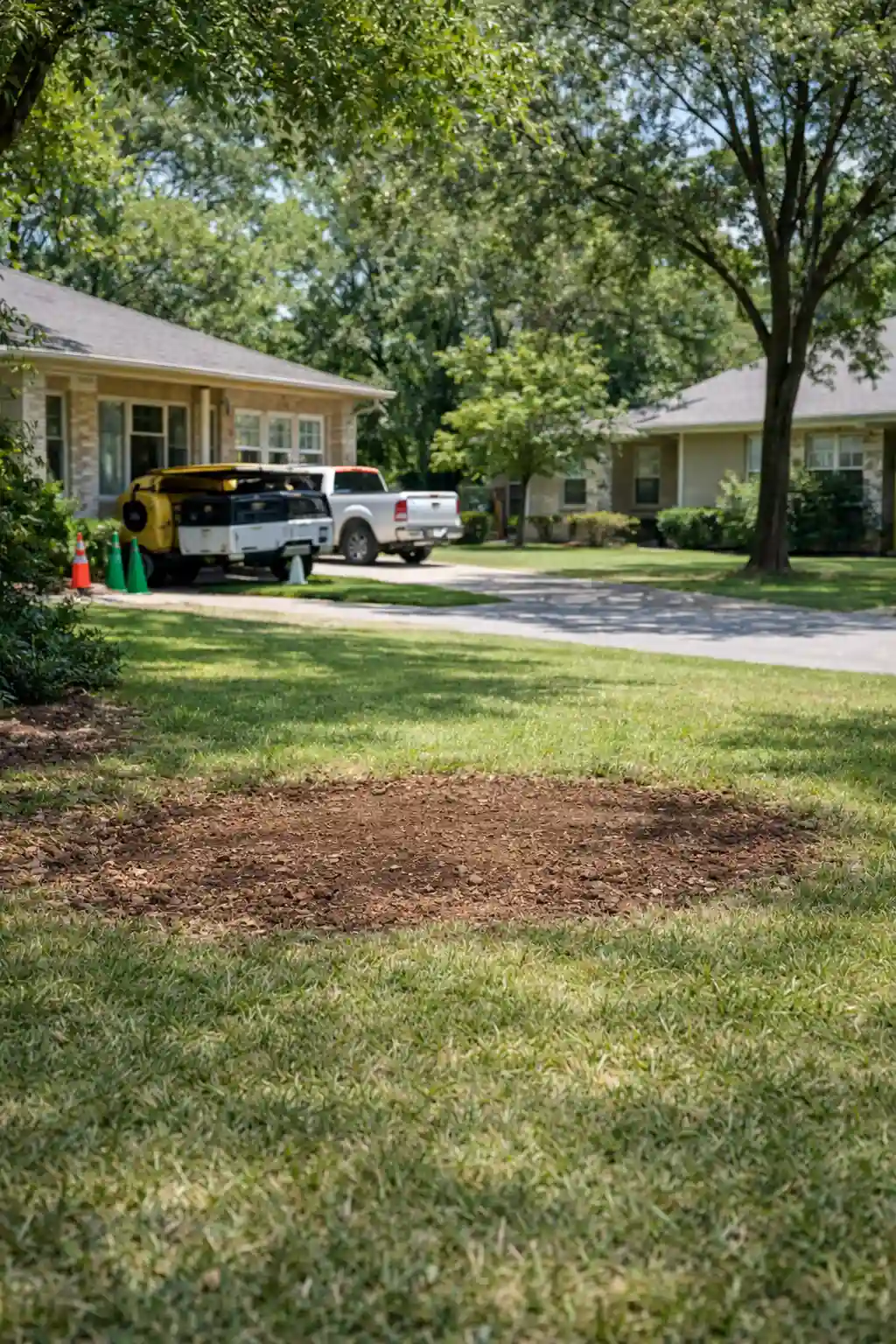
Stump Removal Crews In Action
Frequently Asked Questions About Stump Removal
The ground can sink 2 to 4 inches over the first 6 to 12 months if the cavity isn't properly backfilled and compacted. Layered backfilling in 6-inch lifts with light watering between layers prevents most settling. For sodded or planted areas, topdress with 2 to 3 inches of additional topsoil after 30 days to bring the surface flush with the surrounding grade.
Removal extracts the main root ball and lateral roots within the excavation zone, typically 18 to 36 inches deep depending on species. Very deep taproots from mesquite or pecan and far-reaching surface roots from live oak may extend beyond the excavation area; the crew cuts and removes all visible roots in the work zone. Minor roots left behind decompose naturally without sending up regrowth in most cases.
The stump removal company should call Texas 811 to mark underground utilities at least 48 hours before excavation. Confirm in writing that the company handles the 811 call as part of the service. Hiring an operator who skips this step makes utility damage during excavation your liability — and it can cost thousands of dollars in repairs and fines.
Properly performed removal does not damage adjacent driveways, sidewalks, or fences when equipment is matched to the access space and the operator works carefully near hardscape edges. Risk arises from oversized excavators forced through narrow gates or inexperienced operators working too close to concrete edges. Confirm the company's insurance covers concrete and fence repairs before scheduling.
Stump removal generates 80 to 95 decibels at full operation, similar to a chainsaw or skid-steer engine. Active extraction typically lasts 2 to 4 hours per stump. Austin's noise ordinance allows construction-level work from 7:00 AM weekdays and 8:00 AM weekends until 10:00 PM. Notifying neighbors a day in advance prevents most complaints.
Rocks, old fence wire, rebar, buried cables, and irrigation lines are common obstacles during removal. Notify the company beforehand if the area has been a fence line, garden edge, or construction site. Operators inspect visually and probe softer ground before excavation, but homeowners with knowledge of buried items must disclose them — undisclosed metal or buried concrete can result in equipment damage charged back to the homeowner.
Removal can be performed in damp soil, but heavy rain and saturated ground delay scheduling because the excavator's weight causes deep ruts in soft yards. Most companies postpone jobs after significant rainfall in Central Texas, especially when equipment must cross lawns. Saturated soil also makes backfill compaction less effective, increasing the risk of settling.
Removal is safe for nearby trees when the crew identifies and protects the root zones of healthy specimens during excavation. The standard precaution is keeping extraction at least 5 feet from the trunk of any tree the homeowner wants to preserve. An arborist consultation is recommended for stumps within 10 feet of a heritage or specimen tree.
Most Austin-area HOAs don't require approval for stump removal, since it's considered cleanup of an already-removed tree. Some HOAs — Steiner Ranch, Circle C, and Avery Ranch among them — require notification when removal involves heavy equipment visible from the street or when a replacement tree is being planted. Check HOA bylaws before scheduling.
Standalone visits typically have a 5 to 10 day lead time during normal demand, extending to 2 to 4 weeks during fall and winter peak season. Stumps removed as part of the same-visit tree removal job add no extra wait time. Multi-stump jobs and commercial sites often receive priority scheduling.
Backyard stumps need equipment narrow enough to fit through the gate. Standard residential gates are 36 to 48 inches wide, which fits mini-excavators and stump pullers. Gates narrower than 36 inches require manual extraction or a compact tracked unit, which is slower and may add to the price. Measure your gate width and provide it when requesting a quote.
Removal physically extracts the stump and roots in one visit with immediate, visible results. Stump killer chemicals accelerate decay over 12 to 36 months and require monthly reapplication — they don't eliminate the visible stump and aren't recommended near living trees, water features, or food gardens. Removal is faster, cleaner, and safer for surrounding plant life.
Homeowners don't need to be present as long as access is arranged in advance, the stump location is clearly marked, and payment terms are agreed in writing. Many Austin-area jobs are completed while the homeowner is at work. Confirm whether the company needs gate access codes, key drop-off, or pet containment ahead of the visit.
Active termite activity, fungal growth at the base, new shoot regrowth, soft rotting wood, and proximity to a home's foundation are signs the stump is no longer dormant and is actively damaging the surrounding property.
Stump Removal Service Areas
Austin Tree Services Tx provides stump removal across Austin, Texas, and 17 surrounding cities in the Central Texas metro area. Each location receives dedicated local service, regional pricing, and Texas 811 utility coordination as part of every job.
Related Tree Services
Stump removal is one service in a broader category of arboricultural care. Most removal jobs are scheduled immediately after a tree removal as part of complete site clearance, or as a follow-up to grinding when regrowth or replanting is involved.
Get A Free On-Site Assessment
Every job includes a free on-site assessment, written diameter-based estimate, Texas 811 utility coordination, professional excavation equipment, full liability insurance, and complete backfill and haul-away. Standalone visits are scheduled within 5 to 10 days; stump removal is added at no extra wait when scheduled with a tree removal.
Call (512) 729-9018