
Tree Service in Lago Vista, TX
ISA-certified removal, trimming, stump grinding, and 24/7 emergency response for the limestone bluffs, lakefront lots, and oak-wilt-pressured neighborhoods of Lago Vista.
Call (512) 729-9018Austin Tree Services Tx provides ISA-certified tree removal, trimming, stump grinding, and 24/7 emergency response throughout Lago Vista — with working knowledge of the city's tree preservation ordinance, the Lake Travis watershed permit rules, and the bluff-access constraints unique to this shoreline. Call (512) 729-9018.
What Makes Tree Care in Lago Vista Different
Lago Vista sits on the Austin Chalk and Edwards Limestone formations that define the Hill Country escarpment west of Lake Travis. Topsoil in most yards runs two to four inches deep before hitting fractured bedrock, so live oak and Ashe juniper roots spread laterally instead of down — straight into driveways, fence lines, and water lines with no surface warning.
Oak wilt pressure is elevated by the density of mature live oak canopy in Lago Vista's older sections. The Nitidulid beetle, primary vector for the Ceratocystis fagacearum fungus, is active whenever a fresh pruning wound is exposed in warm months — which is why live oaks here must not be trimmed between February 1 and June 30. Rimrock and the streets around Lago Vista Country Club have documented infection centers that keep expanding whenever a neighboring tree is cut during beetle season.
The dominant species — live oak, Ashe juniper, cedar elm, and Texas persimmon — each carry distinct risks: juniper's tap roots make stump removal on limestone difficult, cedar elm is vulnerable to elm leaf beetle and mistletoe, and persimmon thickets on bluff-edge lots frequently obscure survey lines. Summer heat compounds all of it — afternoon temperatures on exposed south-facing slopes regularly clear 105°F, and drought-stressed trees compartmentalize decay far slower than healthy ones.
Common Tree Problems in Lago Vista
Removal Requires a City Permit, Not Just a Decision to Cut
Lago Vista's tree preservation ordinance — Chapter 14, Section 20 of the Zoning Ordinance — requires a permit before most protected trees can come down, listing species, size, and location. Soil-disturbing removal (heavy equipment, stump grinding, cleared ground cover) also needs a nonpoint source pollution permit under the Highland Lakes Watershed Ordinance. Replacement trees are required afterward unless a certified arborist documents the tree as diseased or severely damaged.
Ashe Juniper Fuel Load and Wildfire Risk
Juniper spreads aggressively on unmaintained north-facing lots and produces the pollen loads that peak January through March — the source of Cedar Fever for most of Lago Vista. Beyond the pollen, dense stands are a documented fire fuel load that the city's wildfire mitigation program specifically targets. Cut stumps resprout from the root collar unless ground below grade.
Oak Wilt in Root-Grafted Live Oak Groves
Live oaks in established neighborhoods are frequently root-grafted below grade — one infected tree can move the fungus to its neighbors with no wound required. Rimrock and Lohman Ford Road show block-by-block spread. Once foliar symptoms appear (April–June), fungicidal injection is rarely effective; trenching to sever root grafts is the only way to protect the rest of the grove.
Storm Limb Failure in Cedar Elms Along Drainage Corridors
Cedar elms along the swales feeding Lake Travis develop wide crowns with co-dominant stems prone to bark inclusion — a defect that fails at wind speeds a sound union would survive. Corrective structural pruning removes those stems before they reach failure diameter.
Root Damage From Bluff-Edge Construction
New builds along the western bluffs are capped at 40 percent impervious cover under the watershed ordinance, but grading and equipment traffic still compact the limestone layer and sever shallow roots inside the critical root zone. A live oak that loses 30 percent of its root system typically shows canopy decline within two seasons — well after the contractor is gone.
Drought Stress Compounding Hardscape Damage
South- and west-facing slopes take full afternoon sun with no wind buffer. The 2022–2023 drought years caused widespread tip dieback and full crown loss in cedar elms. The same shallow, drought-stressed roots are the ones that heave retaining walls and driveways — on bluff lots in Highland Lakes Estates, a failing wall is a structural issue, not a landscaping one.
Neighborhoods We Know
Tree Services We Provide in Lago Vista
Austin Tree Services Tx provides the following throughout Lago Vista and the surrounding Lake Travis area:
Tree Removal in Lago Vista
Removal is the correct call when a hazard can't be corrected through pruning, cabling, or treatment — or when a tree is dead, dying from oak wilt, or too drought-stressed to recover. A live oak with 20–30% canopy thinning after a drought year can often recover with deep watering; the same tree with fungal conks at the base or a split primary union is a removal candidate regardless of how it looks from the street.
-
Site Assessment
ISA-certified evaluation of trunk integrity, root zone condition, lean direction, and proximity to structures and utilities — before any cutting is scheduled.
-
Permit & Replacement-Tree Review
If the tree is protected under Chapter 14 §20, we file the removal permit and, if soil will be disturbed, the Highland Lakes nonpoint source permit — and confirm whether an arborist letter waives the replacement-tree requirement.
-
Removal Method
Sectional felling from the crown down on bluff and steep lots; rigging and hand-lowering where aerial lift access is restricted by narrow Lago Vista streets.
-
Cleanup & Stump Grinding
Debris chipped or hauled per the homeowner's preference. Stump grinding happens the same visit or a scheduled follow-up depending on access.
Full scope and pricing structure is on the Austin Tree Removal Services page.
Pruning Lago Vista's Tree Species the Right Way
Trimming manages size, shape, and clearance on the outer canopy. Pruning removes specific branches for health, structure, or risk reduction, and requires knowing how each species compartmentalizes a wound. Live oaks must not be trimmed between February 1 and June 30 — fresh wounds attract the beetles that carry oak wilt. Cedar elm prunes best in dormant season, November through January; Ashe juniper has no seasonal cutting restriction but shouldn't be disturbed during deer breeding season on lots backing the Highland Lakes wildlife corridor.
Young trees in Lago Vista's newer subdivisions benefit from structural pruning starting in year two or three — establishing a central leader and eliminating co-dominant stems before they develop included bark. A live oak that goes a decade without structural pruning typically develops defects that lead to removal at 30–40 years, and the cost lands on whoever owns the tree by then. Clearance trimming near RR-1431, Lohman Ford, and Boggy Ford Road follows TxDOT's 14-foot vertical clearance standard over travel lanes.
Stump Grinding & Removal in Lago Vista
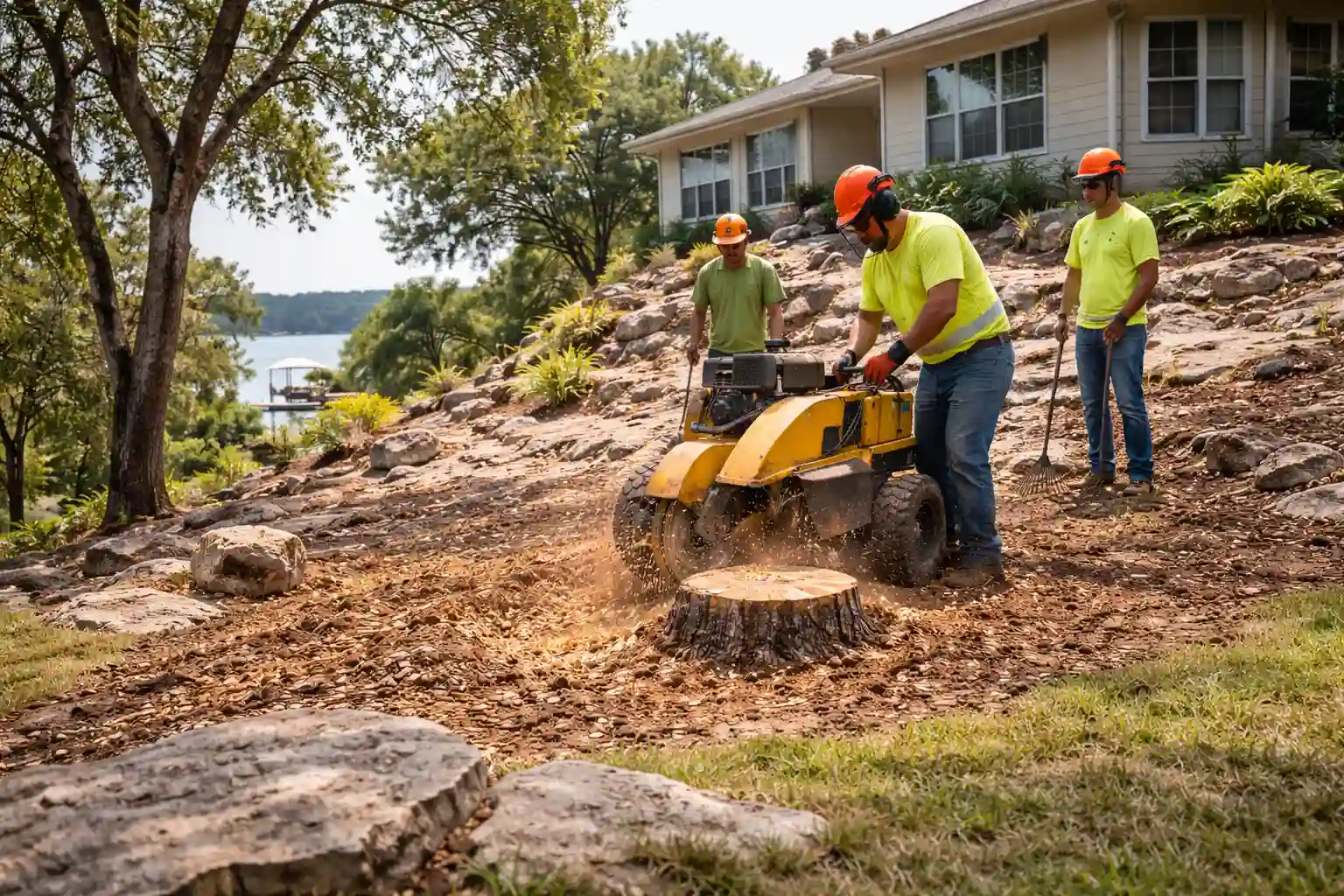
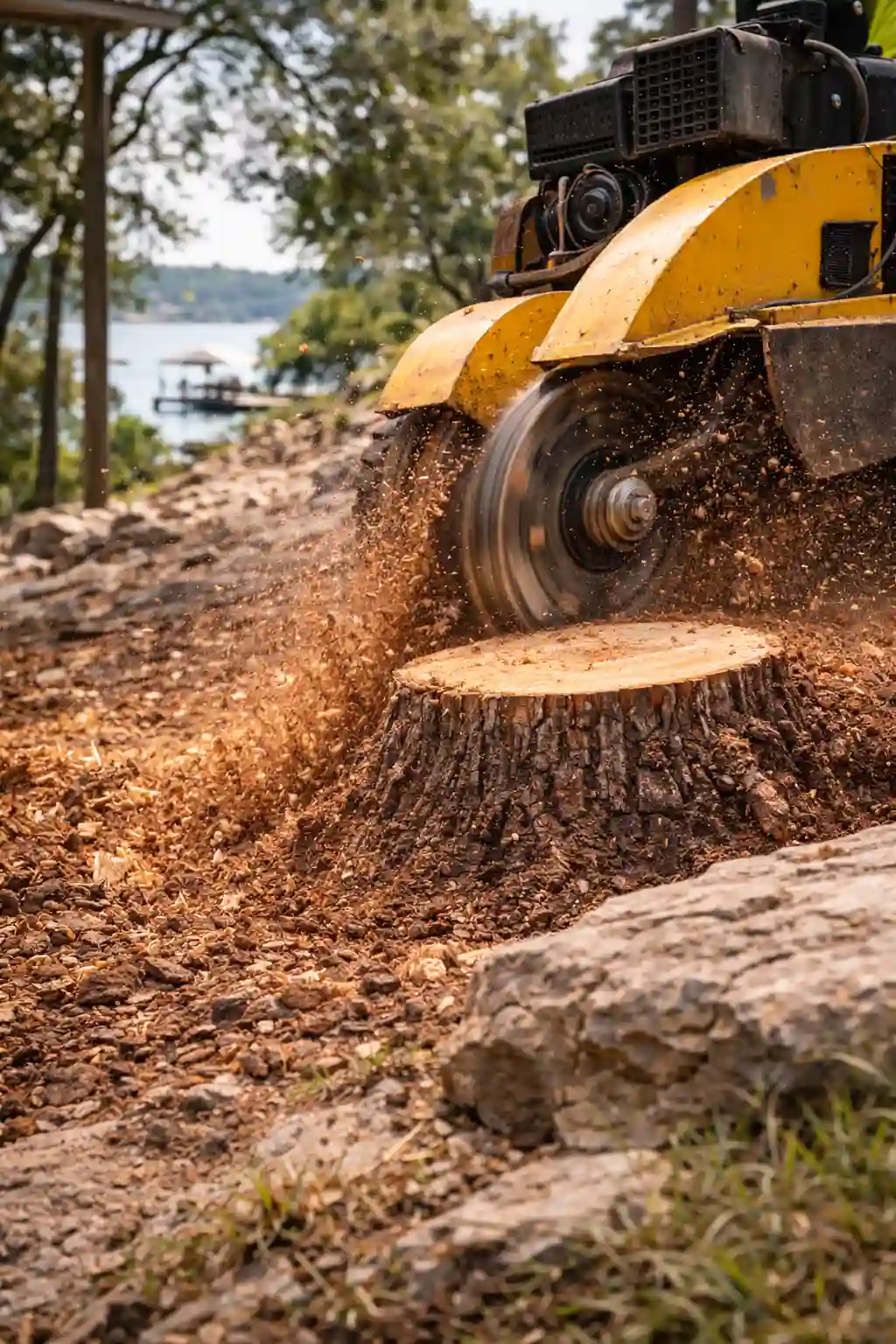
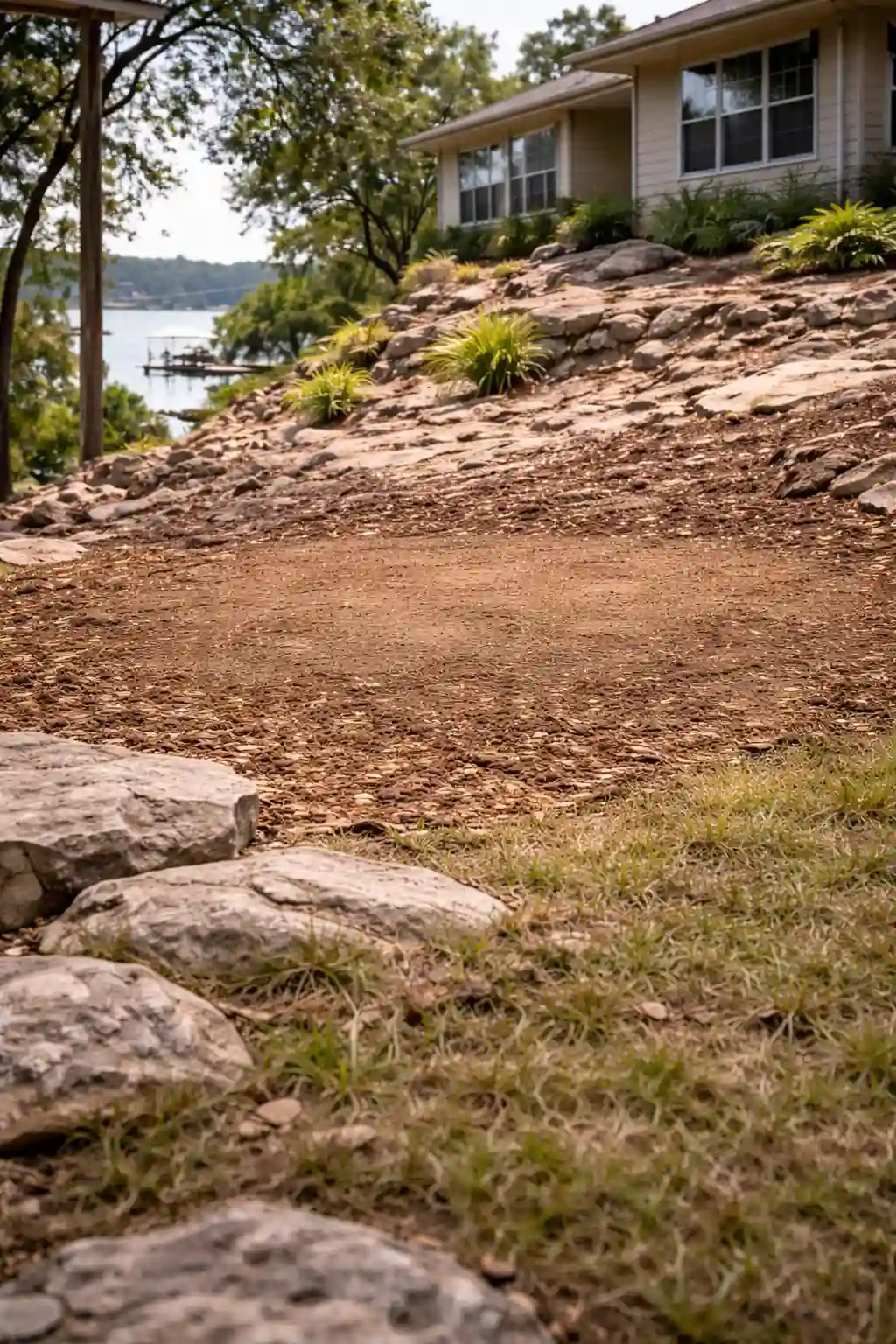
A stump in Lago Vista's thin limestone soil doesn't decompose on a normal timeline — oak and juniper stumps can sit 10 to 15 years before real decay starts, hosting Armillaria root rot the whole time. Juniper stumps resprout from the root collar within weeks unless ground below grade. For most residential sites, grinding to 8–12 inches below grade is sufficient; full extraction is only needed when the site will be replanted or the roots are undermining a foundation or wall.
| Factor | Why It Matters |
|---|---|
| Limestone at grinding radius | Carbide teeth wear faster on rock; cutting pace slows to avoid damage |
| Protected-tree status | Removal permit and possible replacement-tree cost under Ch. 14 §20 |
| Soil disturbance | Highland Lakes nonpoint source permit required for grinding/extraction |
| Bluff-edge access | Restricted equipment positioning increases labor time |
| Stump grinding, per stump | $175–$500 |
Emergency Tree Service in Lago Vista
Lake Travis's orientation channels storm energy from the southwest and northwest straight into the Lago Vista bluff line. Hill Country microbursts — localized downdrafts of 60–80 mph over a one-to-three-block footprint — are the most common cause of acute tree failure here, and they're rarely tracked as named storms even when the damage is real.
An emergency situation includes any of the following:
- Trunk or major limb in contact with a roof, wall, or foundation
- Tree blocking a driveway or street with no alternate egress
- Hanging limb suspended above an occupied structure or outdoor area
- Root ball uplift that has broken a gas or water line
- Partially failed tree leaning on a structure or line, hinge still intact
Austin Tree Services Tx runs hazard assessment before any cutting — mapping the fall zone downslope or toward the water on steep lakeside lots before crews commit. Full response protocols are on the Emergency Tree Removal page.
Why Lago Vista Homeowners Choose Austin Tree Services Tx
Lago Vista adds a layer Lakeway and Austin's interior suburbs don't have: a municipal tree preservation ordinance with its own permit process, a Highland Lakes watershed permit for soil-disturbing removals, and a city wildfire mitigation program that specifically targets Ashe juniper accumulation. A crew without local permitting experience can cut correctly and still leave a homeowner facing a stop-work order or a fine. We handle the permit application, the replacement-tree paperwork, and the watershed permit alongside the tree work itself.
Every assessment is performed or supervised by an ISA-certified arborist, not a sales estimator — and that certification is also what can waive the city's replacement-tree requirement when a tree is documented as diseased or severely damaged. Quotes reflect access conditions, permit fees, and debris disposal up front. The quote matches the invoice; the site is left clean.
Get a Free Tree Service Estimate in Lago Vista
Serving Rimrock, Highland Lakes Estates, Lago Vista Country Club Estates, Waterford on Lake Travis, and the Lohman Ford and Boggy Ford Road corridors.
Call (512) 729-9018Frequently Asked Questions
Yes, for most protected trees, under the city's tree preservation ordinance (Chapter 14, Section 20 of the Zoning Ordinance). The application requires the tree's species, size, and location. If removal disturbs soil — stump grinding, heavy equipment, or clearing ground cover — a separate nonpoint source pollution permit is required under the Highland Lakes Watershed Ordinance. Replacement trees are required afterward unless a certified arborist documents the tree as diseased or severely damaged. Austin Tree Services Tx submits both permits as part of the removal scope. Call (512) 729-9018 to confirm your tree's status before work begins.
Properties within the LCRA's Highland Lakes shoreline buffer zone — generally within 100 feet of the lake's conservation pool elevation — require LCRA review before removing trees or vegetation. This applies regardless of Lago Vista's own permit requirement. Austin Tree Services Tx can identify whether your property falls within the buffer zone during the initial assessment.
HOA tree approval requirements in Lago Vista lakeside subdivisions are common and enforceable under deed restrictions. The architectural control process typically requires a description of the work, the species, and sometimes an arborist letter before approval. Austin Tree Services Tx can provide the documentation most HOA committees require — call (512) 729-9018 to discuss what your HOA needs.
No — live oaks must not be trimmed between February 1 and June 30 due to oak wilt risk, regardless of the reason. Clearance cuts during beetle season carry the same infection risk as any other cut. If overhanging branches are urgent, schedule for July or later, when beetle activity drops.
Ashe juniper seedlings establish aggressively in disturbed soil around decaying stumps, especially where the canopy gap lets full sun reach the ground. The stump isn't producing the juniper — seed dispersal from nearby junipers is colonizing the open patch. Grinding the stump removes the focal point and lets you replant with a species that will eventually shade out new seedlings.
Lean alone doesn't determine removal — root integrity, trunk condition, and the lean's direction relative to the fall zone are what matter. A live oak leaning toward an unoccupied slope with an intact root plate may be stable for decades; the same lean over a structure is a different risk profile entirely. An ISA-certified assessment is the only way to know which situation you have.
Yes. Trees whose roots have historically accessed subsurface moisture from the lake's proximity are stressed when water levels drop significantly over multiple years. The pattern is progressive tip dieback, early leaf drop, and bark cracking on south-facing trunks. Deep root watering helps during extended low-water periods, but already-stressed trees are more vulnerable to bark beetle colonization.
In Texas, each property owner can trim branches and roots that cross their line, back to the boundary, at their own expense — but neither owner can force the other to remove a tree whose trunk sits on their property. If the trunk straddles the line, it's legally a shared tree and removal requires both owners' consent. A survey confirming the trunk's exact position resolves most disputes.
No — that's Ashe juniper releasing pollen, not disease. Pollen release peaks January through March in Lago Vista and is the cause of Cedar Fever symptoms in area residents during that window. It settles as visible orange-gold dust on cars, decks, and standing water, and isn't a sign the tree is unhealthy. Dense stands do carry a real risk — raised wildfire fuel load, which is why the city's mitigation program targets accumulated juniper growth — but the pollen itself is harmless to the tree.
A partially split cedar elm with an intact hinge is an active structural hazard and shouldn't be left to assess later. The remaining wood fiber is under tension and can fail without warning as the detached section dries. This falls under our emergency response criteria — a partially split major stem almost always falls in the immediate-removal category.
Stump grinding in Lago Vista typically ranges from $175 to $500 per stump. Limestone bedrock within the grinding radius does increase cost — carbide teeth wear faster on rock, and operators slow the cutting pace to avoid equipment damage. Stumps on flat interior lots cost less than stumps on bluff-edge properties where equipment positioning is restricted. Call (512) 729-9018 for a site-specific estimate.