
Tree Service in Georgetown, TX
Removal, trimming, stump grinding, cabling, arborist assessment, and emergency response across a city split between limestone caliche and Blackland Prairie clay — where oak wilt, root damage, and storm exposure all behave differently depending on which side of town you're on.
Austin Tree Services Tx provides tree removal, trimming, stump grinding, arborist assessments, cabling, and 24/7 emergency response across Georgetown and Williamson County. Georgetown requires a permit only for Heritage Trees — 24 inches or greater in diameter at breast height — under its Urban Forest Master Plan. Live oaks must not be trimmed between February 1 and June 30 due to oak wilt risk.
What tree services are available in Georgetown, TX?
Austin Tree Services Tx operates across Georgetown and Williamson County with ISA-certified arborists and full liability insurance. Work near HOA-governed neighborhoods such as Sun City and Wolf Ranch follows each community's tree preservation rules in addition to the city's Heritage Tree ordinance.
How much does tree service cost in Georgetown, TX?
Removal ranges from $300 for a small tree to $4,500+ for a mature live oak or pecan, trimming runs $150 to $1,600 per tree, and stump grinding costs $2 to $7 per diameter inch. These are 2026 Central Texas market ranges — Georgetown's caliche substrate and HOA overlays add cost factors most Austin suburbs don't, covered below the table.
| Service | Typical Range | What Drives the Price |
|---|---|---|
| Small tree removal (under 30 ft) | $300–$700 | Diameter, lean, access to the site |
| Medium tree removal (30–60 ft) | $700–$1,600 | Rigging needs, canopy volume, caliche access on western lots |
| Large live oak / pecan removal, 60 ft+ | $1,800–$4,500+ | Trunk diameter, aerial lift need, Heritage Tree permit filing at 24"+ |
| Tree trimming, per tree | $150–$1,600 | Height, deadwood volume, scheduling around the oak wilt window |
| Stump grinding, per stump | $125–$750 | Diameter at $2–$7 per inch — caliche beds dull cutting teeth faster in western Georgetown |
| Full stump/root extraction | $400–$1,500+ | Roots locked in caliche fissures need more equipment time than clay or loam |
| Cabling & bracing, per tree | $250–$1,400 | Number of cables, climbing difficulty |
Georgetown-specific cost drivers: caliche substrate in Berry Creek and Georgetown Village slows stump grinding and root extraction; construction activity along IH-35 and SH-29 can require a root-zone damage assessment before a removal quote is final; and properties inside Sun City or Wolf Ranch may need HOA sign-off before work begins, which adds scheduling time rather than direct cost.
Do I need a permit to remove a tree in Georgetown, TX?
Yes, for Heritage Trees — 24 inches or greater in diameter at breast height — under Georgetown's Urban Forest Master Plan. Trees below that diameter on private residential property generally do not require a city permit, but HOA-governed neighborhoods can impose their own approval step first.
| Rule | Requirement |
|---|---|
| Heritage Tree permit threshold | ≥24" diameter at breast height |
| Governing plan | Georgetown Urban Forest Master Plan |
| HOA overlay | Sun City, Wolf Ranch, and similar HOA communities may require additional approval |
| Oak trimming window | Avoid Feb 1–Jun 30 — Nitidulid beetle activity carries oak wilt fungus into fresh wounds |
| Where to confirm | Georgetown Development Services Department |
What are the signs a Georgetown tree needs attention?
Georgetown's split geology means the same symptom can point to two different causes depending on which side of town the tree is on. These signs call for an arborist inspection before the next oak wilt window or storm season.
- Interveinal chlorosis on newly expanded live oak leaves in April or May — the earliest visible sign of oak wilt.
- Root heave lifting a driveway or sidewalk slab in western Georgetown — live oak lateral roots running along the surface of the caliche layer.
- Crown thinning, early leaf drop, and extended twig dieback on pecans and cedar elms — the clearest drought stress signature going into storm season.
- Increased trunk lean or root plate exposure in eastern Georgetown — Blackland Prairie clay shrinking and swelling with moisture cycles.
- Canopy dieback appearing one to three years after nearby construction — root zone damage from grade changes or trench cuts along the IH-35 and SH-29 corridors.
- A basal cavity consuming more than one-third of the trunk circumference — a structural removal threshold, not a trimming fix.
- Hanging or split limbs still suspended in the canopy after an ice storm — can release without warning hours or days later.
What happens during emergency tree removal in Georgetown?
Austin Tree Services Tx provides 24/7 emergency response in Georgetown. Winter ice storms track across the Hill Country and hit Georgetown harder than areas further south — the February 2021 storm left cedar elms and live oaks across Sun City, Teravista, and the Heritage District with catastrophic limb failures that took weeks to clear.
-
Report the hazard
Call and describe the tree — leaning trunk, split limb, blocked driveway, or a limb on a roofline. Crews triage by phone or photo the same day.
-
Immediate hazard removal
The crew clears the structure, vehicle, or access point first — a tree on a roofline or a hanging limb over an occupied space is treated as an emergency regardless of tree size.
-
Secondary canopy assessment
After a Williamson County ice storm, trees that look stable at ground level may have compromised scaffold limbs still attached. Aerial inspection of the surrounding canopy follows the initial hazard removal.
-
Debris clearing
Wood, brush, and cut material are cleared from the property before the crew leaves the site.
Why does Georgetown's terrain affect tree health?
Georgetown sits on the transition zone between the Edwards Plateau limestone shelf and the Blackland Prairie clay, 30 miles north of Austin. That split geology is why an arborist has to know which side of the city a tree is on before diagnosing a root or canopy problem.
Georgetown has been named one of the fastest-growing cities in the U.S. for its population size by the Census Bureau in recent years — growth that brings construction activity along the IH-35 and SH-29 corridors directly into contact with mature tree root zones on adjacent lots.
Which tree species are common in Georgetown, and how do their roots behave?
| Species | Mature Height | Growth Rate | Root Behavior |
|---|---|---|---|
| Live Oak | 40–50 ft | Slow | Shallow, wide-spreading on caliche; grafts with neighboring live oak roots — the main oak wilt transmission path |
| Cedar Elm | 50–70 ft | Moderate–Fast | Deeper taproot along river corridors; dense canopy collects ice load; conflicts with utility clearance |
| Ashe Juniper | 20–40 ft | Fast, aggressive | Shallow, colonizes rocky upland soil; no oak wilt risk; requires mechanical clearing to prevent root-crown regrowth |
| Pecan | 70–100 ft | Moderate | Deep taproot when young, wide laterals at maturity; earliest and clearest drought-stress signals |
Who provides tree service in Georgetown, TX?
Austin Tree Services Tx employs ISA-certified arborists and carries full general liability insurance and workers compensation coverage on every job in Georgetown. Every estimate matches the invoice at job completion, and the site is cleaned of debris and cut material before the crew leaves.
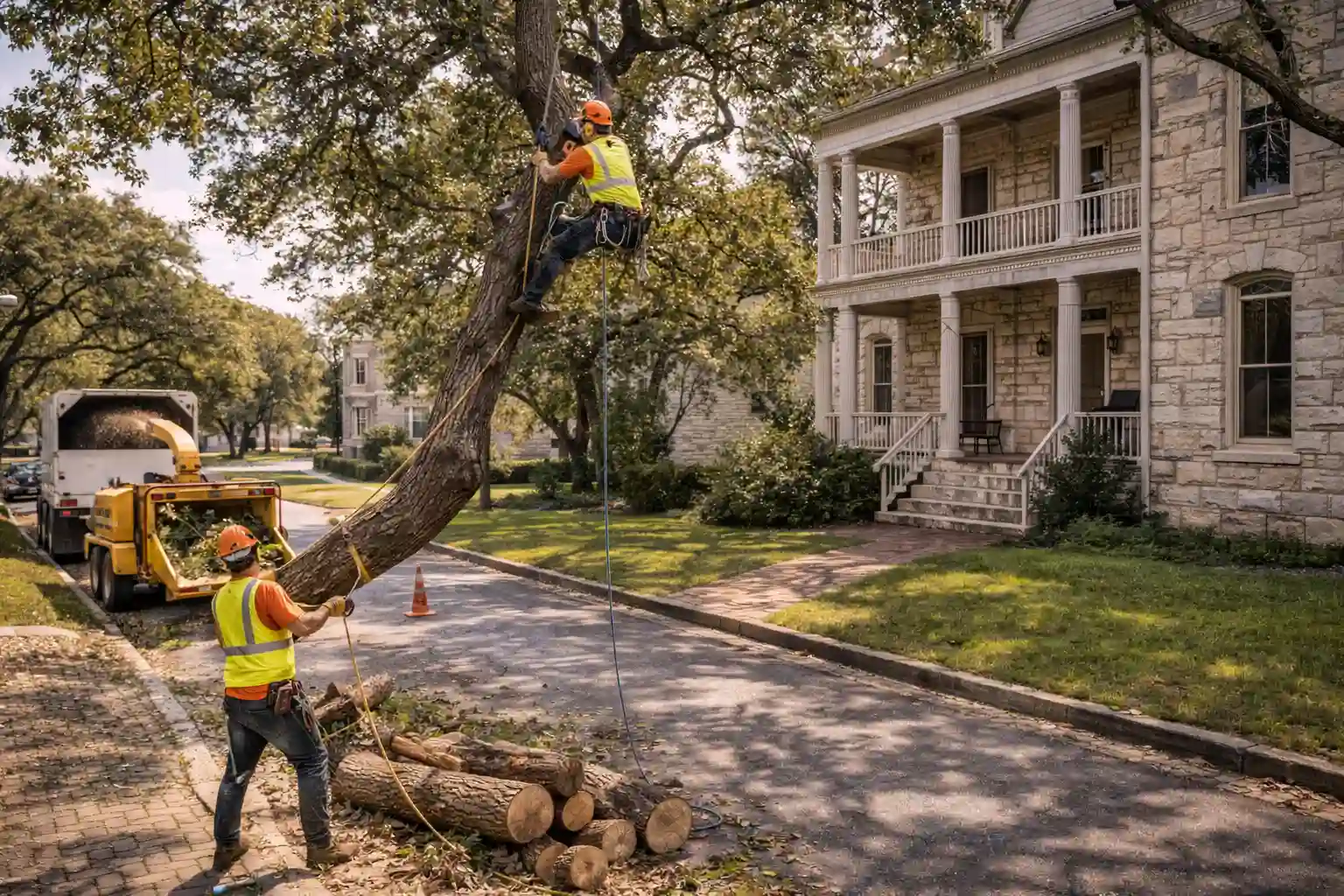
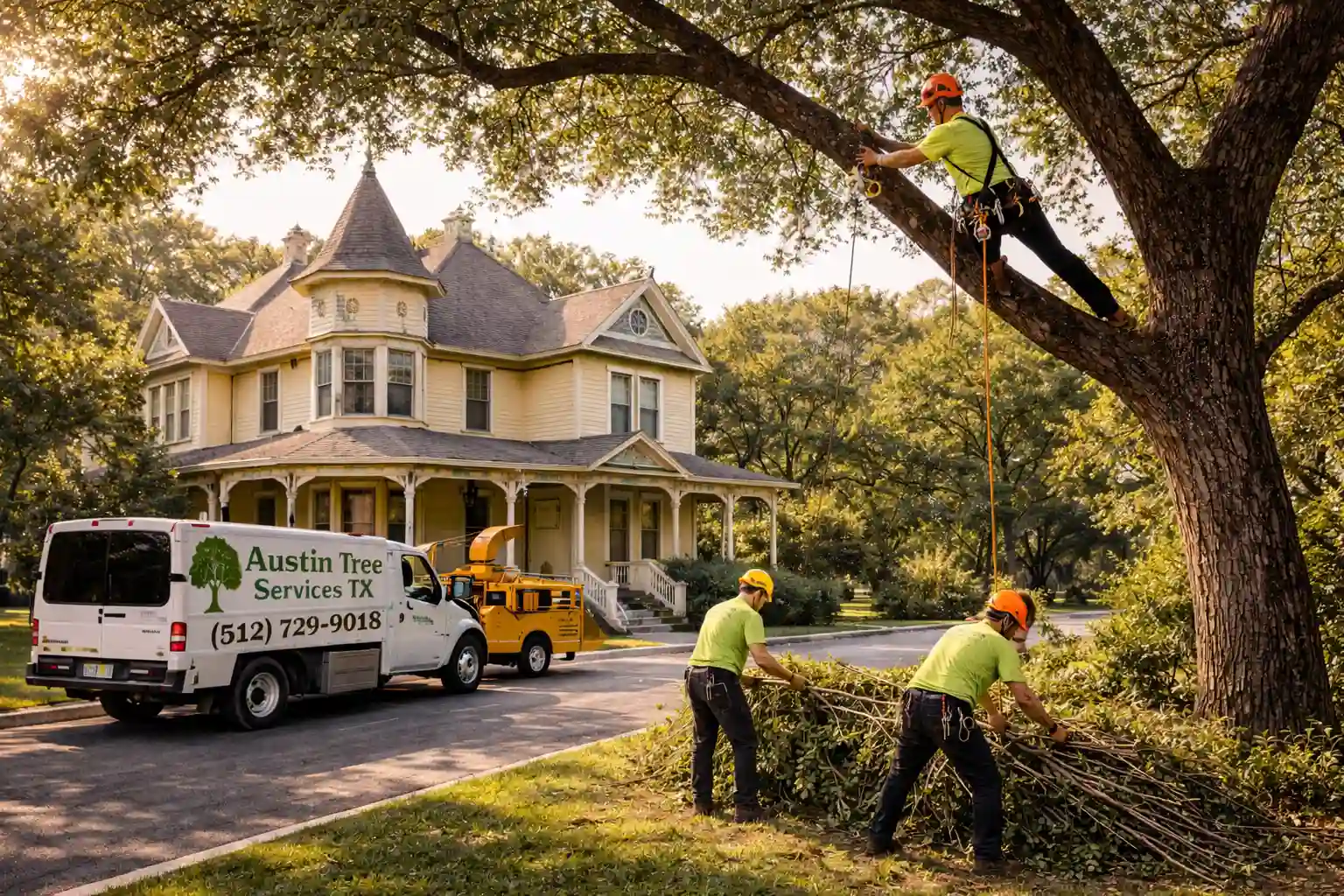
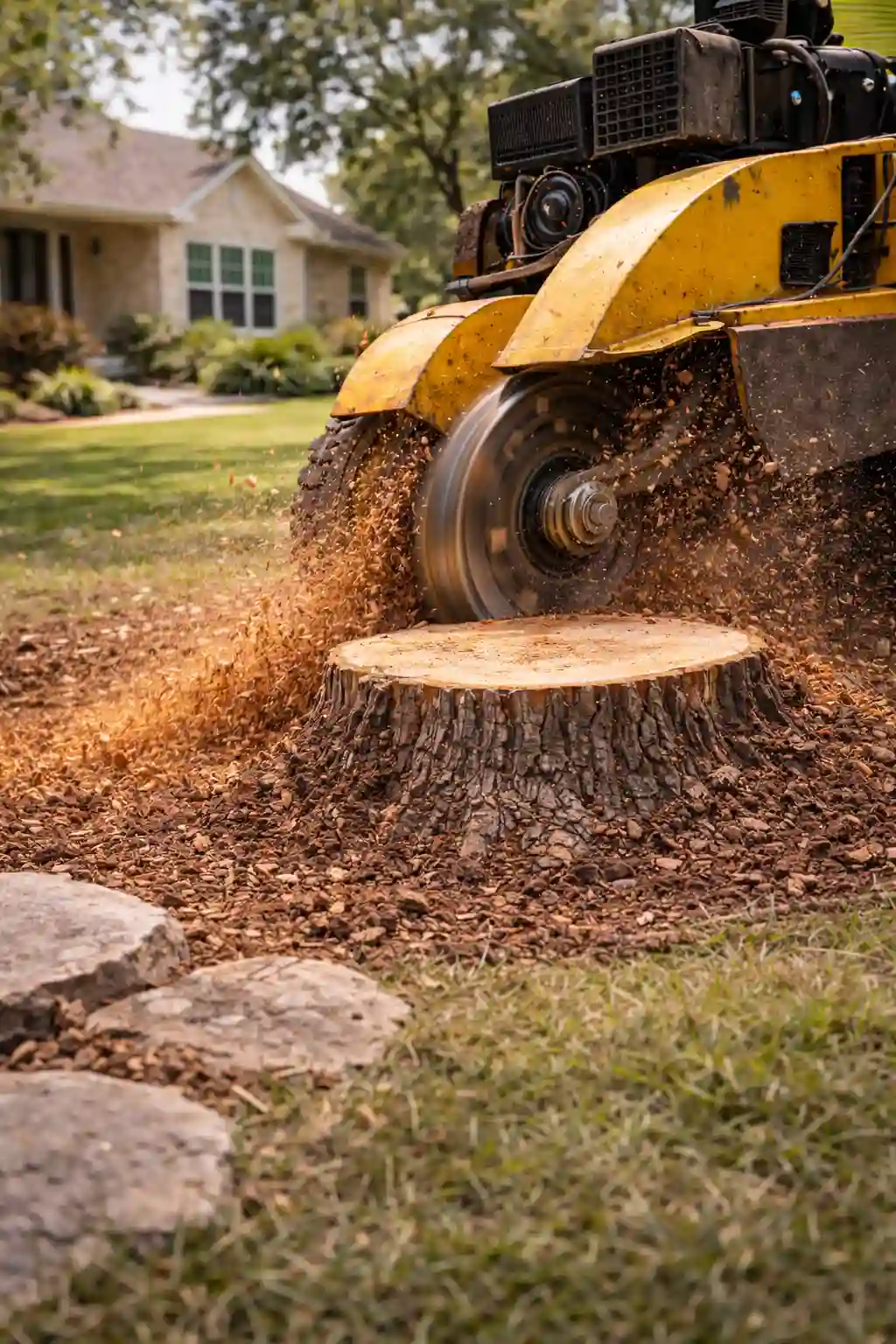
Tree work completed in Georgetown, TX
Georgetown tree service questions
Georgetown requires a tree removal permit for Heritage Trees — trees 24 inches or greater in diameter at breast height — under its Urban Forest Master Plan. Trees below that diameter on private residential property generally do not require a permit, but properties within HOA jurisdictions such as Sun City or Wolf Ranch may have additional tree preservation rules that require HOA approval before removal. Confirm with the Georgetown Development Services Department before removing any large-diameter tree.
For live oaks, the correct trimming window is July 1 through January 31 — live oaks must not be trimmed between February 1 and June 30 due to oak wilt risk. Cedar elms trim best in late winter before leaf-out. Pecan and Texas red oak are less seasonally restricted but benefit from dormant-season pruning when structural defects are easiest to identify.
The earliest sign in live oaks is interveinal chlorosis — the leaf veins stay green while the tissue between them turns yellow or brown — appearing on newly expanded spring leaves, followed by rapid defoliation starting from the outer canopy. Texas red oaks show a different pattern: leaves turn brown beginning at the tips and margins, and the tree can die within weeks. If you see these signs between March and June, call (512) 729-9018 for an arborist assessment before the disease spreads through the root system.
It depends on the percentage of the crown lost and whether the trunk and root plate are structurally intact. A tree that has lost one major limb but retains a healthy crown and stable root system is often worth saving with corrective pruning. A tree with a split trunk, significant root plate heave, or more than 50 percent crown loss rarely recovers structural integrity. An on-site assessment is the only reliable way to make that call.
No. Live oaks are the most severely affected — they decline slowly over one to several years and transmit the disease through root grafts to neighboring trees. Texas red oaks are killed rapidly, often within weeks, but transmit less readily through root grafts. Post oaks and Shumard oaks are susceptible but less commonly affected in Georgetown. Bur oaks and Chinquapin oaks show resistance and rarely develop fatal infections.
The City of Georgetown and utility providers trim trees within the public right-of-way for infrastructure clearance — they aren't responsible for the overall appearance or balance of your tree. The private canopy side is the homeowner's responsibility. A lopsided canopy from one-sided utility trimming can be partially corrected through structural pruning on the remaining crown.
In Texas, liability generally falls on the property where the damage occurred — your homeowner's insurance typically covers the fence, not your neighbor's. The exception is if the tree was visibly dead, diseased, or structurally compromised before the storm and your neighbor knew and failed to act — negligence may apply then. Document the tree's pre-storm condition with photos if you believe that threshold was met.
Most homeowners insurance policies cover removal of a storm-fallen tree if it damaged an insured structure — a roof, fence, or vehicle. Removal of a tree that fell in the yard without hitting a structure is typically not covered. Review your policy's debris-removal language — coverage limits vary between standard and extended policies common in Georgetown's newer HOA developments.
Not necessarily. Root pruning combined with root barrier installation can redirect lateral roots away from hardscape on younger trees — those under roughly fifteen inches in diameter — when the conflicting root is within a manageable distance of the driveway edge. For mature live oaks in Georgetown's limestone soils where the lateral root system is fully established, barriers are rarely effective, and the practical decision becomes repairing the driveway around the roots or removing the tree. An arborist assessment clarifies which situation applies.
Get a Free Tree Service Estimate in Georgetown, TX
ISA-certified arborists. Full insurance and workers comp coverage. 24/7 response for storm and hazard trees.
Call (512) 729-9018