
Tree Service Kyle, TX
ISA-certified arborists working the Blackland clay / Edwards Plateau seam that runs through Plum Creek, 6 Creeks, Steeplechase, Waterleaf, and Kyle Crossing.
Call (512) 729-9018Austin Tree Services Tx provides ISA-certified tree removal, trimming, stump grinding, stump removal, emergency response, and cabling throughout Kyle, TX — including Plum Creek, 6 Creeks, Steeplechase, Waterleaf, and Kyle Crossing. Call (512) 729-9018.
Kyle sits at the geological seam where Blackland Prairie clay meets the eastern edge of the Edwards Plateau — and that transition creates tree stress conditions that most homeowners in Plum Creek, 6 Creeks, and Steeplechase don't see coming until a tree fails. Live oaks and cedar elms here develop root systems shaped by clay that swells after rain and fractures during drought, making root anchoring unpredictable under mature canopies. Austin Tree Services Tx operates in Kyle with ISA-certified arborists who understand these specific soil and species conditions — not general Texas tree care.
One City, Two Soils
Houston Black Clay
- Blackland Prairie vertisol — expands wet, cracks dry
- Shrink-swell cycles destabilize root plates over time
- Dominant species: live oak, cedar elm
- Stump grinding: easier, but produces a wet, heavy mulch pile
Edwards Plateau Limestone
- Rock encountered at 12–18 inches below grade
- Ashe juniper encroachment along FM 1626 and open lots
- Grinder depth limited; full extraction often impractical
- Root anchoring more stable, less clay shrink-swell risk
Common Tree Problems in Kyle
Plum Creek · Onion Creek CorridorOak Wilt in Connected Live Oak Root Systems
Live oaks in Kyle's older neighborhoods and creek-adjacent properties are at elevated oak wilt risk because the fungus travels through connected root systems — and in mature live oak groves, roots are almost always grafted. A single infected tree in Plum Creek can transmit Bretziella fagacearum to every connected live oak on a street within two to three growing seasons. Infected trees display veinal necrosis — leaves yellow along the veins while the blade stays green — before rapid defoliation and death. There is no cure once a tree is infected; the response is root barrier trenching to stop underground spread and immediate removal of the infected tree.
FM 1626 · Undeveloped LotsAshe Juniper Encroachment
Ashe juniper spreads rapidly into any disturbed or ungrazed area, and the open land adjacent to newer Kyle subdivisions west of IH-35 has provided consistent seed source pressure for decades. On residential lots backing up to natural areas, mature junipers often overhang structures and fences, creating fire fuel ladders and persistent debris accumulation on rooflines. Removal requires sectional cutting from the crown down with stump treatment to prevent basal resprouting.
6 Creeks · Steeplechase · Kyle CrossingRoot Damage from IH-35 Corridor Construction
Kyle's rapid growth along the IH-35 corridor has brought continuous utility trenching, road widening, and subdivision grading. Trenches cut through the critical root zone of established trees within 12 to 18 inches of the surface, severing feeder roots. Trees within 50 feet of construction activity show delayed stress symptoms — often not visible until 18 to 24 months after the root damage occurred. By the time canopy decline appears, the structural damage is often irreversible.
Plum Creek GreenbeltStorm Limb Failure in Cedar Elm and Pecan Canopies
Cedar elms and pecans in Kyle carry wide, heavy canopies vulnerable to straight-line wind and ice storms. Pecans along the Plum Creek greenbelt develop included bark — a structural defect where two co-dominant stems grow together with bark trapped between them — that fails under wind loading before any external sign of decay is visible. Pre-storm structural pruning reduces the failure risk by removing included bark unions and redistributing canopy weight.
Waterleaf · Kyle CrossingDrought Stress in Newer Developments
Trees planted during Kyle's development boom of the 2010s are now reaching sizes where their root zones should be extensive — but construction compaction and shallow clay soils have restricted root development in many cases. Extended drought forces accelerated water stress, expressing as progressive canopy thinning from the outer branches inward. Persistent thinning across multiple summers is a reliable indicator of root system failure, not normal seasonal behavior.
Plum CreekLive Oak Roots vs. Driveways and Foundations
Live oaks in Kyle's clay soils develop wide lateral root systems — sometimes extending two to three times the canopy radius — because deep vertical growth is blocked by dense clay beneath the topsoil. In Plum Creek, where live oaks were planted close to driveways and front walks during subdivision buildout, root-driven hardscape displacement is now a common problem. Root pruning and barrier installation can protect hardscape without removing the tree, but the window for intervention closes once roots are actively lifting concrete.
What Tree Service Costs in Kyle
| Service | Typical Range | What Moves the Price in Kyle |
|---|---|---|
| Tree Removal | $450–$2,800 | Sectional removal required in fenced subdivisions; size, species, power-line proximity |
| Tree Trimming | $275–$950 | Live oak jobs scheduled outside Feb 1–Jun 30; TxDOT/HOA clearance rules |
| Stump Grinding | $150–$500 | Rock at 12–18" west of IH-35 slows the grinder vs. clay east side |
| Stump Removal (full extraction) | $400–$1,200 | Backhoe/excavator access, backfill volume, rock west of IH-35 |
| Emergency Response | $500–$3,000+ | After-hours mobilization, secondary hazard scope, storm-wide demand |
| Tree Cabling | $300–$900 | Number of unions cabled, tree height, included-bark severity |
Tree Removal in Kyle: When It Is Necessary and What to Expect
Tree removal is not the default answer to every tree problem in Kyle. A live oak with greater than 50% crown dieback from oak wilt, a cedar elm with a trunk cavity at the root flare extending more than one-third of the circumference, or any tree with a root plate that has partially lifted from the soil are all candidates for removal rather than intervention. The most common removal scenarios involve live oaks and cedar elms planted within 10 feet of foundations during subdivision buildout in Plum Creek and Steeplechase.
Site Assessment
Access routes for equipment, overhead utility proximity, structural condition of the tree, and fall zone clearance are evaluated on-site — photos and general descriptions miss the subsurface conditions that determine whether a tree can be saved.
Removal Method Selected
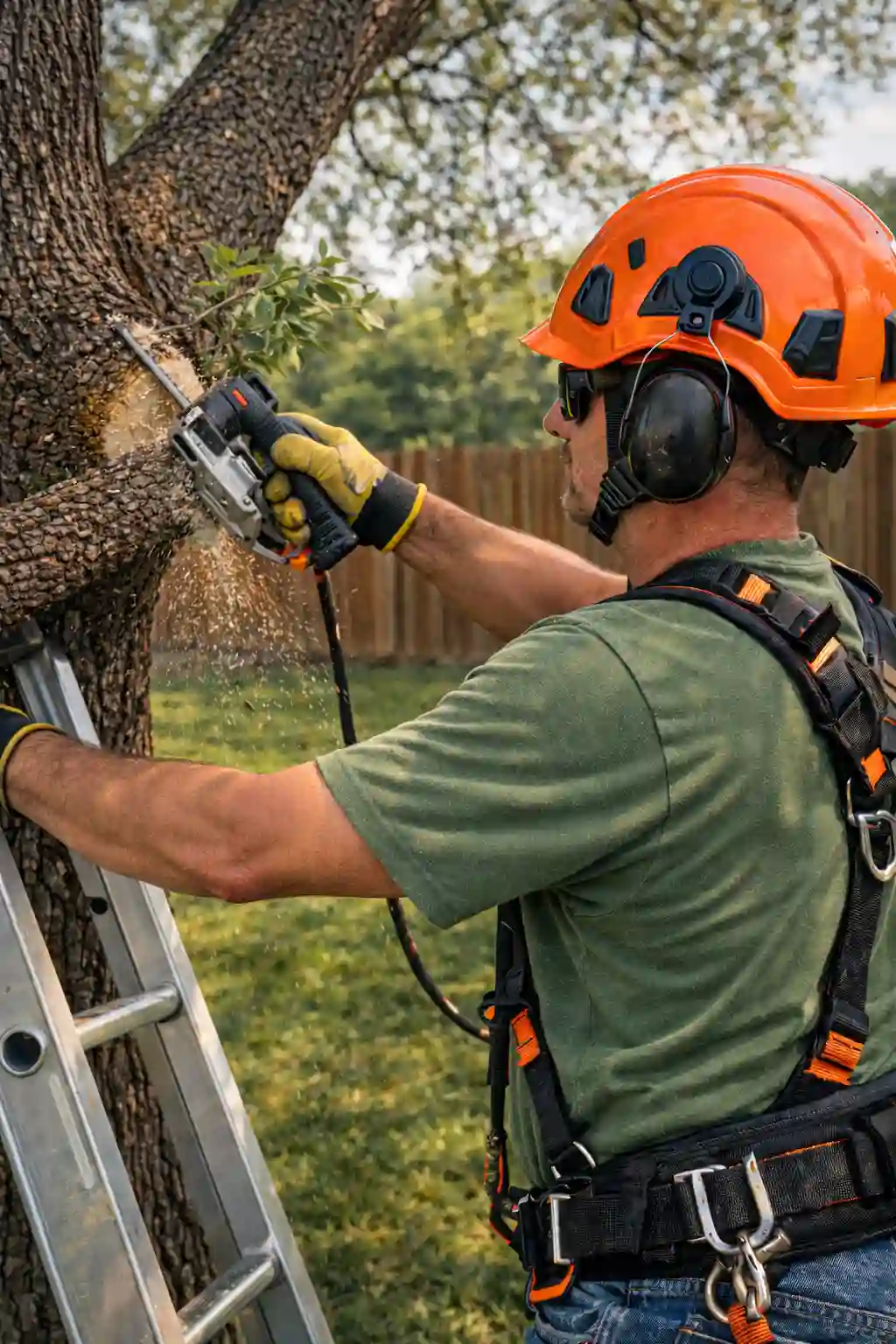
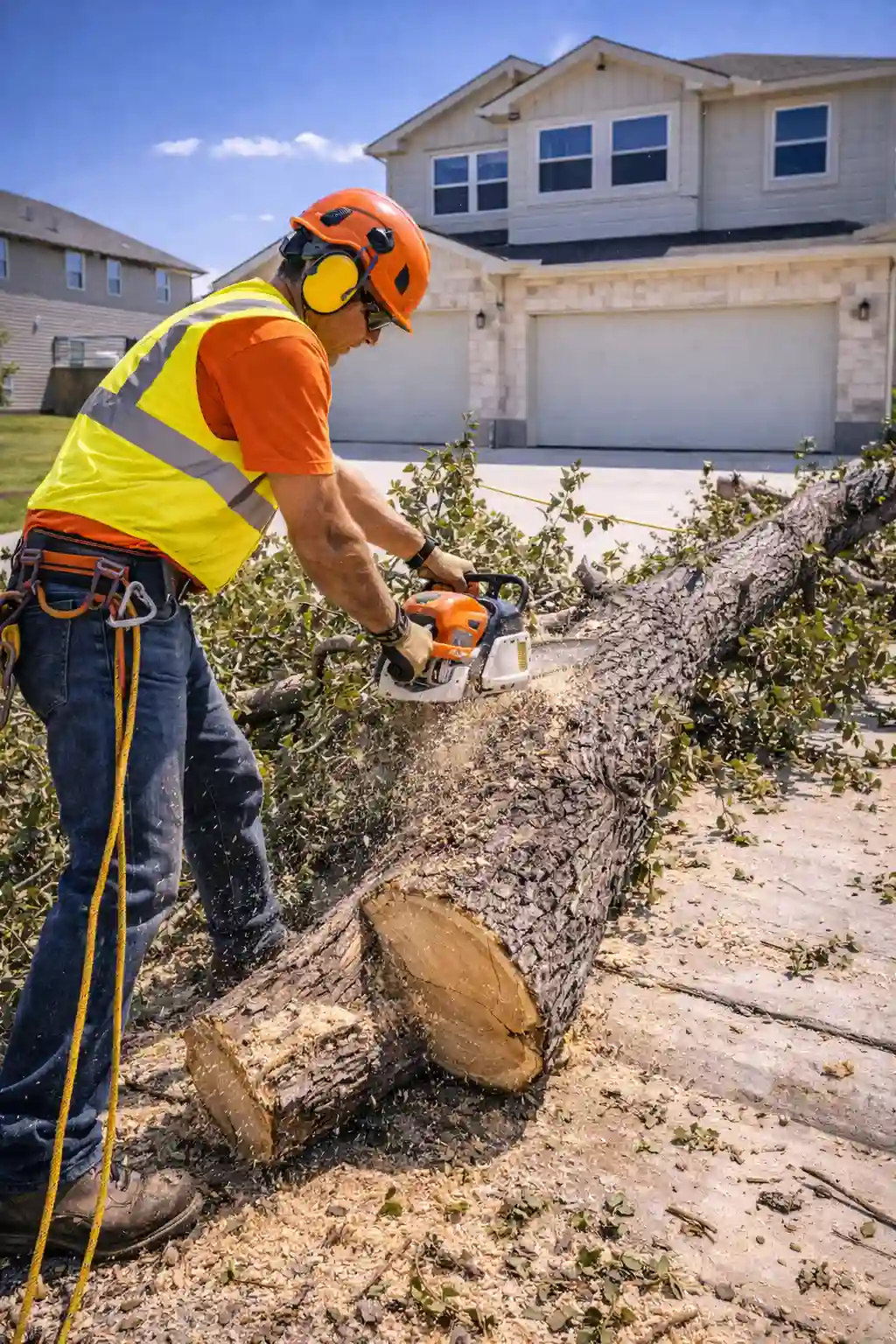
Most removals in Kyle's subdivisions require sectional removal from the top down — using aerial lift equipment or climbing rigging — because fenced yards, adjacent structures, and utility lines eliminate a clear directional-fell path.
Utility Coordination
Trees near power lines require coordination with the utility provider before any cutting begins.
Debris Cleared
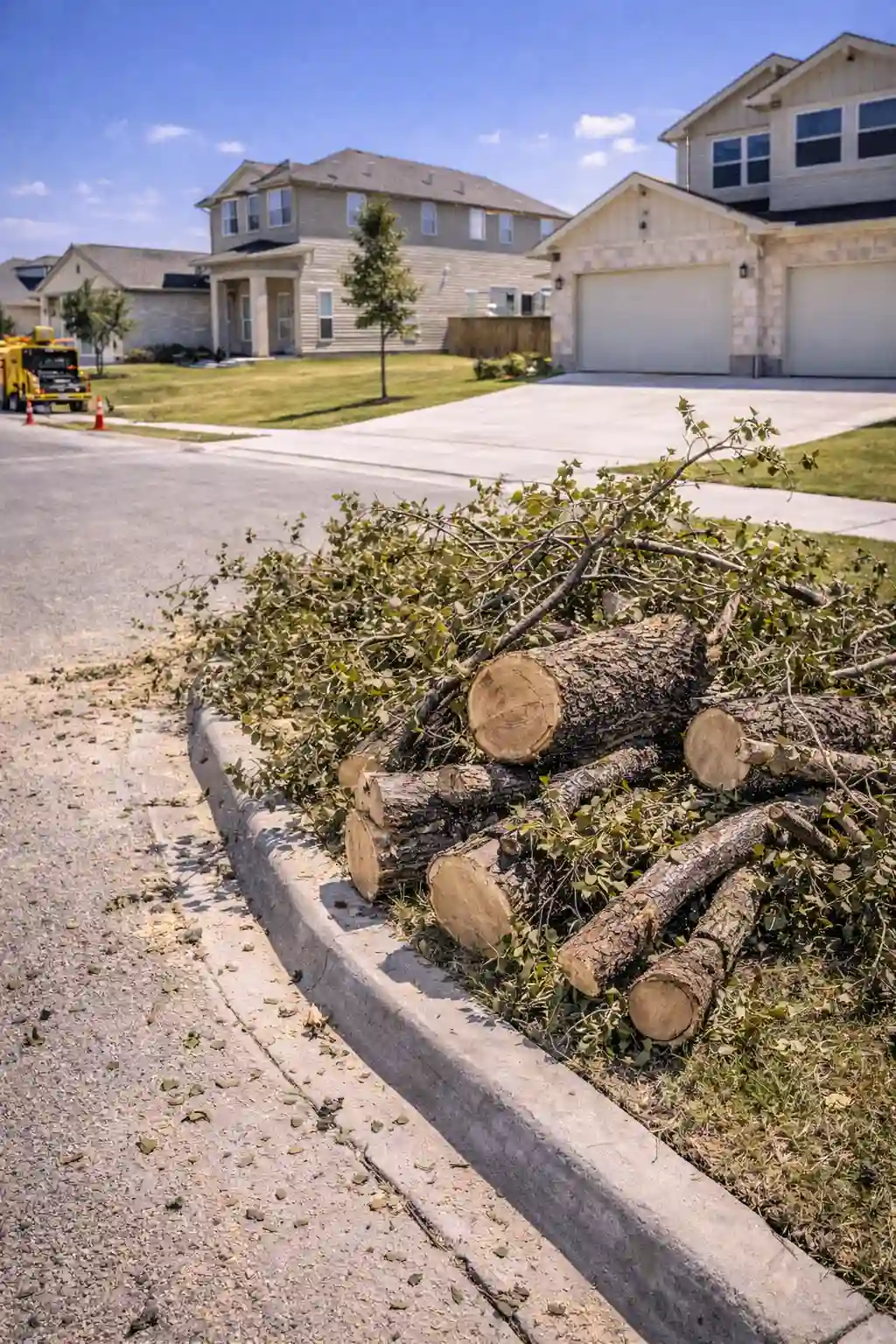
Limbs, trunk sections, and wood chips are cleared from the site before the crew leaves. Wood sections retained for firewood must be arranged before the job starts, not after the crew has already chipped.
Stump Decision
The stump remains unless grinding or full extraction is included in the scope. Grinding removes the visible stump to 6–8 inches below grade and leaves a mulch pile that can be used in beds or hauled away.
Tree Trimming and Pruning for Kyle's Tree Species
Trimming removes growth that conflicts with structures, clearance zones, or utility lines — it is defined by the obstacle, not the tree's biology. Pruning is a biological intervention: removing specific branches to improve structure, reduce failure risk, or manage disease. A crew that only trims without understanding pruning will remove the wrong wood — creating large wounds, eliminating the leader, or leaving stubs that decay back into the trunk.
Live oaks are the most timing-sensitive species in Kyle. The Nitidulid beetle that vectors oak wilt is active February 1 through June 30, and any pruning wound made in that window gives it a direct infection path within hours. The correct pruning window for live oaks is July 1 through January 31. Cedar elms are less timing-sensitive but benefit from late winter pruning before bud break. Ashe juniper can be trimmed year-round.
Structural pruning for young trees under 6 inches in trunk diameter is the most cost-effective service a Kyle homeowner can invest in — it prevents the included bark unions and heavy branch attachments that drive removal costs 20 years later. In fast-growing subdivisions like 6 Creeks and Waterleaf, builder-planted 2- to 3-inch caliper trees are now reaching sizes where structural decisions become permanent.
Clearance trimming along IH-35 frontage and FM 1626 follows TxDOT right-of-way standards: 14-foot minimum vertical clearance over roadways, 8 feet over sidewalks. Properties with utility easements must maintain 10 feet from the nearest conductor. HOAs in Kyle's larger subdivisions often add canopy height and setback requirements independent of city or TxDOT standards.
Stump Grinding and Stump Removal in Kyle
A stump left in place does not stay dormant. Decay begins within one to two growing seasons as wood-decay fungi break the trunk down from the top. As it softens, it becomes a preferred nesting site for carpenter ants, termites, and beetles already present in Kyle's soil. Stumps from live oaks and pecans also produce basal sprouts that draw energy from the remaining roots.
Stump grinding runs a carbide-tipped wheel across the wood until it's ground to 6–8 inches below the soil surface, producing a wood-chip mulch pile. Grinding does not remove lateral roots — they remain in the soil and decay naturally over several years. For most residential jobs in Kyle, grinding is the correct call: faster, less soil disturbance, no excavation equipment required.
Full stump removal — mechanical extraction of the stump and lateral root system — is appropriate when the stump sits in a construction zone, a new foundation footprint, or a planting bed. Extraction in Kyle's clay soils requires a backhoe or excavator and leaves a soil void that must be backfilled.
Properties west of IH-35 may encounter limestone rock at 12–18 inches below grade, which limits grinder depth and can make full extraction impractical without pneumatic equipment. Properties in the Blackland clay zone grind more easily but produce a wetter, heavier mulch pile.
Emergency Tree Service in Kyle
Kyle sits in a weather corridor pressured by multiple storm systems. Hill Country microbursts along the Onion Creek and Plum Creek drainages can exceed 70 mph with no prior warning. Winter ice storms driven by cold fronts sliding through the I-35 corridor accumulate ice on cedar elm and pecan canopies fast enough to split major limbs within hours.
What Counts as an Emergency
- A tree on a roof
- A trunk blocking a driveway
- A hanging limb over a vehicle or walkway
- A root plate that has lifted and is pulling the tree over
A tree that lost a few small branches in a storm is storm damage, not an emergency. Emergency response prioritizes hazard mitigation first, full cleanup second.
Austin Tree Services Tx provides 24/7 emergency response to Kyle properties. Every response begins with a secondary hazard assessment — other compromised limbs, adjacent damaged trees, and utility lines that may be in contact with fallen material — before any cutting starts. After the active hazard is cleared, the homeowner can schedule the full cleanup and any additional work — stump grinding, debris removal, cabling of adjacent trees — as a separate appointment.
Why Kyle Homeowners Choose Austin Tree Services Tx
Kyle's tree conditions are specific: Blackland clay soils that stress root systems differently than the sandy loam north of Round Rock, a live oak population running through Plum Creek and Gregg-Clarke Park with connected root networks and active oak wilt pressure, and a rapid-growth development pattern that has left many trees with compromised root zones from construction activity. General tree service crews that operate across Central Texas without local species and soil knowledge miss the early indicators that distinguish a tree worth saving from one that will fail.
ISA certification is the standard the insurance industry and municipal arborist programs use to verify competency — demonstrated knowledge of tree biology, pruning standards, hazard assessment, and safe work practices. If a tree service cannot provide a current certificate of insurance and workers compensation documentation before starting work, the homeowner assumes liability for any crew injury or property damage during the job. Every job ends with a clean site, and the quoted price is the invoiced price unless the scope changes — discussed with the homeowner before additional work begins.
Frequently Asked Questions About Tree Service in Kyle
Yes, in most cases. Live oaks and cedar elms planted within 8 to 10 feet of a slab foundation in Kyle's Blackland clay soils will develop lateral roots that follow the moisture differential along the foundation edge. The timeline varies — most homeowners start seeing hardscape displacement or foundation stress symptoms 10 to 15 years after planting. Early root barrier installation is the most cost-effective intervention before roots establish under the slab.
The portion of the tree over your property is your responsibility; the portion over common area is typically the HOA's. In practice, many Kyle HOA governing documents assign full trimming responsibility to the homeowner whose lot the trunk sits on, regardless of where the canopy extends. Review your CC&Rs before doing any work — and do not trim between February 1 and June 30 if the tree is a live oak.
Almost certainly yes. Utility and road trenching within 15 to 20 feet of a mature cedar elm severs the feeder roots responsible for water uptake. The tree's visible decline typically lags 12 to 24 months behind the root damage, so symptoms appearing now align with work done last year. The tree may stabilize with supplemental watering and canopy reduction, or the root loss may be too extensive to recover from — an arborist assessment determines which scenario applies.
Start with a hazard assessment, not a trimming quote. Untrimmed live oaks in Plum Creek frequently have included bark unions — co-dominant stems growing together with bark trapped between them — that are invisible from the ground but represent structural failure points. An ISA-certified arborist identifies those conditions before any cutting starts. Call (512) 729-9018 to schedule an assessment.
Live oaks must not be trimmed between February 1 and June 30 due to oak wilt risk — that restriction applies regardless of what your HOA requests. The Nitidulid beetle that transmits oak wilt is active during this window and will locate fresh pruning wounds within hours. Document the HOA's request in writing and explain the oak wilt risk; most HOAs accept a scheduled post-July 1 trimming date.
A standard stump grinder cuts to 6 to 8 inches below grade, which removes the visible stump and the top of the taproot. Lateral roots running horizontally under patios and driveways are not reached by grinding — they remain in the soil and continue to decay over several years. If roots are actively lifting concrete, the fix is root pruning and barrier installation rather than stump grinding, which addresses the stump but not the lateral root system.
Dead pecans are structurally unpredictable. A live tree distributes wind load through a flexible root-to-canopy system; a dead tree loses that flexibility as the wood dries and the root connection degrades. Kyle's clay soils shrink away from dead root systems during drought, accelerating the destabilization. The longer a dead pecan stands, the less warning it gives before it fails. Removal timelines and what's included are covered on our tree removal services page.
A partially split branch that is still attached and has living tissue can sometimes be cabled and bolted back, but only if the split has not exposed the heartwood to decay and the remaining attachment point is structurally sound. If bark is shredded, the split extends into the main trunk, or the wood has started to dry at the wound, removal is the right answer. A failed cable job on a re-split limb creates a more dangerous projectile than removing the limb in the first place.
Ask for a certificate of insurance naming you as the certificate holder, issued directly from their insurer — not a copy of a document the company provides themselves. It should list general liability coverage and workers compensation. If they cannot produce a current certificate within 24 hours of your request, assume they are uninsured. An uninsured crew working on your property shifts liability for injuries and property damage to your homeowners policy.
It depends on the species and how they were planted. Builders in Kyle's newer subdivisions commonly used live oak, cedar elm, and Texas mountain laurel — all appropriate species. The issue is planting depth and root ball handling: trees planted too deep or with the root flare buried develop girdling roots and structural defects that shorten their functional lifespan significantly. An arborist can assess the root collar and determine whether a young tree is worth investing in or likely to fail within 10 years.
Serving Plum Creek, 6 Creeks, Steeplechase, Waterleaf & Kyle Crossing
Rural and commercial properties along FM 1626, Bunton Creek Road, and the IH-35 corridor, too — tree removal, trimming, stump grinding, stump removal, emergency service, cabling, and ISA-certified arborist assessments.
Call (512) 729-9018