
Tree Service in Rollingwood, TX
Removal, trimming, stump grinding, cabling, and emergency response inside a 0.7-square-mile city with its own Tree Canopy Management Ordinance — permits, protected species, and heritage-tree rules included.
Tree service in Rollingwood, TX covers removal, trimming, stump grinding, cabling, and emergency response inside a city that regulates its own tree canopy separately from Austin. Removing a protected-species tree 12 inches or wider in diameter requires a permit filed with the City of Rollingwood. Austin Tree Service is a City of Rollingwood-registered tree contractor and provides same-day response for hazard and storm-damaged trees.
What tree services are available in Rollingwood, TX?
Austin Tree Service provides tree removal, trimming, stump grinding, stump removal, cabling and bracing, arborist diagnosis, tree planting, and emergency response inside Rollingwood city limits. Work on protected species follows the city's Tree Canopy Management Ordinance, including permit filing where the ordinance requires it.
How much does tree service cost in Rollingwood, TX?
Removal ranges from $300 for a small tree to $4,000+ for a mature live oak, trimming runs $150 to $1,800 per tree, and stump grinding costs $2 to $6 per diameter inch. These are 2026 Central Texas market ranges — Rollingwood adds cost factors most Austin suburbs don't, covered below the table.
| Service | Typical Range | What Drives the Price |
|---|---|---|
| Small tree removal (under 30 ft) | $300–$700 | Diameter, lean, access to the site |
| Medium tree removal (30–60 ft) | $700–$1,500 | Rigging needs, canopy volume |
| Large / heritage live oak removal | $2,000–$4,000+ | Trunk diameter, proximity to structures, Board of Adjustment filing time |
| Tree trimming, per tree | $150–$1,800 | Height, deadwood volume, scheduling around the oak wilt window |
| Stump grinding, per stump | $100–$700 | Diameter at $2–$6 per inch, wood density, root flare |
| Cabling, per tree | $250–$1,500 | Number of cables, climbing difficulty |
| Bracing rods, per rod | $200–$800+ | Hardware count, trunk and limb condition |
What makes Rollingwood pricing different from other Austin-area cities?
Three factors that don't apply everywhere in the metro. A heritage-size removal (24 inches and up) needs a Board of Adjustment special exception, which adds filing and documentation time to the project. Removing a protected tree from a setback replaces it at a 1:3 ratio, adding the cost of replacement trees and planting labor. Trimming an oak outside the July–January window risks the city's $500 fine on top of the job cost. Tight, fenced lots near the Greenbelt and lakefront can also require smaller equipment, which adds labor time compared to an open lot.
Do I need a permit to remove a tree in Rollingwood, TX?
Yes, for any protected-species tree 12 inches or more in diameter, measured 4.5 feet above grade. The permit application is filed with the City of Rollingwood at no cost before work begins. Unprotected species and routine trimming of non-oak trees generally don't require one.
| Rule | Requirement |
|---|---|
| Permit threshold | Protected species ≥12" diameter, measured 4.5 ft above grade |
| Heritage tree | 24"+ diameter — removal needs a Board of Adjustment special exception |
| Protected species | All oaks, pecan, cedar elm, American elm, Texas ash, bald cypress, Texas madrone, bigtooth maple, Arizona walnut, eastern black walnut |
| Replacement ratio | 1:3 in setback/green space, 1:1 in buildable area, capped at a maximum total |
| Oak trimming window | Banned Feb 1–Jun 30; $500 fine for trimming an oak during this period |
| Contractor requirement | Must be registered with the City of Rollingwood |
| Permit cost/term | Free application; trimming permit valid one year |
| No room for replacements | Good Neighbor Program allows planting on an adjacent lot with owner consent |
What counts as a heritage tree in Rollingwood?
A protected-species tree 24 inches or more in diameter, measured 4.5 feet above grade. Removing a heritage tree requires a special exception from Rollingwood's Board of Adjustment, granted only after the applicant shows every reasonable alternative to removal was considered.
When can oak trees be trimmed in Rollingwood?
Outside of February 1 through June 30. Rollingwood bans oak trimming citywide during that window to slow oak wilt, a fungal disease that spreads through fresh pruning wounds and through root grafts between live oaks growing close together — common on Rollingwood's small, densely wooded lots. Trimming an oak during the ban carries a $500 fine.
What are the signs a Rollingwood tree needs attention?
Rollingwood's shallow limestone soil and tightly spaced live oak canopy create hazard patterns that show up earlier and spread faster than in deeper-soil suburbs. These signs call for an inspection before the next storm or the next oak wilt window.
- Yellowing or browning live oak leaves outside of fall — an early oak wilt symptom that spreads quickly through root-grafted trees on adjoining lots.
- Mushroom-like conks growing at the base of a trunk — a sign of internal root or trunk decay, more common where shallow limestone keeps roots close to the surface and exposed to injury.
- Root heave lifting a driveway, patio, or foundation slab — pecans and mature live oaks push roots laterally rather than deep once they hit Rollingwood's bedrock.
- Increased trunk lean since the last storm — wind funneling through the Barton Creek Greenbelt can loosen root plates in the city's clay-heavy soil pockets.
- Cracked or split limbs still hanging in the canopy after a storm — common on the heavy-limbed, mature oaks found on older Rollingwood lots.
- Dieback concentrated on one side of the canopy — often signals root or trunk damage on that side, worth checking before storm season.
- A trunk diameter approaching 24 inches on a tree near a structure — once it crosses the heritage threshold, removal requires a Board of Adjustment exception, so a health assessment beforehand avoids that process later.
What happens during emergency tree removal in Rollingwood?
Austin Tree Service dispatches the same day for storm-damaged, leaning, or hazard trees inside Rollingwood city limits. A registered arborist determines whether the tree can be cabled and saved or has to come down, clears access and debris, and files any required permit paperwork with the city.
-
Report the hazard
Call and describe the tree — leaning trunk, split limb, blocked driveway, or downed wire contact. Crews triage by phone or photo the same day.
-
Same-day site assessment
A registered arborist inspects lean angle, root plate movement, and canopy damage on-site to decide whether the tree is salvageable.
-
Removal or stabilization
The tree comes down using rigging suited to Rollingwood's compact, fenced-in lots, or gets cabled and braced if the structure can be saved.
-
Debris clearing and permit filing
Wood and brush are cleared from the property, and any permit paperwork the ordinance requires is filed with the city.
Why does Rollingwood's terrain affect tree health?
Rollingwood sits on limestone bedrock with clay-heavy pockets on the west bank of Lady Bird Lake, across roughly 0.7 square miles bordered by Zilker Park to the east and West Lake Hills to the west. Shallow, rocky soil limits lateral root spread, so mature oaks and pecans on these lots depend on deep watering rather than surface irrigation.
Which tree species are common in Rollingwood, and which are protected?
Live oak, cedar elm, and pecan make up most of Rollingwood's mature canopy, and all three are protected species under the city's ordinance once they reach 12 inches in diameter. Yaupon holly is common as understory planting and is not protected, so it can be trimmed or removed without a permit.
| Species | Mature Height | Growth Rate | Root Behavior | Rollingwood Protected? |
|---|---|---|---|---|
| Live Oak | 40–50 ft | Slow | Shallow, wide-spreading, grafts with neighboring live oak roots | Yes, ≥12" |
| Cedar Elm | 50–70 ft | Moderate–Fast | Deeper taproot, does not root-graft, lower oak wilt risk | Yes, ≥12" |
| Pecan | 70–100 ft | Moderate | Deep taproot when young, wide laterals at maturity — can lift pavement on shallow lots | Yes, ≥12" |
| Yaupon Holly | 15–25 ft | Moderate | Shallow, fibrous, non-invasive | No |
Live oak's root-grafting habit is why the city bans trimming during oak wilt season — a wound on one tree can transmit the fungus to every live oak sharing its root system, which on Rollingwood's compact lots often means several neighboring properties.
Who provides tree service in Rollingwood, TX?
Austin Tree Service is registered as a tree contractor with the City of Rollingwood, a requirement under the city's Tree Canopy Management Ordinance for anyone performing removal or trimming work inside city limits.
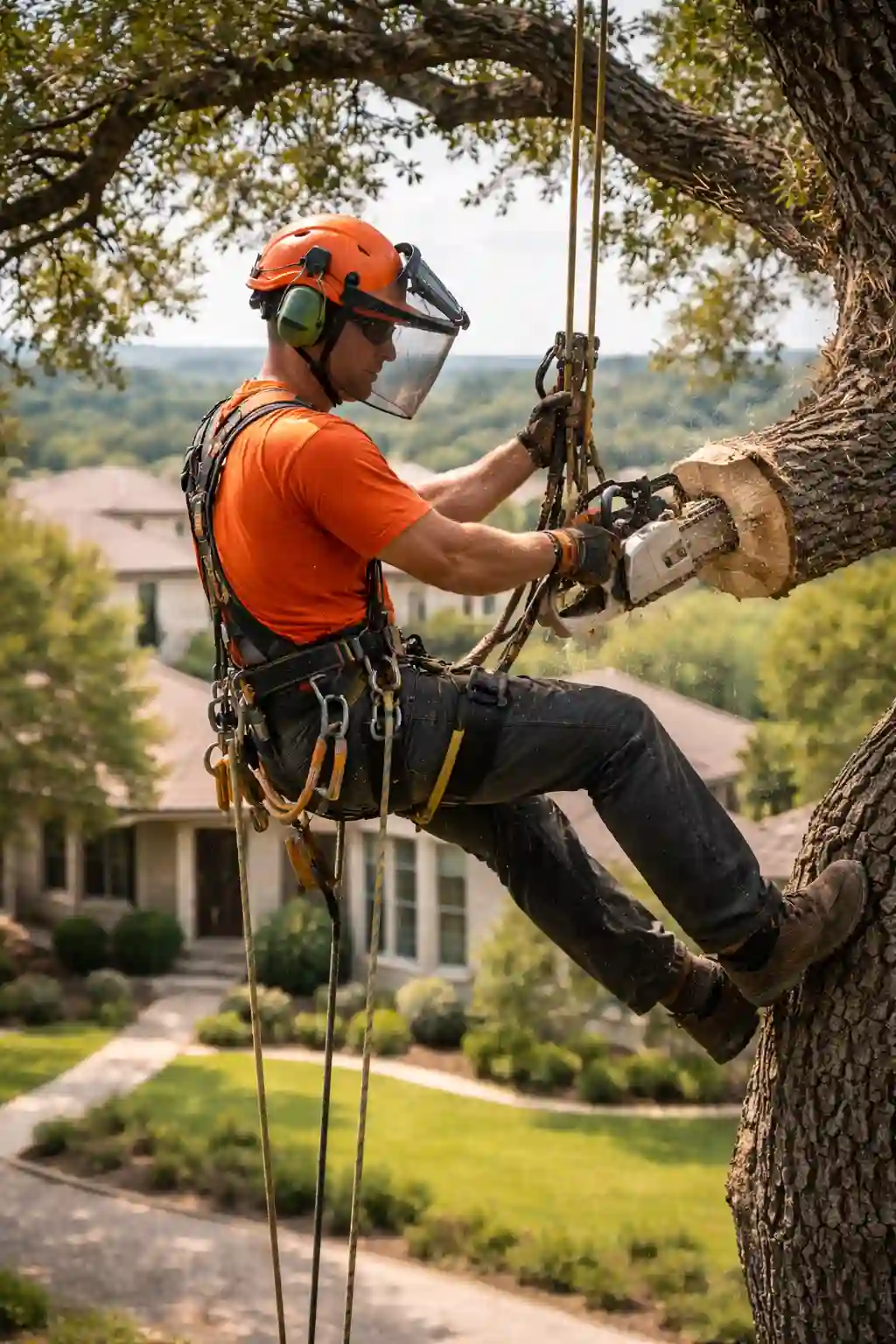
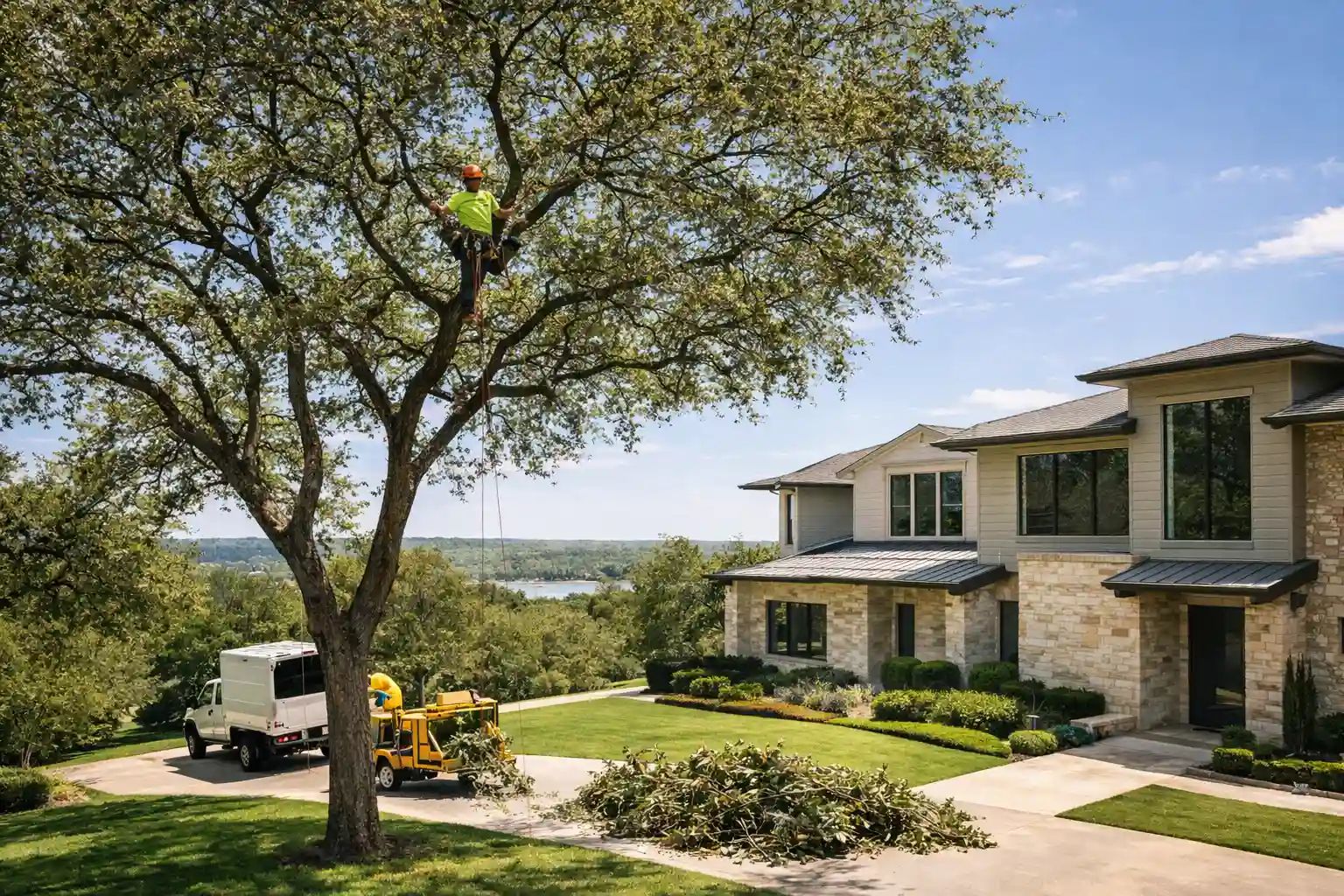
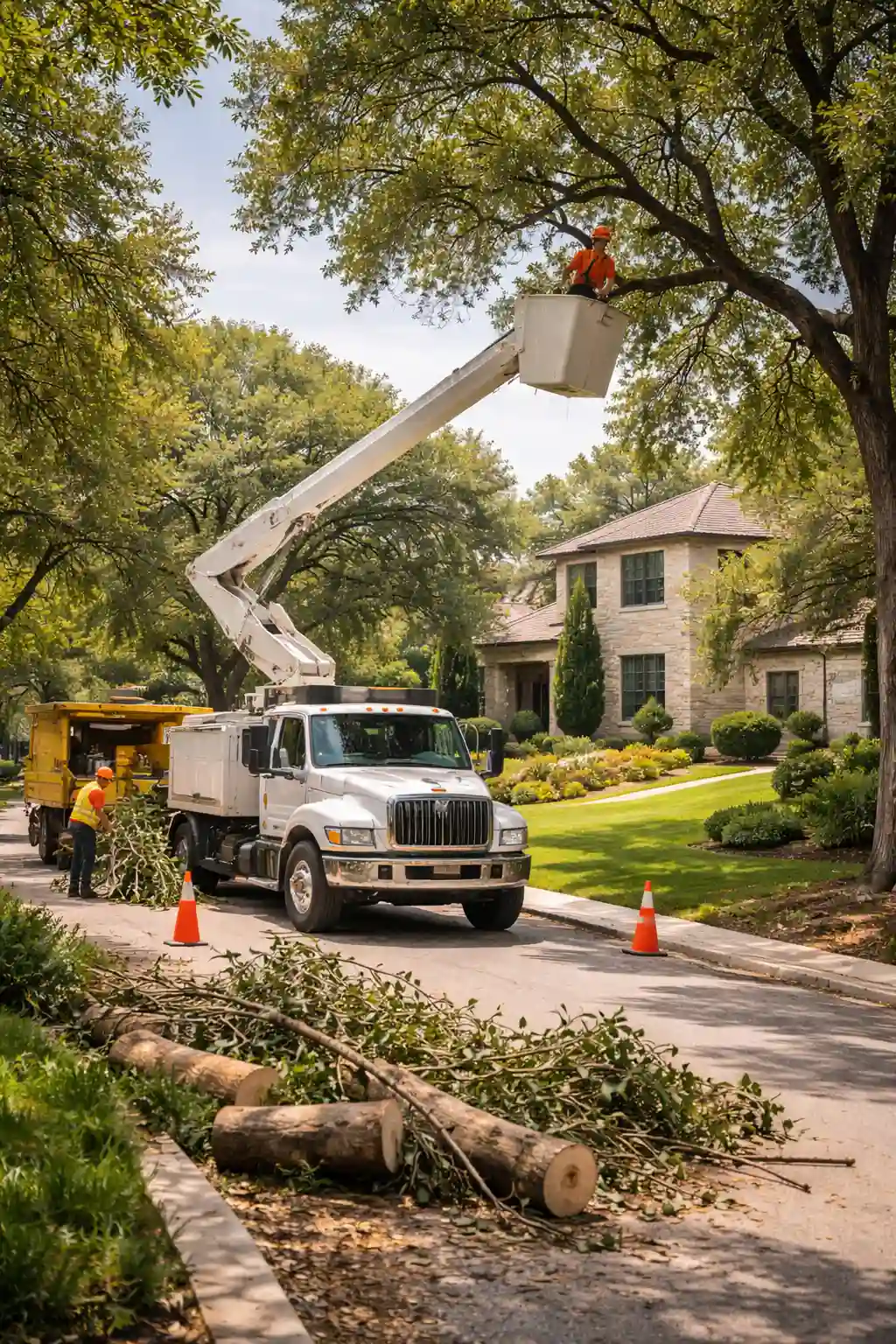
Tree work completed in Rollingwood, TX
Rollingwood tree service questions
Yes, if it's a protected species 12 inches or more in diameter at 4.5 feet above grade. The application is free and filed with the City of Rollingwood before work starts.
A protected-species tree 24 inches or more in diameter. Removing one requires a special exception from the city's Board of Adjustment, granted only if all reasonable alternatives to removal were considered first.
No. Rollingwood bans all oak trimming from February 1 through June 30 to reduce oak wilt spread. Trimming during this window carries a $500 fine.
Yes. Anyone trimming or removing trees inside city limits must be registered with the City of Rollingwood. Austin Tree Service holds this registration.
Same day for hazard and storm-damaged trees — leaning trunks, split limbs, or trees blocking access or power lines.
Rollingwood's Good Neighbor Program allows planting replacement trees on an adjacent property with that owner's written consent.
Get a Free Tree Service Estimate in Rollingwood, TX
City-registered tree contractor. Same-day response for hazard and storm-damaged trees.
Request a Free Estimate