
Tree Service Lakeway, TX
Tree removal, structural trimming, stump grinding, and 24/7 emergency response for Rough Hollow, The Preserve, Serene Hills, and Lakeway Highlands.
Austin Tree Services Tx provides ISA-certified tree removal, structural trimming, stump grinding, and 24/7 emergency tree response throughout Lakeway, TX. Crews work daily with the shallow limestone soil, oak wilt pressure, and HOA requirements specific to Lake Travis communities. Call (512) 729-9018 for an estimate or immediate dispatch.
Lakeway's Limestone Soil and What It Does to Your Trees
Lakeway's soil profile is dominated by thin, rocky limestone derived from the Cretaceous Edwards Plateau formation. Where Austin's eastern suburbs sit on deep clay or sandy loam, Lakeway homeowners in areas like Serene Hills and World of Tennis are frequently working with six to twelve inches of topsoil before hitting solid rock. Trees in this environment cannot develop deep taproots — they spread laterally instead, which explains why root-to-structure conflicts are so common in Lakeway's older sections near Lakeway Drive and RM 620.
Oak wilt is an active threat in Lakeway's mature live oak canopy. The fungus Bretziella fagacearum spreads through root grafts between neighboring trees and through nitidulid beetles attracted to fresh pruning wounds. Live oaks must not be trimmed between February 1 and June 30 due to oak wilt risk — that window covers peak beetle flight season in the Lake Travis area. Lakeway's density of mature live oaks in neighborhoods like Lohmans Crossing Estates means one infected tree can transmit the disease to adjacent trees through shared root systems within months.
The dominant species in Lakeway are live oak (Quercus fusiformis), cedar elm (Ulmus crassifolia), Ashe juniper (Juniperus ashei), and Texas mountain laurel (Sophora secundiflora). Cedar elms frequently develop double leaders and codominant stems — a structural defect that raises failure risk during ice storms, which the Lake Travis corridor experiences more severely than central Austin due to elevation exposure.
Common Tree Problems on Lakeway's Rock-Heavy Lots
Oak Wilt in Lakeway's Live Oak Canopy
Live oak groves in The Preserve at Lakeway and Rough Hollow function as interconnected root systems — trees planted near each other often share root grafts, meaning one oak wilt infection can move to multiple trees without any above-ground contact. Once a live oak reaches the symptomatic stage, the tree cannot recover — containment through trenching to sever root grafts is the only way to protect adjacent trees.
- Veinal necrosis in the leaves
- Rapid leaf drop starting at branch tips
- Brown leaf pattern moving from the outside of the canopy inward
Ashe Juniper Encroachment Along Drainage Corridors
Lakeway's creek drainages — including those feeding into Lake Travis — provide ideal germination conditions for Ashe juniper. In subdivisions bordering the Hamilton Greenbelt and Canyonlands areas, juniper stands encroach on native understory and crowd structural trees. Juniper is not a candidate for trimming or shaping — removal and ongoing monitoring is the correct response.
Root Damage from Golf Course and Lakefront Development
Lakeway's development history — including the former Lakeway Resort and several phases of lakefront construction — left compacted, graded soils in older sections near Lakeway Drive. Root zones cut or covered during site grading often surface as internal decay, canopy dieback, and basal instability ten to twenty years later.
Ice Storm Limb Failure in Cedar Elms and Live Oaks
Lakeway's elevation makes it more exposed to ice accumulation than lower-elevation Austin neighborhoods. Codominant stems in cedar elms fail under ice loads at rates far higher than properly pruned single-leader trees, making structural pruning before winter a risk-management decision rather than an aesthetic one.
Drought Stress and Canopy Thinning in Shallow-Soil Properties
Properties in Serene Hills, Lakeway Highlands, and along Bee Creek Road frequently have limestone bedrock at or near the surface, leaving no moisture buffer once surface water is gone. Trees showing significant canopy thinning should be evaluated for the two-lined chestnut borer, which targets drought-stressed oaks.
Foundation and Hardscape Conflicts from Lateral Root Spread
A mature live oak in Lohmans Crossing Estates with a 40-foot canopy radius likely has roots extending 60 to 80 feet from the trunk, running just below the limestone surface. Root pruning and physical barrier installation can protect structures without removing the tree — but the window for intervention is early, before structural damage becomes severe.
Tree Services in Lakeway, TX
Austin Tree Services Tx operates throughout Lakeway and surrounding Lake Travis communities.
Live Oaks, Cedar Elms, and When to Let Go
Tree removal is the correct answer when structural failure is no longer preventable, not a default response to any problem. A live oak showing early oak wilt symptoms can sometimes be stabilized if caught before it reaches the root zone — but a tree with fungal vascular blocking through its primary scaffold limbs has no recovery path. The correct sequence is always an assessment before a removal decision.
-
Site Assessment
Canopy spread, proximity to structures, overhead utilities, and ground conditions determine whether the tree comes down in sections from an aerial lift or via directional felling.
-
Sectional Removal or Felling
Lakeway's residential density in areas like Serene Hills typically requires sectional removal from the top down using a bucket truck or climbing operation. Felling is reserved for open, cleared properties.
-
Debris Handling
Debris is chipped on-site and removed, or stacked as requested. The stump remains unless grinding or extraction is included in the scope.
-
HOA Sign-Off and Site Cleanup
In Lakeway's HOA communities — including Rough Hollow, which has specific landscaping standards — scope is confirmed against HOA guidelines before the job starts. The site is raked and cleared before the crew leaves.
Pruning Lakeway's Live Oaks and Cedar Elms the Right Way
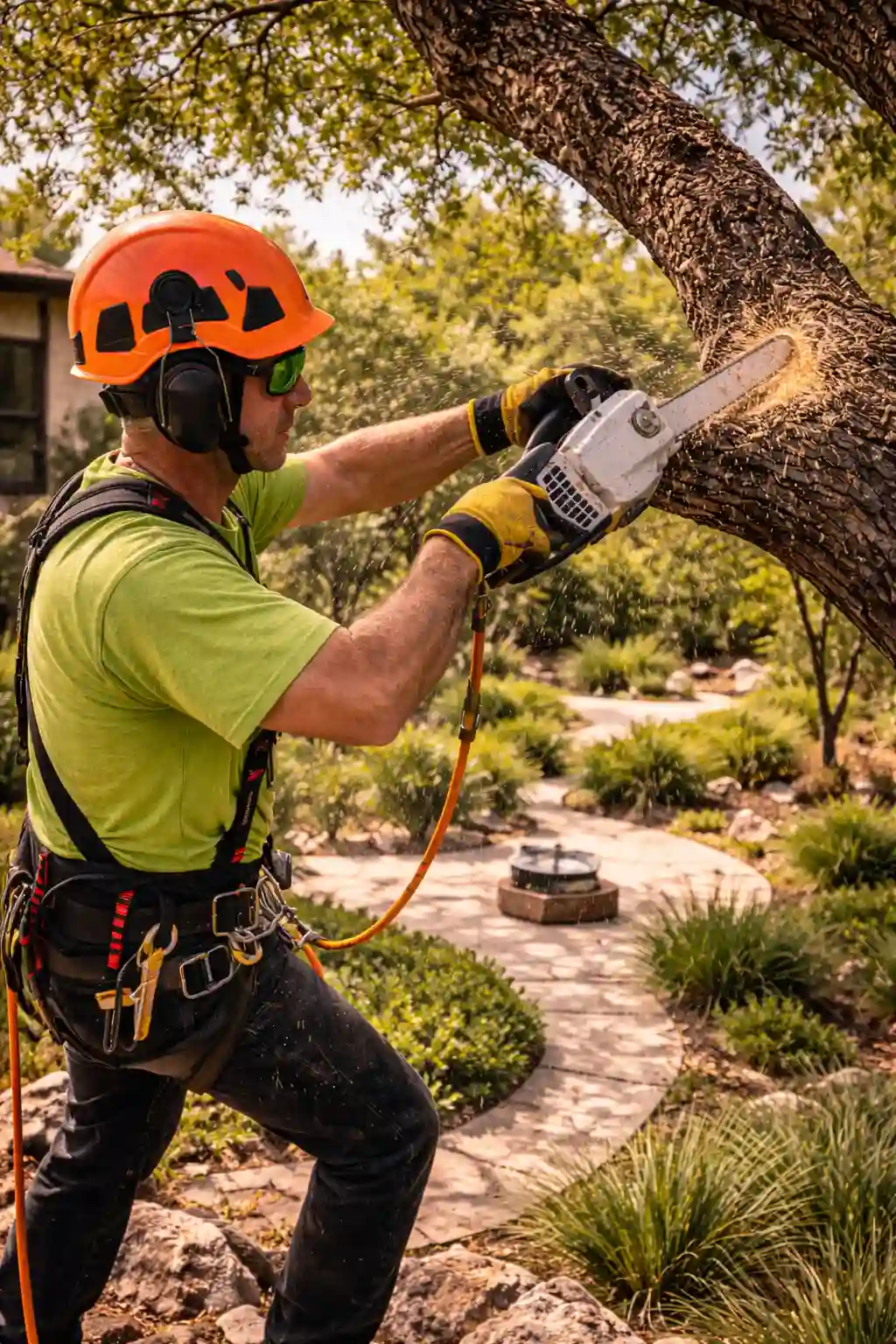
Trimming removes exterior growth to manage size, shape, clearance, and appearance — it operates on the outer canopy. Pruning is a surgical operation that removes specific branches to improve structural integrity, redirect growth, eliminate disease, or reduce failure risk from included bark and codominant stems.
Live oaks must not be trimmed between February 1 and June 30 due to oak wilt risk — no exceptions, except where a structural failure creates an immediate safety hazard and the wound can be treated with pruning paint on the spot. Cedar elms can be pruned year-round but respond best to structural work in late fall after leaf drop, when branch architecture is visible.
Young trees in Rough Hollow Phase III, Serene Hills, and lakefront infill lots need structural pruning within the first three to five years after planting. One correctly executed pruning session on a five-year-old tree eliminates the need for cabling or emergency intervention twenty years later.
Clearance trimming is required along RM 620, Lohmans Spur, and Bee Creek Road where trees overhang travel lanes, creating TxDOT right-of-way concerns. Utility clearance near overhead lines in older Lakeway sections requires coordination with the serving utility before work begins.
What Limestone Changes About the Job
A stump left in place does not stay static. Decay progresses from the outer cambium inward over three to seven years depending on species — live oak stumps decay more slowly than cedar elm stumps due to wood density. Decaying stumps attract carpenter ants, termites, and wood-boring beetles, all of which treat the stump as a bridgehead to nearby structures.
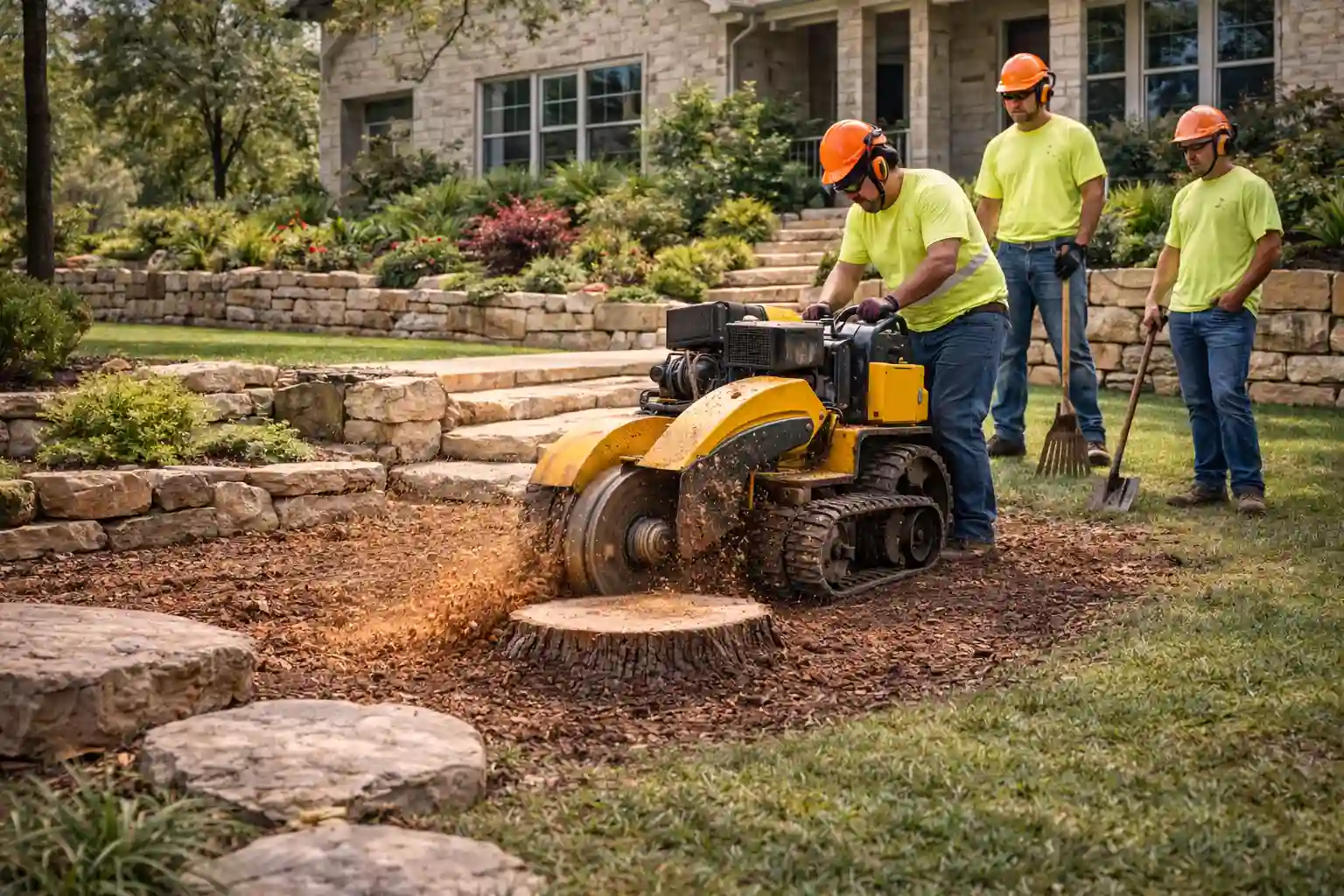
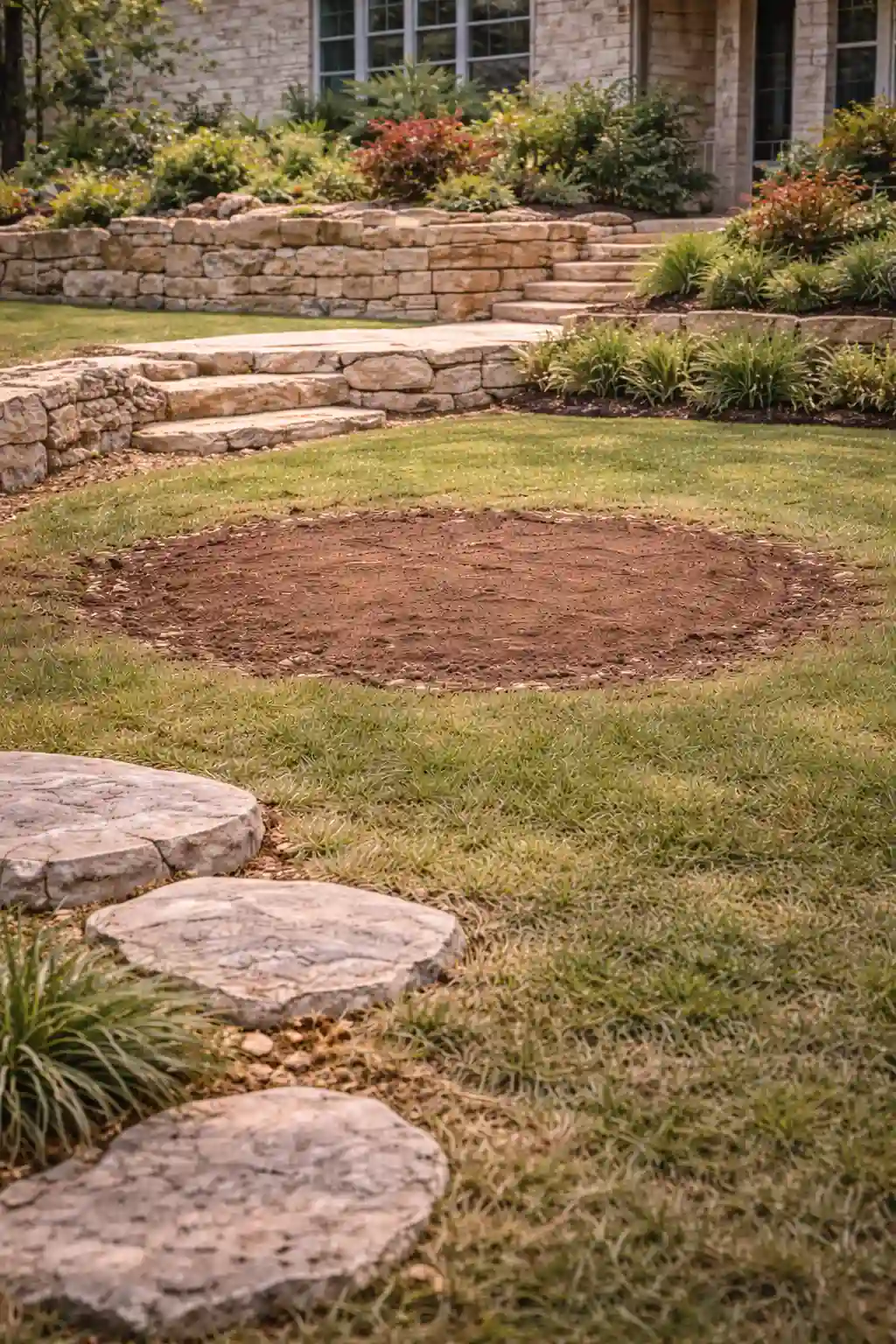
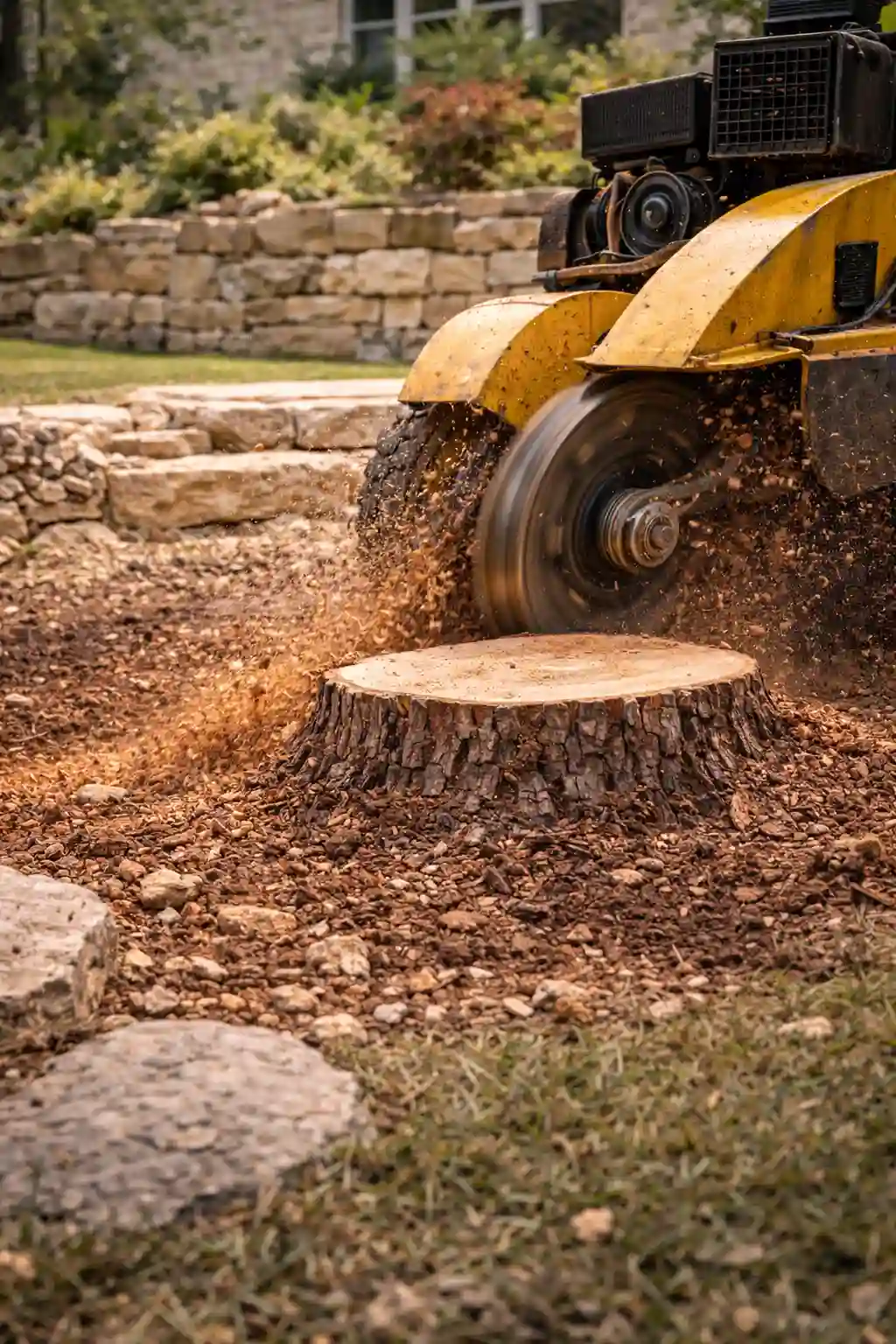
Lakeway's limestone substrate is the primary complication in grinding operations. In areas like The Preserve at Lakeway and older sections near the marina, grinding depth can be limited by rock contact. Sites where limestone sits within six to eight inches of the surface may require hand-clearing around the root flare before grinding begins — this is a standard condition in Lakeway; it adds time but does not change the outcome.
| Factor | Stump Grinding | Full Stump Removal |
|---|---|---|
| Depth | 6–12 in. below grade | Stump and primary root ball extracted |
| Best for | Replanting, general yard use | Driveways, retaining wall footers, pool installs |
| Equipment | Stump grinder | Mini-excavator |
| Limestone impact | Rock contact limits grind depth | Excavation slowed; hand-clearing may be needed |
Emergency Tree Service After Storms and Ice Events
Lakeway's position at the Lake Travis corridor exposes it to weather the urban core of Austin doesn't see with the same intensity. Hill Country microbursts move up Lake Travis and across Lakeway with little warning, producing localized straight-line winds that exceed 70 mph over small geographic areas. The February 2021 ice storm caused structural failures in live oaks, cedar elms, and pecan trees throughout the Lake Travis watershed that took months to fully address.
A tree emergency in Lakeway is any situation where a tree or tree component poses an active structural threat to a person, a building, or a utility:
- A tree that has fallen on a roof or fence
- A hanging limb that failed at the attachment point but has not fallen
- A tree leaning against a power line after root plate failure
- A trunk split at a codominant union with both halves still standing
Austin Tree Services Tx provides 24/7 emergency response in Lakeway: initial hazard mitigation, followed by a full secondary assessment of the damaged tree and adjacent trees for additional failure risk. Lakeway HOA communities have specific notification requirements for emergency work in common-area adjacencies; Austin Tree Services Tx is familiar with those requirements in Rough Hollow and The Preserve.
Why Lakeway Homeowners Call Austin Tree Services Tx
Lakeway's tree conditions are specific enough that generic tree service experience does not translate directly. Shallow limestone, oak wilt pressure from interconnected root systems, HOA compliance in communities like Rough Hollow and The Preserve, and the structural demands of properties on steep lakefront slopes all require local knowledge — not just equipment and a crew. Austin Tree Services Tx has operated in the Lake Travis corridor long enough to know which Lakeway neighborhoods have rock at four inches versus twelve, where drainage easements create recurring Ashe juniper problems, and what the Rough Hollow HOA requires before and after tree work on properties within their managed sections.
Every job includes an ISA-certified arborist assessment. That credential matters because it represents a documented standard of tree health evaluation, species-specific management knowledge, and liability awareness that unlicensed operators do not carry. Austin Tree Services Tx carries full general liability insurance and workers compensation coverage — both critical on Lakeway's elevated, rocky terrain where falling hazards and equipment positioning on slopes present higher risk than flat residential work. Before any crew starts, the certificate of insurance is available on request.
The quote produced before the job starts matches the invoice when the job is finished. Scope changes that arise during the work — rock contact that limits stump depth, an additional hanging limb discovered during aerial assessment, secondary root grafts requiring trenching — are communicated before the additional work is performed, not added to a bill after the crew leaves. The site is cleaned before departure: debris is chipped and removed, sawdust is raked, and hardscape is blown clear.
Tree Service Jobs in Lakeway, TX
Lakeway Tree Service FAQs
Yes. The City of Lakeway's tree ordinance applies to all properties within city limits regardless of HOA membership. HOA approval is a separate requirement on top of the city permit — you need both before removal begins.
No — live oaks must not be trimmed between February 1 and June 30 due to oak wilt risk. The only exception is an immediate structural failure, where the wound must be sealed with pruning paint right after the cut. Schedule non-emergency work for July 1 or later.
Yes, if your trees are within 50 feet and share root grafts with the infected tree. Oak wilt travels through connected roots without any above-ground contact. A trench cut along the property line severs those grafts — call for an assessment before the infected tree is removed, because removal alone does not stop transmission.
Lakeway's limestone substrate is the reason. Rock contact at four to eight inches below grade slows the grinder, limits depth, and sometimes requires hand-clearing before grinding begins. Round Rock's deeper clay soils do not create the same resistance. Call (512) 729-9018 for an on-site quote.
Not automatically. A live oak that lost one limb but retains more than half its canopy and an intact root plate is often a candidate for corrective pruning and cabling. Where the limb failed and whether the trunk was damaged determines the answer — get an arborist assessment before deciding.
No. In live oaks it moves through root grafts and progresses slowly, sometimes over years. In red oaks it moves through the vascular system and kills the tree within weeks. Red oaks also produce fungal spore mats under the bark, creating above-ground beetle transmission risk that live oaks do not generate at the same level.
You do. TxDOT and the city are responsible for clearance within the right-of-way only — restoring canopy balance and removing stubs is the homeowner's responsibility. If the tree is a live oak, schedule corrective pruning outside the February 1 through June 30 oak wilt window.
Generally no, unless the tree was visibly diseased or hazardous and you had previously notified them in writing. A healthy tree that failed under ice load is treated as an act of nature under Texas law — your homeowners insurance covers your fence.
Usually only if the tree hit an insured structure — a roof, fence, garage, or vehicle. A tree down in the open yard with no structural contact is typically not covered. Review your HOA's master policy as well if the tree was in a common area or easement.
At 30 feet you are likely still in the intervention window. A root barrier installed along a cut line between the tree and the foundation redirects growth without removing the tree. An arborist assessment determines how close the roots already are to the slab before you choose the approach.
Get a Free Estimate in Lakeway
ISA-certified assessments, transparent pricing, and 24/7 emergency dispatch for Rough Hollow, The Preserve, Serene Hills, and every Lakeway neighborhood in between.
Call (512) 729-9018