
Austin Tree Removal Service
Tree removal is the arboricultural process that eliminates a tree entirely from a property, including trunk felling, branch sectioning, crown dismantling, and debris hauling. Homeowners, property managers, and municipalities request tree removal for safety hazards, disease, storm damage, construction clearance, or landscape redesign.
Call (512) 729-9018Austin Tree Services Tx is a licensed tree removal company serving Austin, Texas, and the surrounding Central Texas region.
- The company removes live oaks, cedar elms, post oaks, pecans, Texas ash, Arizona ash, hackberries, and mesquites across residential, commercial, and emergency contexts. Every tree removal job is performed by certified arborists using rigging equipment, chainsaws, bucket trucks, and crane-assisted methods where site access requires it.
- Tree removal differs from tree trimming in scope and intent. Tree trimming preserves the tree by cutting selected branches; tree removal eliminates the tree down to the stump or below grade.
- Property owners schedule tree removal when a tree threatens a structure, shows advanced disease symptoms, has suffered irreparable storm damage, or has died and presents a falling hazard.
What Is Tree Removal?
Tree removal is the complete arboricultural procedure of cutting down a tree and clearing the debris, typically performed when a tree is dead, diseased, hazardous, or interferes with property or construction. The process involves crown reduction, sectional felling, trunk cutting, and site cleanup, performed by certified arborists with specialized equipment.
Tree removal is classified under the broader discipline of arboriculture, which is the cultivation and management of trees. An arborist performs tree removal by assessing the tree's condition, mapping the fall zone, selecting the cutting technique, executing the felling, and hauling the resulting debris. The service ends when the stump is either ground down, removed, or left for a separate stump grinding service.
A tree removal job has four standard outputs: a cleared site, stacked or hauled wood, ground debris (branches, leaves, bark), and an exposed or removed stump. The property owner decides whether to retain firewood, have the stump ground down, or have the stump fully removed. Austin Tree Services Tx offers stump grinding and stump removal as companion services to tree removal.
When Do You Need Tree Removal?
Tree removal is required when a tree is dead, structurally compromised, diseased beyond treatment, leaning dangerously, damaging foundations, blocking construction, or creating a safety hazard. An arborist inspection confirms whether removal is necessary or whether the tree can be preserved through cabling, pruning, or disease treatment.
There are eight common situations that require tree removal:
- Dead tree — the tree has no living tissue, leaves fail to emerge in spring, and bark is peeling or falling off.
- Structurally unsafe tree — the trunk shows large cavities, splits, or hollow areas exceeding one-third of the trunk diameter.
- Severely leaning tree — the tree leans more than 15 degrees from vertical, especially after a recent storm.
- Root damage — major roots are cut, exposed, or rotted, compromising stability.
- Advanced disease — oak wilt, hypoxylon canker, or other untreatable diseases affecting more than 50 percent of the crown.
- Property damage risk — the tree threatens a house, garage, pool, fence, or power line.
- Construction clearance — the tree sits within the footprint of a new build, driveway, or addition.
- Invasive species — the tree is classified as invasive in Central Texas (chinaberry, tree of heaven, ligustrum).
Read more about when a tree needs to be removed in our guide on when a tree needs to be removed, and check the warning signs in signs a tree is dying and cannot be saved.
What Are the Signs a Tree Must Be Removed?
The signs that a tree must be removed include dead branches in the upper crown, fungal growth at the base, cracked or split trunk, exposed or decayed roots, severe leaning, hollow sections, and failure to produce leaves in spring. Two or more signs together indicate that removal is likely necessary.
Visible Signs on the Tree
- Dead branches in the upper crown — more than 25 percent of the canopy shows no leaves during the growing season.
- Fungal conks or mushrooms at the base — indicates internal wood decay.
- Cracks or splits in the trunk — vertical cracks longer than 12 inches signal structural failure.
- Peeling or sloughing bark — large sections of bark falling off expose dead wood beneath.
- Hollow or cavity in the trunk — hollows wider than one-third of the trunk diameter compromise stability.
Signs at the Root Zone
- Exposed or heaving roots — roots lifting out of the ground after wind or heavy rain indicate root failure.
- Soil mounding on one side — the tree is actively tipping.
- Rotted root collar — soft, dark wood at the base where trunk meets soil.
Signs in the Canopy
- Sparse foliage — thin canopy even during peak growing season.
- Discolored leaves out of season — yellowing or browning in summer, not fall.
- Oak wilt symptoms — leaves turning from the tip inward with a scorched appearance, especially in live oaks and red oaks.
For a deeper walkthrough of tree hazards, read our articles on tree rot at the base, leaning trees, and how to tell if a tree is structurally unsafe.
How Does the Tree Removal Process Work?
The tree removal process works in six sequential stages: arborist assessment, site preparation, crown reduction, trunk felling, debris removal, and stump handling. Each stage uses specific equipment and techniques based on tree size, species, location, and proximity to structures.
Arborist Assessment
A certified arborist inspects the tree, identifies the species, measures trunk diameter and height, evaluates structural condition, and maps the drop zone. The assessment determines whether the tree will be felled in one piece or sectionally dismantled.
Site Preparation
The crew clears the fall zone, protects nearby structures with plywood or tarps, coordinates with utility companies if power lines are present, and sets up rigging points. For urban Austin properties, sectional dismantling is standard because fall zones are limited.
Crown Reduction
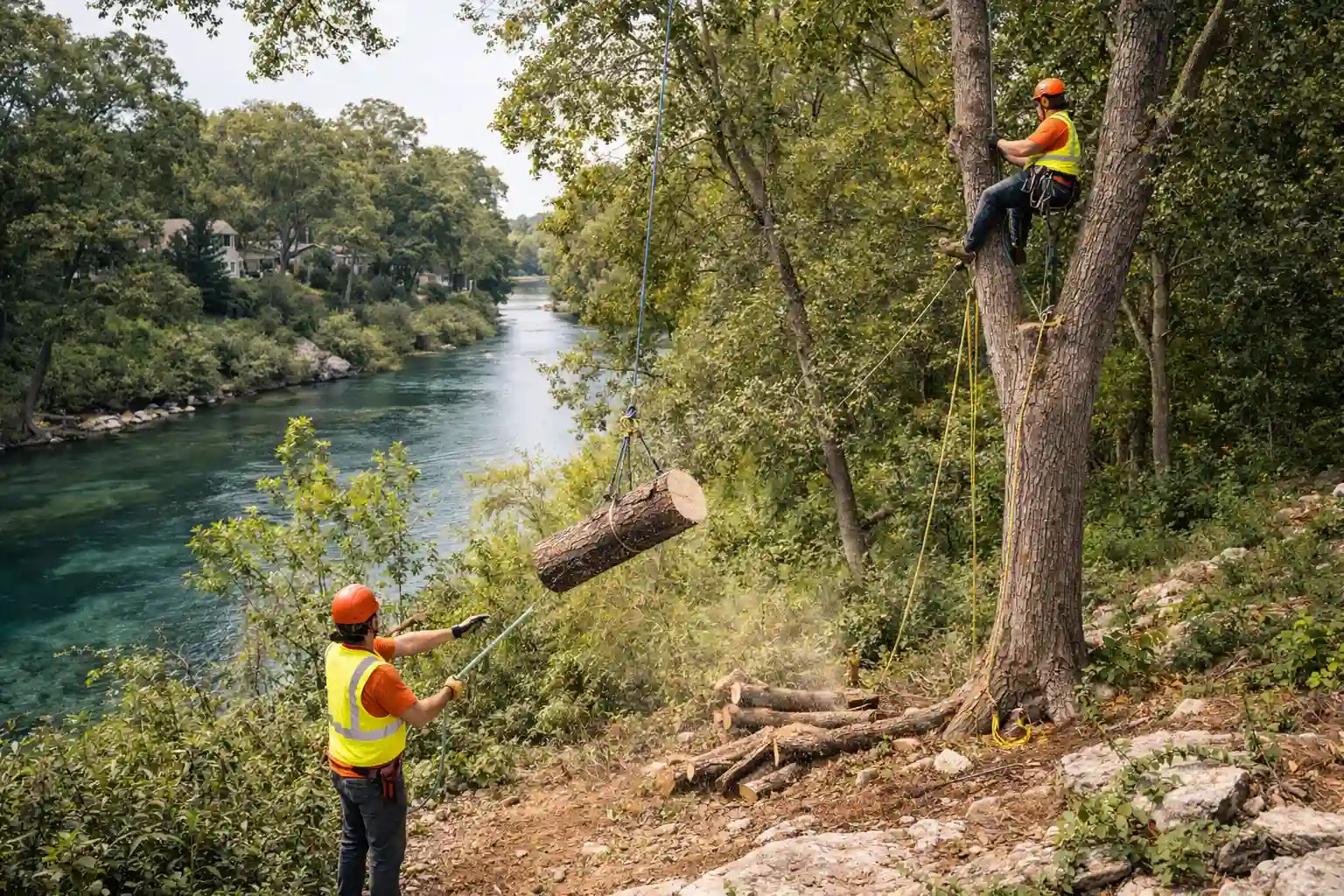
A climber or bucket truck operator removes branches from the top down. Each branch is either lowered by rigging or dropped into the cleared zone. Crown reduction lightens the tree and reduces fall impact.
Trunk Felling or Sectioning
For open sites, the trunk is felled whole using a directional notch cut. For tight sites, the trunk is cut into sections from the top down and lowered to the ground. Crane-assisted removal is used when neither method is safe.
Debris Removal
Branches are chipped into mulch, trunk sections are cut to manageable lengths, and all material is hauled away or stacked on-site at the owner's request. The crew rakes and cleans the work area.
Stump Handling
The stump is left at ground level unless stump grinding or removal is included in the job. Most Austin homeowners schedule stump grinding immediately after tree removal to restore usable ground space.
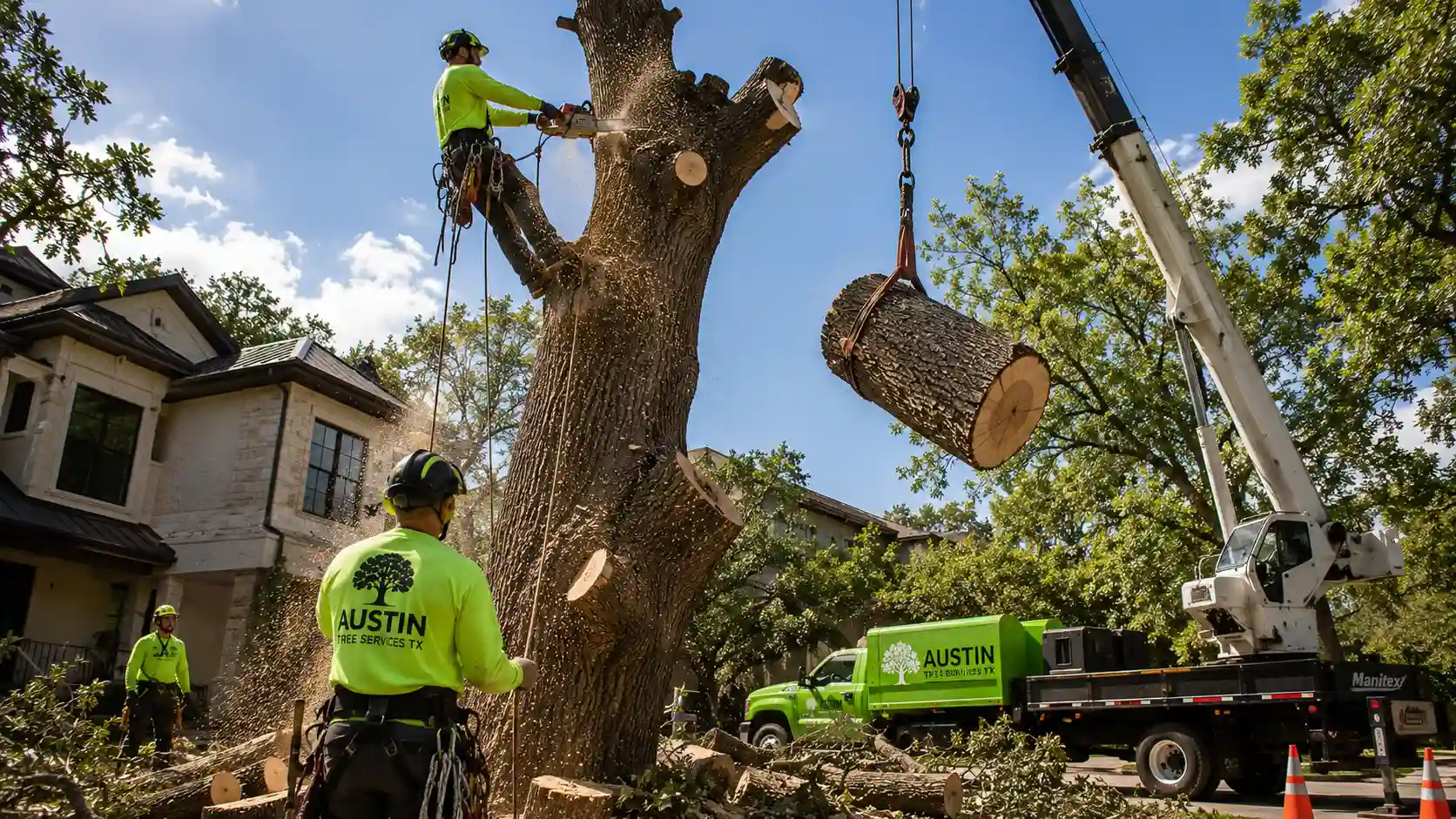
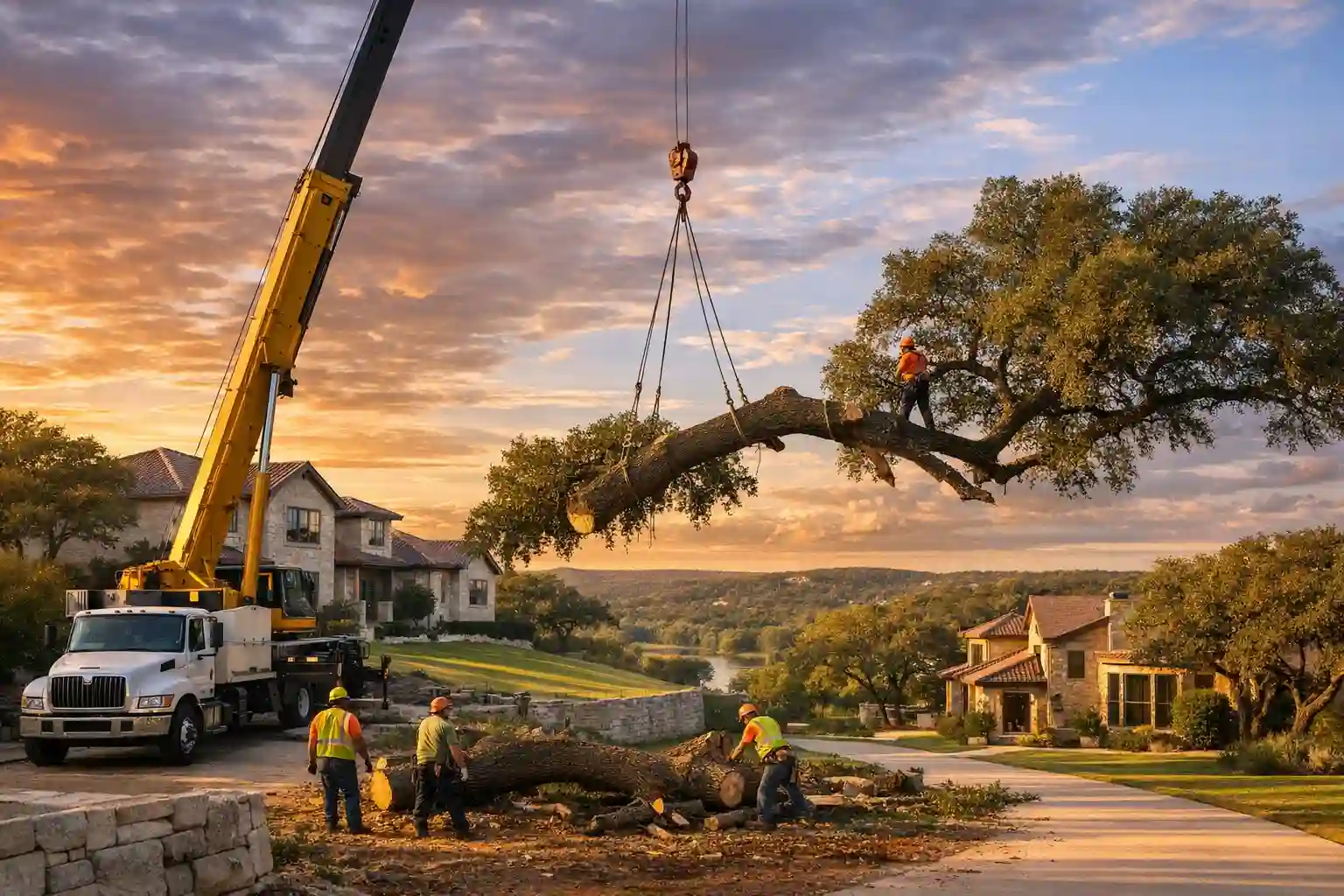
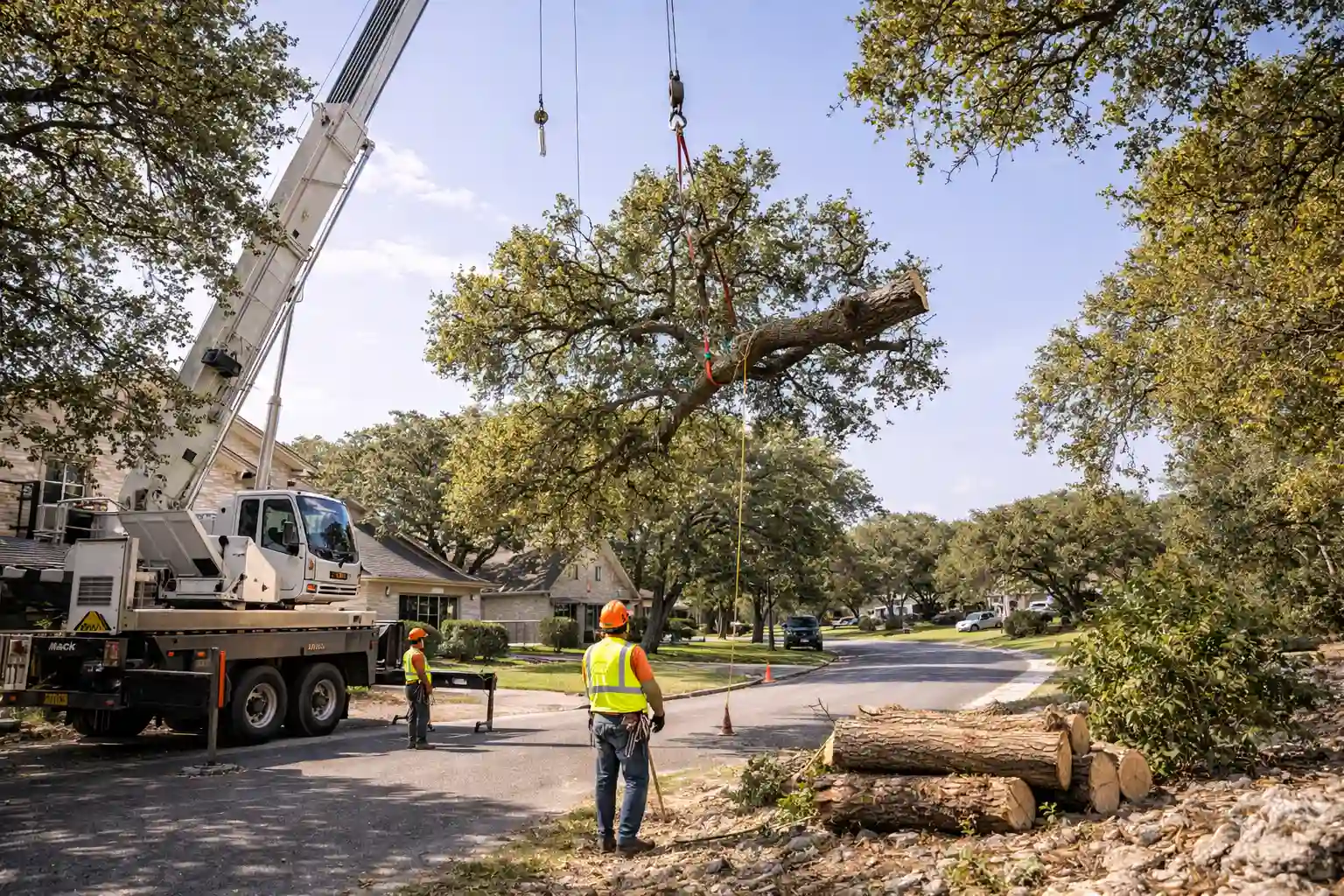
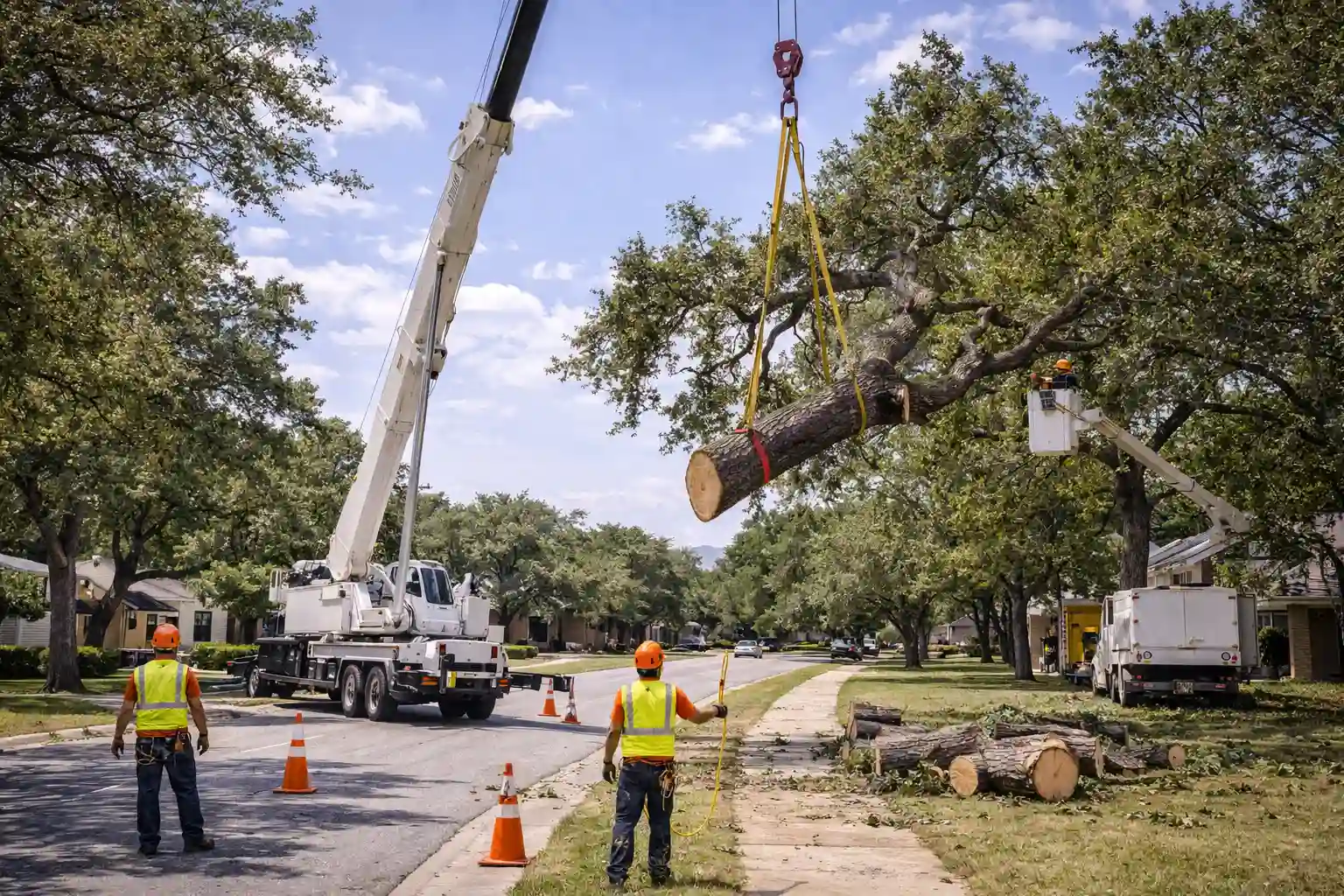
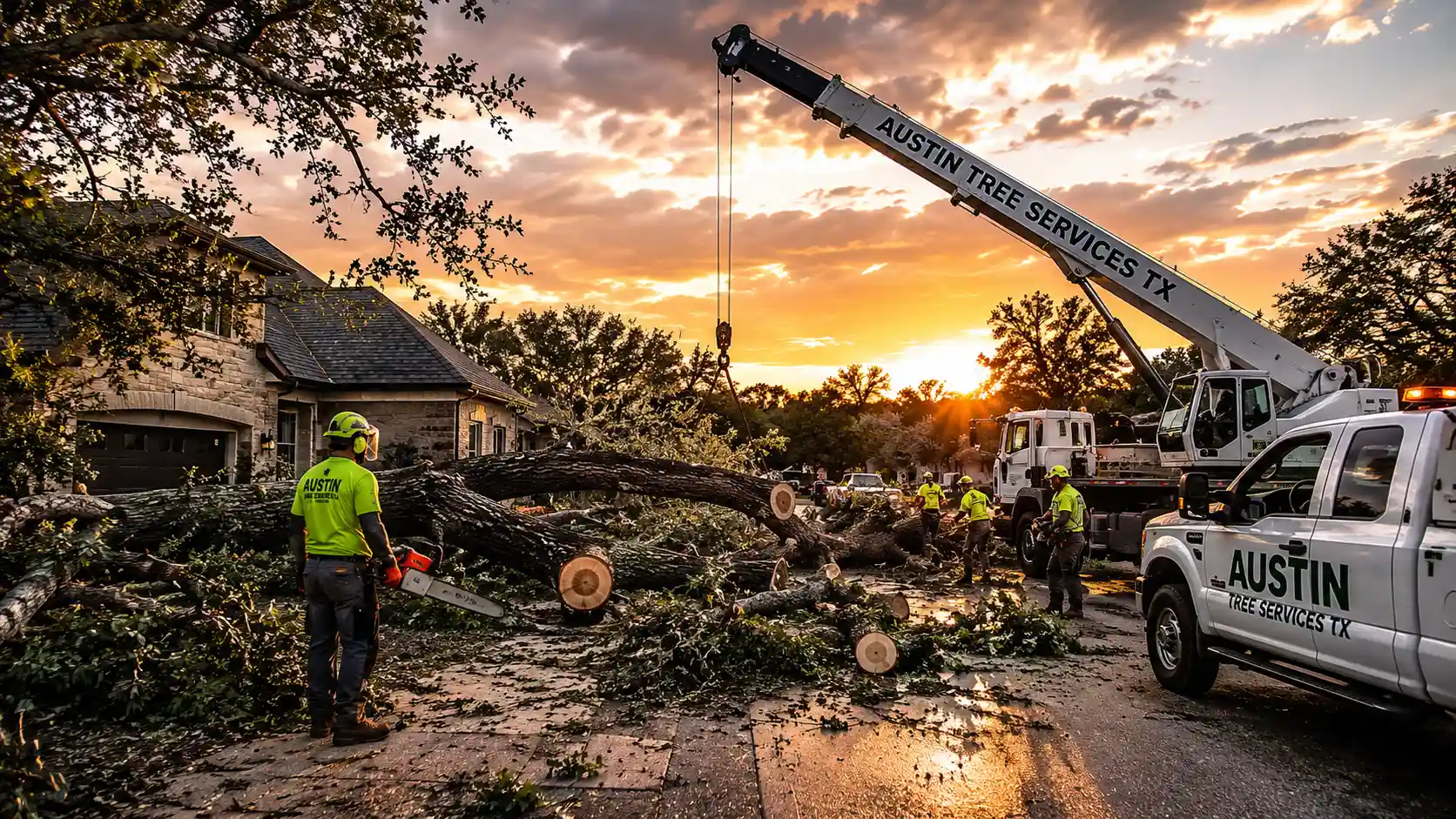
Tree Removal Crews In Action
What Equipment Is Used for Tree Removal?
Tree removal uses chainsaws, pole saws, climbing ropes, harnesses, rigging blocks, bucket trucks, wood chippers, stump grinders, and cranes. The specific equipment depends on tree height, trunk diameter, site access, and proximity to buildings or power lines.
| Equipment | Function | When It's Used |
|---|---|---|
| Chainsaw | Cuts branches, sections trunks, makes felling notches | Every tree removal job |
| Pole saw | Reaches high branches from the ground | Smaller removals, initial clearance |
| Climbing rope and harness | Allows arborist to ascend and work in the canopy | Sectional dismantling, tight access |
| Rigging blocks and lines | Lower cut sections safely to the ground | Near structures, power lines, or fragile landscape |
| Bucket truck | Elevates the operator to canopy height | Roadside trees, commercial sites, accessible yards |
| Wood chipper | Converts branches into mulch for hauling | Debris processing on-site |
| Crane | Lifts large trunk sections over buildings | Large trees in confined sites |
| Stump grinder | Grinds the stump 6–12 inches below grade | Companion service after removal |
What Are the Different Types of Tree Removal?
There are five main types of tree removal: standard removal, sectional dismantling, crane-assisted removal, emergency removal, and large-tree removal. Each type corresponds to the tree's size, site conditions, and urgency of the job.
Standard Tree Removal
The tree is felled whole with a directional notch cut. Used on open properties where the drop zone is clear. Most common for small to medium trees under 40 feet tall.
Sectional Dismantling
The tree is removed piece by piece from the top down. Used on urban Austin properties where buildings, fences, or landscaping make whole-tree felling impossible. The standard method for most residential jobs.
Crane-Assisted Removal
A crane lifts cut sections over structures to a staging area. Used for very large trees, trees leaning over houses, or dead trees where climbing is unsafe. Costs more but completes the job in fewer hours.
Emergency Tree Removal
Performed when a tree has fallen, is about to fall, or has caused structural damage. Scheduled same-day or within hours. See our emergency tree removal service for storm response and hazard trees.
Large-Tree Removal
Trees over 60 feet tall or with trunk diameter over 30 inches. Requires crane assistance, specialized rigging, and a larger crew. Common for mature live oaks and pecans in older Austin neighborhoods.
How Much Does Tree Removal Cost?
Tree removal costs in Austin range from $350 to $2,500 for most residential jobs, with an average cost of $750 to $1,500. Small trees under 30 feet cost $350–$700, medium trees 30–60 feet cost $700–$1,500, and large trees over 60 feet cost $1,500–$3,500 or more depending on complexity.
| Tree Size | Height Range | Typical Cost Range |
|---|---|---|
| Small | Under 30 feet | $350 – $700 |
| Medium | 30 – 60 feet | $700 – $1,500 |
| Large | 60 – 80 feet | $1,500 – $2,500 |
| Very large | Over 80 feet | $2,500 – $3,500+ |
| Emergency / crane-assisted | Any size | +30% to +50% premium |
| Stump grinding (add-on) | — | $75 – $400 per stump |
What Factors Change the Price?
Eight factors affect tree removal cost: tree height, trunk diameter, tree species, location on the property, proximity to structures, health of the tree, accessibility for equipment, and whether stump grinding or hauling is included. Emergency removals cost 30–50 percent more than scheduled jobs.
- Tree height — taller trees require more time, rigging, and sometimes crane assistance.
- Trunk diameter — wider trunks take longer to cut and generate more debris.
- Species — hardwoods like live oak and pecan are denser and slower to cut than softwoods like hackberry.
- Location — backyard trees cost more than front yard trees due to access.
- Proximity to structures — trees near houses, fences, or power lines require sectional dismantling and rigging.
- Tree health — dead or decayed trees are more dangerous to climb and cost more to remove safely.
- Accessibility — narrow gates, sloped yards, or limited street access add labor time.
- Stump and debris handling — stump grinding and hauling debris are optional line items.
For a detailed cost breakdown and the variables that change your final quote, read tree removal cost — what homeowners should expect.
How Long Does Tree Removal Take?
Tree removal takes between 2 and 8 hours for most residential trees. Small trees under 30 feet take 2–3 hours, medium trees take 4–6 hours, and large trees over 60 feet take 6–8 hours or span two days. Crane-assisted removals can compress large-tree jobs into 3–5 hours.
The total duration depends on five variables: crew size, equipment used, debris volume, site access, and whether stump grinding is included. A two-person crew with a bucket truck typically completes a medium tree removal in one working day, including cleanup.
Is Tree Removal Dangerous?
Tree removal is a high-risk activity classified by the U.S. Bureau of Labor Statistics as one of the most dangerous occupations. Risks include falling from height, being struck by cut branches, chainsaw injuries, electrocution from power lines, and structural collapse of decayed trees. Certified arborists use safety protocols, PPE, and rigging systems to control these risks.
Homeowners should never attempt removal of trees taller than 15 feet, trees near power lines, leaning trees, or trees with visible decay. A falling tree section can weigh hundreds of pounds, and misjudged cuts kill or injure dozens of DIY attempts every year in the United States. Austin Tree Services Tx carries full liability insurance and workers' compensation, which protects the property owner from liability in the event of an accident.
Do You Need a Permit for Tree Removal?
In Austin, tree removal requires a permit when the tree is a Protected Size Tree (19 inches or greater in diameter at 4.5 feet above ground) or a Heritage Tree (24 inches or greater, of a protected species). Smaller trees on private residential property generally do not require a permit, but homeowners should verify with the City of Austin Development Services Department before removal.
Austin's Tree Preservation Ordinance protects mature trees, especially native species like live oak, cedar elm, pecan, bald cypress, American elm, Arizona walnut, bigtooth maple, Eastern black walnut, and Texas ash. A Heritage Tree removal requires justification such as disease, hazard, or construction necessity. Austin Tree Services Tx helps property owners navigate the permit process and submits documentation on behalf of clients when required.
What Happens to the Stump After Tree Removal?
After tree removal, the stump is left at ground level unless stump grinding or stump removal is scheduled as an add-on. Stump grinding chips the stump 6–12 inches below grade using a rotating cutting wheel. Stump removal extracts the entire stump and root ball, leaving a larger hole that requires backfill.
Property owners typically choose between three stump outcomes:
- Leave the stump — lowest cost, but the stump attracts termites, becomes a trip hazard, and sprouts new shoots.
- Stump grinding — moderate cost, restores usable surface for lawn or landscaping. See stump grinding service.
- Full stump removal — highest cost, eliminates root ball and prepares the site for building or deep planting. See stump removal service.
For guidance on restoring the area after removal, read 7 steps to grow grass faster after tree removal.
Can You Remove a Tree Yourself?
Homeowners can remove small trees under 15 feet tall with a clear fall zone and no overhead obstructions. Trees taller than 15 feet, trees near structures, trees near power lines, and trees with visible decay should always be removed by a certified arborist. DIY removal of larger trees causes most of the preventable property damage and injuries in the industry.
Three conditions make DIY tree removal acceptable: the tree is under 15 feet tall, the drop zone is at least twice the tree's height and clear of structures, and the trunk shows no signs of decay or instability. All other removals require professional equipment and insurance.
How Do You Choose a Tree Removal Company?
Choose a tree removal company that holds ISA arborist certification, carries liability insurance and workers' compensation, provides written estimates, has verifiable local reviews, and uses proper safety equipment. Avoid companies that demand full payment upfront, lack proof of insurance, or offer unusually low quotes without a site inspection.
Seven Criteria for a Qualified Tree Removal Company
- ISA Certified Arborist on staff — the International Society of Arboriculture certification confirms training and ethics.
- General liability insurance — minimum $1 million coverage protects your property.
- Workers' compensation insurance — protects you from liability if a crew member is injured.
- Written estimates — line-item pricing for felling, debris removal, stump handling, and permits.
- Local reviews — verifiable Google, Yelp, or BBB ratings with recent Austin-area jobs.
- Proper safety equipment — helmets, chainsaw chaps, harnesses, and rigging gear on every crew.
- Clear contract — scope, timeline, cleanup terms, and payment schedule in writing.
Avoid the common mistakes explained in is cheap tree service worth the risk.
What Tree Species Most Often Need Removal in Central Texas?
The tree species most often removed in Central Texas are live oak (due to oak wilt), cedar elm (storm breakage), post oak (root disturbance from construction), hackberry (short lifespan and weak wood), Arizona ash (decay), and mesquite (invasive root systems). Each species has distinct removal considerations based on wood density, root structure, and disease susceptibility.
| Species | Common Removal Reason | Removal Difficulty |
|---|---|---|
| Live oak | Oak wilt, structural decline | High — dense wood, heritage tree status |
| Cedar elm | Storm damage, crown breakage | Medium — brittle branches |
| Post oak | Construction root damage | High — sensitive to root disturbance |
| Pecan | Disease, old age, storm loss | High — large spreading canopy |
| Hackberry | Weak wood, short lifespan | Low — soft wood, easy to cut |
| Arizona ash | Trunk decay, borer infestation | Medium — hollow trunks common |
| Mesquite | Invasive growth, thorns | Medium — dense but smaller |
| Texas ash | Disease, storm damage | Medium |
For a full list of species and when to plant them, see our guide on the 9 best tree species to plant in Texas and native Texas trees that require regular trimming.
Tree Removal Service Areas
Austin Tree Services Tx provides tree removal across Austin, Texas, and 13 surrounding cities in the Central Texas metro area. Each location has dedicated local service, regional pricing, and familiarity with neighborhood tree species, HOA requirements, and municipal permitting.
Related Tree Services
Tree removal is one service in a broader category of arboricultural services offered by Austin Tree Services Tx. Related services include tree trimming, stump grinding, stump removal, emergency tree removal, tree cabling and bracing, and arborist consultations. Many tree removal jobs are scheduled alongside one or more of these services.
Get A Free On-Site Assessment
Austin Tree Services Tx provides tree removal across Austin, Texas, and the surrounding Central Texas region. Every job includes a free on-site assessment, written estimate, ISA-certified arborist supervision, and full liability and workers' compensation insurance coverage. Call us to schedule tree removal service. The team responds to emergency removals within hours and schedules standard removals within days. Free quotes are provided on-site after a visual inspection of the tree and property.
Call (512) 729-9018Frequently Asked Questions About Tree Removal
A small deposit of 10 to 50 percent of the total cost is standard practice for scheduled tree removal, especially for large jobs requiring crane rental or specialty equipment. Never pay the full amount upfront, and never pay in cash without a signed written contract. A contractor demanding 100 percent prepayment or cash-only payment is a red flag for tree removal scams, which increase sharply after storms in the Austin area.
Homeowners insurance covers tree removal when a tree falls on a covered structure such as a house, garage, shed, or fence due to wind, storm, hail, or other covered peril. Insurance typically pays between 500 and 1,500 dollars toward removal of the fallen tree. Removal of a standing healthy tree, a tree that has not caused structural damage, or a tree removed for landscaping reasons is not covered by standard homeowners policies.
When a neighbor's tree falls on your property in Texas due to a storm or natural event, your own homeowners insurance handles the damage claim and the removal cost. Liability shifts to the neighbor only when the tree was visibly dead, diseased, or hazardous and the neighbor was notified in writing and failed to act. Document any questionable tree on a neighboring property with photos and a dated letter to preserve a negligence claim.
The best time to remove or prune oak trees in Austin is July through January, according to the City of Austin Urban Forest Program. Oak trees cut between February and June are at elevated risk of oak wilt infection, because the nitidulid beetles that carry oak wilt fungal spores are most active in those months. Emergency removals of hazardous oaks are performed year-round with immediate wound sealing to reduce infection risk.
Most Austin-area HOAs require written approval before removing trees in front yards, corner lots, or trees visible from the street. Submit a removal request to the HOA architectural committee at least two weeks before the scheduled job, include photos of the tree, and keep the approval letter on file. HOAs in neighborhoods like Circle C, Steiner Ranch, Avery Ranch, and Lakeway commonly protect mature trees above a specified trunk diameter and may require a replacement planting.
Property owners choose between four wood disposal options: keep the wood cut into firewood lengths stacked on-site, have the crew haul it away as part of the job, donate it to a local wood reclamation or Habitat for Humanity program, or request it chipped into mulch for landscape use. Mesquite, pecan, and oak produce premium firewood that burns clean and hot. Hackberry, Arizona ash, and chinaberry burn poorly and are usually hauled away as debris.
Professional tree removal minimizes property damage through plywood ground protection, rigging lines that lower branches instead of dropping them, and crane assistance for trees over sensitive landscape features. Light turf impressions from equipment tires recover within 4 to 6 weeks. Severe damage to lawns, sprinkler heads, pavers, fences, or buildings is covered by the contractor's general liability insurance, which is why hiring an uninsured pickup-truck operator transfers all damage liability to the homeowner.
Wait 12 months after stump grinding before planting a new tree in the exact same location. The ground needs time to settle, residual wood chips need to decompose, and soil nitrogen levels need to rebalance. For faster replanting, choose a location at least 6 feet away from the original stump, or excavate the chip-filled cavity and backfill with fresh topsoil mixed with compost.
Most Austin tree removal companies offer 10 to 20 percent discounts when two or more trees are removed in the same visit. The savings come from shared equipment setup, consolidated debris hauling, and reduced mobilization time. Austin Tree Services Tx provides combined quotes for multi-tree removals at no charge and applies the volume discount automatically on qualifying jobs.
Tree removal generates chainsaw and wood chipper noise between 90 and 110 decibels, comparable to a lawn mower or motorcycle at close range. Austin's noise ordinance allows construction-level work between 7:00 AM and 10:00 PM on weekdays and 8:00 AM and 10:00 PM on weekends and holidays. Notifying neighbors one day in advance prevents most complaints and courtesy calls to 311.
Tree felling is the specific act of cutting down a tree so it falls to the ground in one piece with a directional notch cut. Tree removal is the complete service that includes felling or sectional dismantling, branch processing, debris hauling, and site cleanup. Felling is one stage within the full removal process. A removal job is not complete until the work area is raked and cleared.
Pickup-truck tree services typically lack general liability insurance, workers' compensation insurance, ISA arborist certification, a business license, and a verifiable local address. They often solicit door-to-door after storms, demand cash upfront, decline to show a certificate of insurance, provide no written contract, and disappear before warranty issues arise. Request a certificate of insurance naming you as a certificate holder, and verify the company's license with the Texas Department of Licensing and Regulation before hiring. See the full breakdown in is cheap tree service worth the risk.
Homeowners can keep all wood from a tree removal at no extra charge. Request firewood-length cuts of 16 to 18 inches in writing before the job begins, and specify a stacking location accessible to the crew. Green wood from Austin removals requires 6 to 12 months of seasoning before burning cleanly in a fireplace. Live oak seasons slowest but burns longest; mesquite seasons in 4 to 6 months and produces the hottest burn.
Removing a mature, healthy shade tree in Austin can reduce residential property value by 1 to 3 percent, because mature trees add documented curb appeal and reduce summer cooling costs. Removing a dead, diseased, or hazardous tree increases property value by eliminating a known liability and preventing buyer-inspection concerns during resale. A replacement planting of a native Texas species such as live oak, cedar elm, or bur oak restores value over 7 to 10 years.