
Tree Service in Liberty Hill, TX
Removal, trimming, stump grinding, cabling, and arborist care for Liberty Hill's live oaks, cedar elm, and Ashe juniper — filed and performed to City Code §6.07 tree preservation standards.
Austin Tree Services TX provides tree removal, trimming, stump grinding, cabling, and arborist care throughout Liberty Hill, TX and its extraterritorial jurisdiction (ETJ), including Santa Rita Ranch, Orchard Ridge, Stonewall Ranch, and Butler Farms. Liberty Hill's tree ordinance (City Code §6.07) protects trees 8 inches or larger in trunk diameter — our crews handle the City permit filing and mitigation paperwork whenever a removal requires it.
What Makes Liberty Hill's Trees Different?
Liberty Hill sits on the western edge of Williamson County, on the Balcones Escarpment, where Blackland Prairie clay grades into Edwards Plateau limestone. That transition — not just a general "Hill Country" label — determines which species survive here and what removal or root work costs.
What Happens When You Request Tree Service in Liberty Hill?
Every job starts with a free on-site evaluation. If a tree is protected under City Code, permit filing happens before any cutting begins.
Free On-Site Evaluation
An arborist inspects the tree and measures trunk diameter at 4.5 feet above grade — the same method the City of Liberty Hill uses to determine protected-tree status.
Ordinance Check
Trees 8 inches or larger in diameter, or heritage-sized, require written approval from the Director of Planning before removal. We file the application; the City reviews it within 10 working days.
Permitted Work
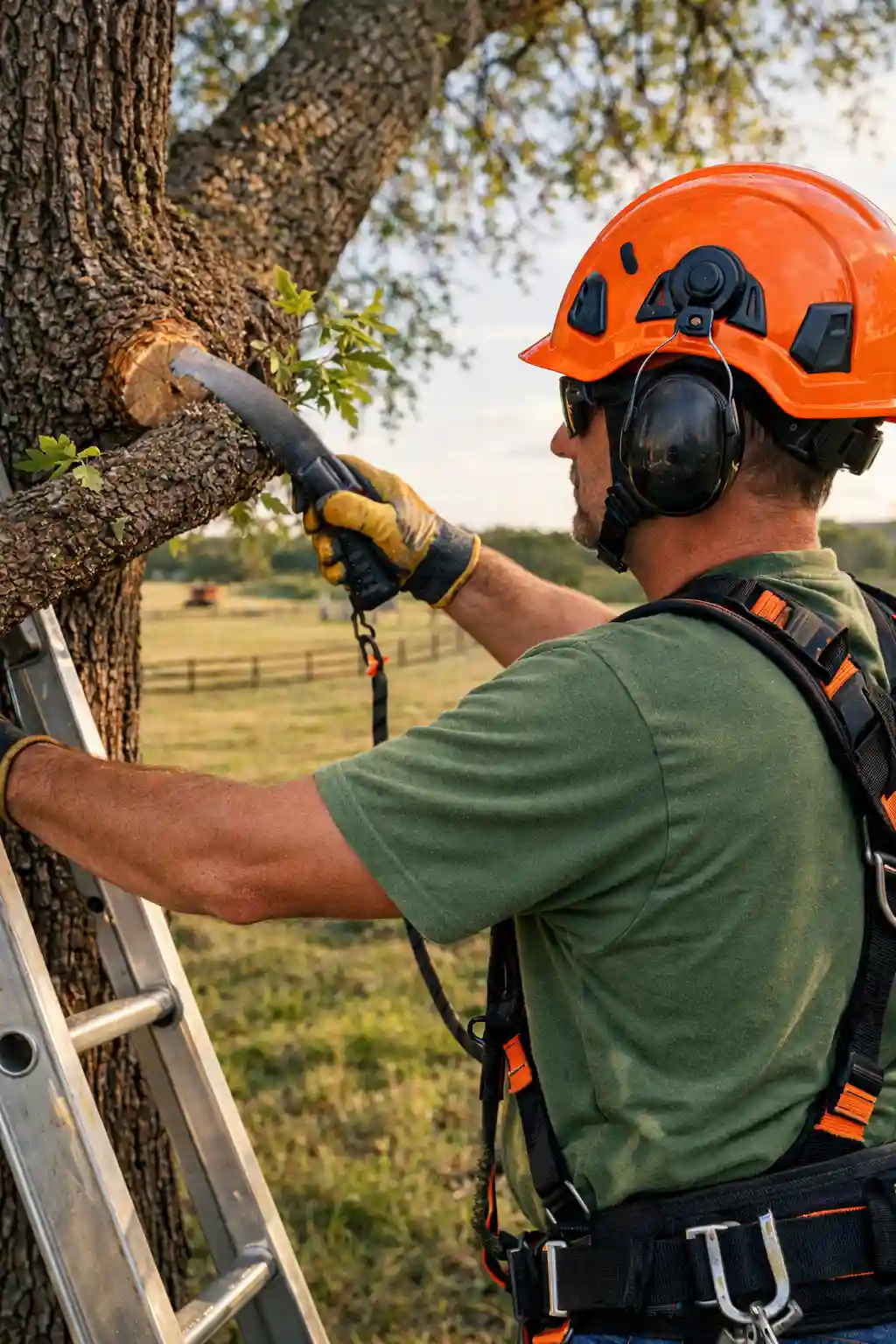
ISA-certified crews complete the removal, trimming, or stump grinding, following ANSI A300 pruning standards as required for protected trees.
Site Cleanup
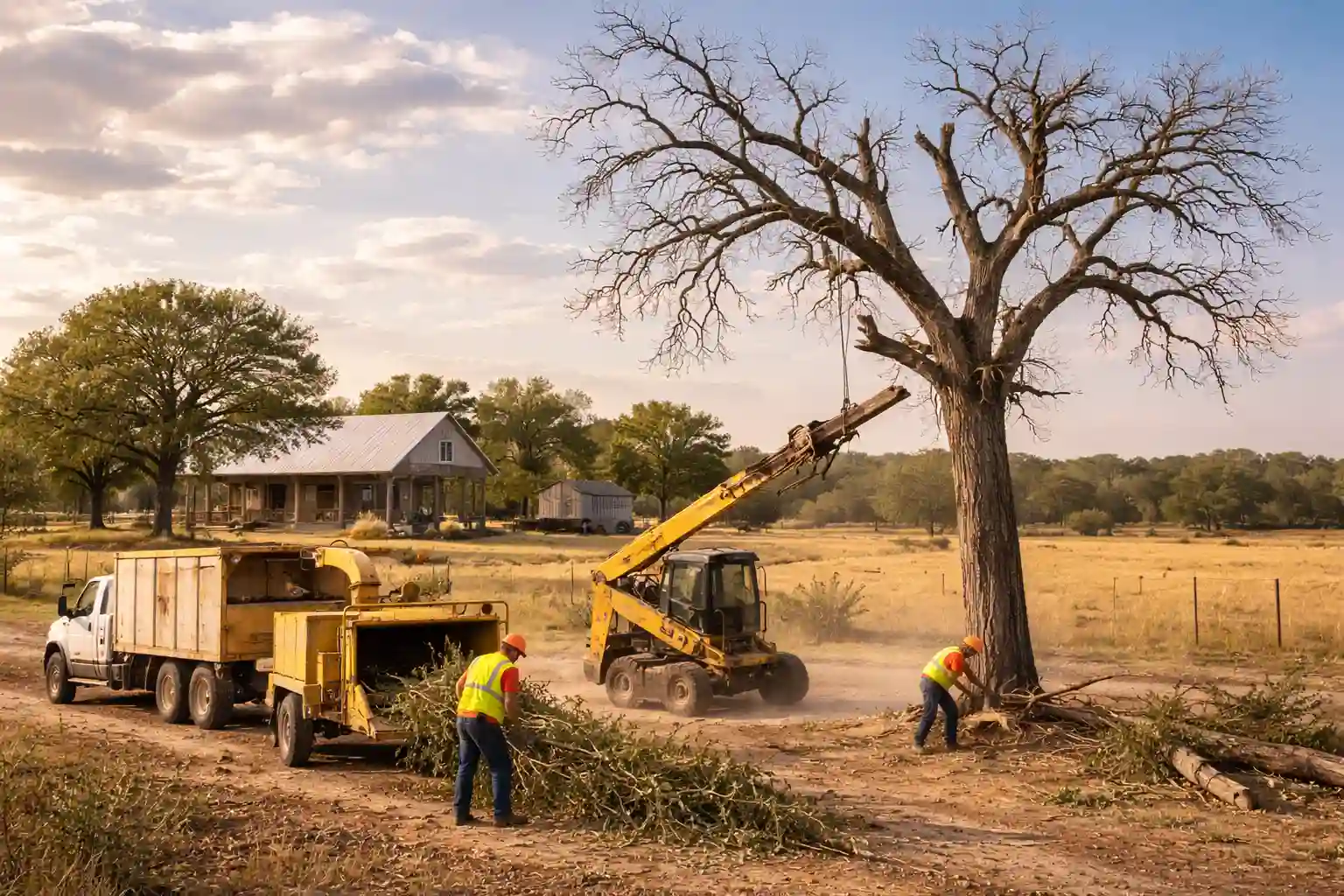
Branches, debris, and ground stump material are hauled off the same day.
Mitigation Filing
For approved removals of protected trees, we submit the replacement planting plan or tree-fund payment within the City's 30-day window.
Tree Services Available in Liberty Hill, TX
Why Choose Austin Tree Services TX in Liberty Hill?
Protected-tree pruning in Liberty Hill legally requires an ISA Certified Arborist under City Code §6.07.01(c)(2)(E) — our crews meet that standard on every job, not only the ones the City checks.
- General liability and workers' compensation coverage carried on every job. [INSERT: insurance carrier + policy details]
- [INSERT: years] serving Williamson County and the Liberty Hill ETJ.
- Equipment sized for acreage access — bucket trucks, stump grinders, and chippers suited to rural driveways and gated properties.
What Does Liberty Hill's Tree Ordinance Require?
Liberty Hill protects trees 8 inches or larger in trunk diameter under Chapter 6.00 of its Unified Development Code. Removing one without written approval from the Director of Planning is a Class C misdemeanor carrying a $1,000 civil penalty per tree. The rule applies inside the city limits and the extraterritorial jurisdiction (ETJ).
Which trees are protected?
Any tree 8 inches or more in diameter, measured 4.5 feet above ground — except Hackberry, Chinaberry, Chinese Tallow, Osage-orange, Ashe juniper ("Texas Common Cedar"), and Honey Mesquite, which are exempt regardless of size.
Which trees are designated heritage trees?
Any hardwood 26 inches or larger in trunk diameter, or these species at a smaller size:
| Species | Trunk Diameter |
|---|---|
| Cedar Elm | 25 in. |
| Post Oak | 24 in. |
| Shumard Oak / Texas Red Oak | 21 in. |
| Italian Stone Pine | 20 in. |
| Magnolia | 14 in. |
What does removal mitigation cost?
If the City approves removal of a protected tree, replacement planting is required on-site, or as a fee paid into the City's tree fund:
| Diameter Removed | Replacement Ratio | Fee Per Inch |
|---|---|---|
| 8 – 19.9 in. | 1:1 | $150 |
| 20 – 25.9 in. | 2:1 | $300 |
| 26 in.+ or Heritage | 3:1 | $450 |
Example: removing a 12-inch protected tree requires 12 inches of replacement planting, or a $1,800 fee (12 × $150).
What are the oak wilt rules?
City code requires cutting equipment to be sterilized with a 9-parts-water-to-1-part-bleach solution after every tree, and recommends pruning live oaks and red oaks only between October and January. All protected-tree pruning must be performed by an ISA Certified Arborist following ANSI A300 standards.
Do HOA or PID rules add anything beyond City Code?
Many of Liberty Hill's newest neighborhoods sit inside Public Improvement Districts — including Summerlyn West, Liberty Parke, and Butler Farms — which can carry separate landscape and tree covenants layered on top of City Code §6.07. A tree below the City's 8-inch protected threshold can still be restricted by an HOA or PID architectural committee. Check those documents before removal, in addition to the City permit process above.
Do drought watering restrictions affect new trees?
Liberty Hill's Water Conservation Plan (Ordinance 2023-O-037) sets mandatory irrigation stages during drought, and Section 6.06.16(D) of the Code requires new landscaping to comply with whatever stage is active. Newly planted or freshly fertilized trees need consistent watering to establish — confirm the current restriction stage with the City before scheduling tree planting or deep root fertilization.
Which Trees Grow Best in Liberty Hill's Soil?
The city's preferred tree list favors species tolerant of shallow, alkaline, limestone-based soil. Live oak and cedar elm dominate established neighborhoods; post oak is common on undisturbed acreage and is sensitive to root compaction from nearby construction.
| Species | Mature Height | Water Need | Oak Wilt Risk |
|---|---|---|---|
| Live Oak | 40–50 ft | Low–moderate | High |
| Cedar Elm | 50–70 ft | Low | Low |
| Shumard / Texas Red Oak | 40–60 ft | Moderate | High |
| Post Oak | 40–50 ft | Low | Moderate |
| Ashe Juniper ("cedar") | 15–30 ft | Very low | None |
| Texas Mountain Laurel | 15–25 ft | Low | None |
Who Handles Tree Clearance Near Power Lines in Liberty Hill?
Pedernales Electric Cooperative (PEC) — not Austin Energy — provides electric service to Liberty Hill, with a local office at 10625 W Hwy 29. Vegetation clearance around primary lines follows PEC's right-of-way standards, which are separate from the City's tree ordinance. Limbs inside PEC's clearance zone typically need coordination with the co-op before trimming or removal near an energized line.
Our crews handle that coordination call directly when a job falls inside PEC's clearance zone.
How Much Does Tree Service Cost in Liberty Hill?
Rocky, shallow soil on the Hill Country side of town adds equipment time to removal and stump grinding jobs compared to flatter, clay-soil lots to the east. Ranges below reflect typical Central Texas markets — every quote starts with a free on-site evaluation.
| Service | Typical Range | Primary Cost Driver |
|---|---|---|
| Tree Trimming | $250–$1,200 | Height, canopy density, access |
| Tree Removal | $450–$3,500+ | Trunk diameter, proximity to structures |
| Stump Grinding | $125–$450 | Stump diameter, root depth |
| Emergency Removal | Scheduled rate + 25–50% | After-hours dispatch |
| Deep Root Fertilization | $150–$400 | Tree size, soil compaction |
| Cabling & Bracing | $300–$900 | Number of cables, tree height |
When Does a Tree in Liberty Hill Need Professional Attention?
- Leaf discoloration or sudden branch dieback on live oaks or red oaks — an early oak wilt symptom in Central Texas.
- Trunk diameter approaching 8 inches near a planned building pad, driveway, or fence line — this triggers Liberty Hill's protected-tree permit requirement before removal.
- Cracked or split trunks after high-wind events along the TX-29 corridor during spring storm season.
- Stump regrowth or fungal conks at the base of a cut tree, signaling an active root system.
- Limbs overhanging a roofline or power line on acreage lots in Santa Rita Ranch, Orchard Ridge, or Stonewall Ranch, where more of the original tree canopy was retained during development.
What Is Defensible Space on a Liberty Hill Acreage Property?
Texas A&M Forest Service's Firewise guidance recommends a minimum 30-foot defensible space around structures on wildland-adjacent properties. Ashe juniper carries the highest fuel load of any species common to Liberty Hill's undeveloped acreage, and should be thinned first.
- Remove dead cedar and brush within 30 feet of structures, propane tanks, and fence lines.
- Thin live oak and cedar elm canopies so crowns don't touch within the defensible zone.
- Clear leaf litter and juniper duff from gutters and under decks before summer fire season.
Tree Service Projects in Liberty Hill, TX

Liberty Hill Tree Service Questions
Typical Central Texas removals run $450 to $3,500 or more, based on trunk diameter, proximity to structures, and site access. Acreage properties with tight gate access or sloped terrain add cost. A free on-site evaluation is required for an exact quote.
Only if it's a "protected tree" under City Code §6.07 — 8 inches or more in diameter, or a designated heritage species and size. Written approval from the Director of Planning is required before removal; unpermitted removal carries a $1,000 civil penalty per tree.
Yes. The tree preservation and site development standards in Chapter 6.00 of the Liberty Hill Code apply both inside the city limits and within the city's extraterritorial jurisdiction (ETJ).
City code recommends pruning live oaks and red oaks between October and January, and requires cutting equipment to be sterilized with a 9-to-1 water-to-bleach solution between trees to limit oak wilt transmission.
The property owner must fund treatment to restore the tree's health, or, if it's no longer viable, replant at twice the standard mitigation ratio and pay a $1,000 civil penalty per tree, under City Code §6.07.01(c)(8).
Emergency crews are dispatched to Liberty Hill and surrounding Hill Country communities 24/7. Typical response for hazardous limbs or a blocked driveway is same-day.
Yes. Live oaks and red oaks across Williamson County face documented oak wilt pressure. City Code requires equipment sterilization between cuts and limits live oak and red oak pruning to October through January to reduce beetle-vectored transmission.
A protected tree damaged by a storm, tornado, flood, or other "act of God" that creates an immediate hazard can have the hazardous portion removed without a permit application, provided the owner documents the damage with photos for the Director of Planning.
Areas Near Liberty Hill We Serve
Crews serving Liberty Hill also cover neighboring Williamson County communities:
Also serving Burnet, Bertram, and Florence, TX.
Get a Liberty Hill Tree Service Quote
Removal, trimming, stump grinding, or ordinance-compliant permit filing — call for a free evaluation.
(512) 729-9018