Tree Problems & Safety

Aged oak in afternoon light
Tree Problems & Safety

Tree Stress Symptoms Homeowners Often Miss

Tree failure is rarely sudden. In most cases, the tree has been communicating distress for months — sometimes years — through signals that are easy to dismiss as normal. This article covers the full picture of tree stress: what causes it, what it looks like at each stage, why Austin’s climate makes it worse, and how to determine whether your tree can still be saved. What Tree Stress Actually Means The word “stress” gets used loosely in tree care, so it’s worth being precise. Tree stress is not a disease, and it is not the same as a tree dying. It is a physiological state in which the tree’s internal systems — water transport, nutrient uptake, photosynthesis, and defense chemistry — are operating below the threshold needed to sustain healthy function. A tree under stress is not simply struggling. It is actively redirecting resources. It may shed leaves to reduce transpiration demand. It may stop investing in root expansion to focus energy on the canopy, or vice versa. These are adaptive responses — but they come at a cost. Each tradeoff weakens the tree’s long-term capacity to resist pests, disease, and structural failure. The critical concept here is cumulative stress loading. A single drought year might not kill a healthy live oak. But a drought year, followed by compacted soil from a driveway install, followed by an insect infestation — each event stacks. The tree that looked fine after year one may fail spectacularly in year three, and without understanding cumulative loading, homeowners are left confused about why “it seemed healthy until now.” Key distinction: A stressed tree is not always a dying tree. The difference is whether the stressor has been removed and whether the tree’s core systems — particularly the root system and vascular tissue — remain functional. That distinction determines the entire care pathway. Acute Stress vs. Chronic Stress — Why the Difference Matters Not all tree stress behaves the same way, and confusing the two types leads to the wrong interventions. Acute stress is caused by a sudden, identifiable event: a late spring freeze, a single severe drought, construction that severs a major root, or a lightning strike. The tree’s response is rapid and the cause is usually traceable. Chronic stress is subtler and far more dangerous. It builds gradually from persistent conditions: consistently poor soil drainage, long-term root zone compaction, repeated over-pruning, or the slow progression of a vascular disease. The tree does not show dramatic symptoms because it adapts incrementally — until it can no longer compensate. Why does this distinction matter practically? Because acute stress often allows for a clear intervention. Remove the stressor, provide supportive care, and the tree frequently recovers. Chronic stress, however, means the tree’s structural and physiological decline has been accumulating over a long period. By the time symptoms are visible, the tree may already be compromised at a level that makes recovery difficult. The diagnostic question to ask is not just “what does the tree look like right now?” but “what has this tree’s environment looked like over the past three to five years?” Soil changes, construction activity, recent drought history, and past pruning decisions all feed into the picture. Chronic stress rarely announces itself — it accumulates silently until a threshold is crossed. Why Austin Trees Face Compounding Stress Factors Austin’s climate creates a specific combination of stressors that most tree care guides — written for temperate climates with moderate summers — simply do not address. Understanding what makes this region different is essential for interpreting stress symptoms correctly. The Austin stress equation: Expansive clay soil + extreme summer heat + periodic drought + rapidly expanding suburban development = a stress environment unlike most of the United States. Trees here are not just dealing with one challenge at a time. Clay soil behavior is perhaps the most underappreciated factor. Austin’s black clay soil, common across much of the metro area and surrounding communities like Round Rock, Cedar Park, and Pflugerville, expands dramatically when wet and contracts and cracks when dry. This cycle physically disrupts root systems over time. It also leads to poor drainage — roots sit in waterlogged conditions after rain, then are suddenly deprived of moisture as the soil contracts and pulls away from root surfaces during dry spells. Summer heat intensity in the Austin area is a genuine physiological stressor. When air temperatures exceed 95–100°F for extended periods, trees close their stomata to conserve water — which also halts photosynthesis and gas exchange. A tree that spends weeks in mid-summer with closed stomata is burning through stored carbohydrates without replenishing them. The result can look like late-season drought stress even when irrigation is adequate. Development pressure is another compounding factor. In rapidly growing communities like Leander, Kyle, and Bee Cave, trees that were established in open land conditions suddenly find themselves in constrained root zones — surrounded by concrete, compacted by construction traffic, and competing with new impervious surfaces for water infiltration. What looks like stress from “unknown causes” is often the delayed response to site changes made years earlier. Finally, oak wilt remains an endemic threat throughout Central Texas. It behaves like a stress multiplier: trees already weakened by heat or drought are more vulnerable to infection through root grafts or fresh wounds, and the disease itself produces stress symptoms — wilting, off-color foliage, leaf drop — that can mask or overlap with environmental stress, complicating diagnosis. The Four Stages of Tree Stress Tree stress does not stay static — it progresses through identifiable stages. Understanding where a tree sits on this continuum determines both urgency and treatment options. Stage 1 Early / Compensating The tree is stressed but actively adapting. Symptoms are subtle. Recovery is highly achievable with stressor removal and supportive care. Stage 2 Moderate / Declining Visible canopy changes, early dieback, or bark abnormalities appear. Tree can still recover, but professional assessment is now needed. Stage 3 Severe / Structural Risk Internal decay, significant deadwood, or root compromise is
Tree felling in the neighbourhood
Tree Problems & Safety

Is Cheap Tree Service Worth the Risk?

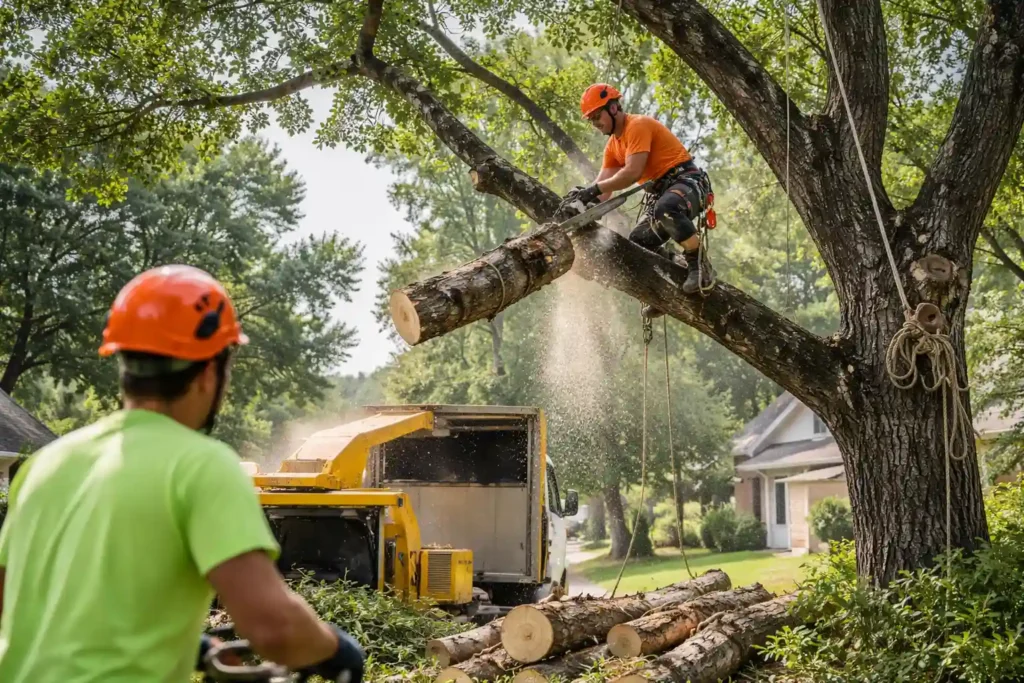
The lowest quote almost always wins. When three companies come out to look at a tree, most homeowners choose the one that charged the least — and most of the time, nothing bad happens. The tree gets cut, the debris gets hauled, and the job looks finished. But “looks finished” and “was done correctly” are two very different outcomes in tree work. What separates a $300 job from a $900 job on the same tree is rarely profit margin. It is insurance coverage, training, equipment, and the kind of knowledge that prevents a 60-foot oak from landing on your roof instead of the drop zone. Understanding what actually drives tree service pricing is the only way to make a decision you won’t regret when something goes wrong. This article covers exactly that — not in vague warnings, but in specific detail about what cheap tree services skip, what the real liability exposure looks like, and how to evaluate any quote before you sign off on it. What Actually Makes a Tree Service Quote “Cheap” Low pricing in tree care is almost always an arithmetic problem. Running a legitimate tree service in Austin costs real money: general liability insurance, workers’ compensation, ISA-certified arborist salaries, proper climbing gear, chainsaws, chippers, cranes for large removals, and vehicle maintenance. When a quote comes in 40–60% below the market rate, one or more of those line items has been removed from the equation. The most common things missing from cheap quotes: None of this means every lower-priced company is a scam. It means you need to know what the price includes before comparing numbers. A $700 quote that includes liability insurance, debris removal, and ISA-certified work is a better deal than a $400 quote that includes none of those things. The Specific Risks of Uninsured Tree Work in Texas Texas does not require tree service companies to be licensed at the state level. Anyone can legally pick up a chainsaw and offer tree removal services in Austin. This makes the insurance question more important here than it would be in states with stricter contractor licensing requirements. Here is what the risk exposure actually looks like: Scenario 1: A worker falls on your property. A crew member climbs your tree without proper harness technique and falls, breaking both legs. The company has no workers’ compensation. Under Texas law, a property owner can be held liable for injuries sustained on their premises. You are now managing a personal injury claim with no coverage. Scenario 2: A section of tree falls on a neighbor’s fence. The crew fails to use a rigging system and a heavy oak limb swings wide, crushing the fence next door. The company has no general liability. Your neighbor files a claim. Your homeowner’s insurance absorbs it — and your premiums increase. Scenario 3: A limb falls on your vehicle. A 300-pound section of a water oak drops on your car in the driveway. The company is unreachable. No insurance. You pay out of pocket for the vehicle damage and the corrective tree work. These are not rare outcomes. They happen regularly with unlicensed and underinsured operators, particularly after storm events when unqualified crews flood the market offering cheap emergency work. If you have ever dealt with emergency tree removal after a severe weather event, you know how quickly desperation can lead to poor hiring decisions. The verification step is simple: ask for a certificate of insurance naming you as an additional insured, and call the insurance company on the certificate to confirm the policy is active. A legitimate company will not hesitate to provide this. What ISA Certification Actually Means — and Why It Matters for Your Trees ISA certification is not a marketing badge. It is a credential that requires a tree care professional to demonstrate knowledge of tree biology, diagnosis, risk assessment, pruning standards, and safe work practices. ISA Certified Arborists are also required to complete ongoing education to maintain their certification. Why does this matter for a homeowner hiring tree work? Because trees are living systems. A cut made in the wrong place does not just look bad — it creates a wound that the tree cannot compartmentalize properly, opening an entry point for decay fungi, bacteria, and insects. In Central Texas, this is particularly consequential because of oak wilt — a lethal fungal disease spread through root grafts and sap-feeding beetles that enter fresh pruning wounds. The Texas A&M Forest Service recommends painting fresh oak cuts with wound sealant between February and July to reduce beetle transmission risk. An uncertified crew that has never heard of oak wilt will not follow this protocol. For a deeper look at what professional tree assessment looks like from a certified arborist’s perspective, see how arborists assess tree health. ISA certification also means familiarity with ANSI A300 pruning standards — the industry standard that defines correct cut placement, maximum removal percentages per visit, and appropriate pruning objectives. Work performed outside these standards can leave trees structurally compromised, aesthetically ruined, or physiologically stressed. This is especially relevant for large, established trees. A mature live oak that has been incorrectly topped — a practice condemned by ISA standards — may look “trimmed” but is actually now subject to rapid, weakly-attached regrowth, interior decay, and significantly reduced lifespan. The homeowner paid to damage their own tree. Tree Topping: The Most Visible Sign of Unprofessional Work Tree topping is the practice of removing large sections of the main trunk and major scaffold branches, leaving flat or stub cuts throughout the canopy. It is offered by cheap crews because it is fast, requires no rigging, and looks dramatic — customers feel they got “a lot done.” It is also one of the most harmful practices in arboriculture. What actually happens when a tree is topped: The irony is that homeowners often pay for topping because they believe it will make the tree safer near their house. In reality, a topped tree is more structurally dangerous than an

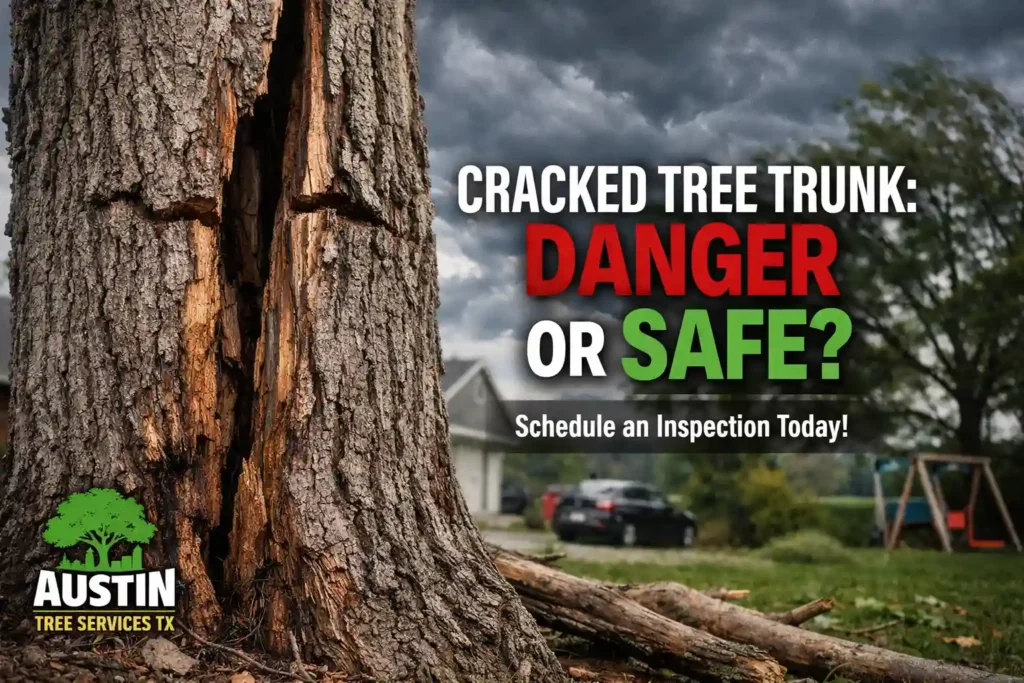
Cracked tree trunk danger or safe
Tree Problems & Safety

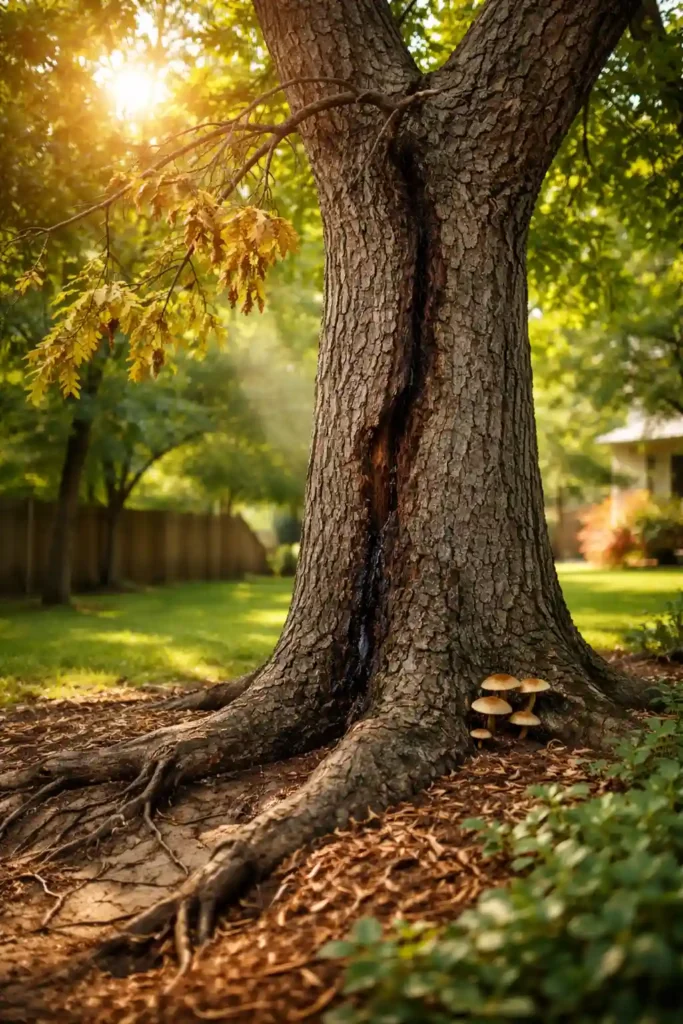
Cracked Tree Trunk: What It Means and What to Do

A crack in a tree trunk is not always a death sentence. But it is always a message — and what it says depends entirely on the type of crack, where it sits on the trunk, how deep it runs, and what the tree has been through. The problem is that most homeowners either panic and remove a tree that could have been saved, or they ignore a crack that was silently signaling structural failure. Both mistakes are costly. One costs you a healthy, mature tree. The other can cost you your roof. This guide covers the topic completely: the biology of how trunks crack, every major crack type and what each one actually means, the specific risk factors that turn a cosmetic issue into a hazard, the assessment process a qualified arborist uses, and the full range of responses from monitoring to removal. If you’ve noticed a crack in your tree and want a clear, grounded answer — not a vague “call a professional” deflection — this is it. Why Tree Trunks Crack: The Biology Behind the Damage To understand trunk cracks, you need to understand what a trunk actually does. A tree trunk is not a solid column of dead wood. It is a living system of layers, each with a distinct structural and biological role. The outermost layer is bark — protective, insulating, and largely inert structurally. Beneath it is the cambium, a thin layer of actively dividing cells responsible for the trunk’s radial growth. Inside the cambium is the sapwood (xylem), which carries water and nutrients upward from the roots. At the center is the heartwood — older, denser, and no longer biologically active, but critical to the trunk’s structural rigidity. Cracks form when stress exceeds the wood’s capacity to flex or absorb force. Wood is anisotropic — it behaves differently depending on direction. Along the grain, it is strong. Across the grain, it is far weaker. This is why horizontal cracks are almost always more dangerous than vertical ones: they fracture across the grain, severing the wood fibers responsible for bearing load. When we talk about a “cracked trunk,” we are talking about one of several failure modes, each with a different origin, anatomy, and risk profile. Lumping them together as “trunk cracks” is like calling every chest pain a heart attack — technically related, but diagnostically meaningless without more information. The CODIT Model: How Trees Respond to Cracks and Wounds Before evaluating any crack, it helps to understand how trees defend themselves. The CODIT model — Compartmentalization of Decay in Trees — describes the biological walls a tree builds to contain damage and prevent it from spreading. When a tree is wounded or cracked, it does not heal the way animal tissue does. It cannot regenerate damaged cells. Instead, it compartmentalizes — it chemically isolates the damaged zone and grows new wood around it. This is why you sometimes see a tree that appears to have “swallowed” an old wound or grown around a crack. That is compartmentalization in action. The CODIT model defines four walls of resistance. Wall 1 blocks upward and downward spread through vessels. Wall 2 resists inward spread toward the pith. Wall 3 limits lateral spread between growth rings. Wall 4 — the strongest — is the new wood grown after the injury, which creates a biological barrier between old and new tissue. Why does this matter for cracks? Because a tree’s ability to compartmentalize a crack determines whether the crack is a stable, contained wound or an active, expanding failure. Young, healthy trees with vigorous growth compartmentalize better. Old, stressed, or diseased trees may fail to contain the damage, allowing decay to advance deeper into the trunk. This is one reason why the same type of crack in two different trees can carry very different levels of risk. Types of Tree Trunk Cracks and What Each One Means Crack type is the single most important diagnostic variable. Each type has a different cause, a different structural implication, and a different management path. Frost Cracks (Radial Shakes) Frost cracks are among the most visually dramatic and most commonly misunderstood trunk cracks. They appear as long vertical splits, often running several feet up the trunk, and they typically develop on the south or southwest-facing side of the tree. The mechanism is thermal stress. During cold nights, the outer wood contracts rapidly while the inner wood remains warmer and relatively expanded. This differential contraction generates tension that can exceed the wood’s radial tensile strength, causing a sudden split — sometimes loud enough to hear as a sharp crack on a cold night. In Austin and the wider Central Texas region, frost cracks most often develop during freeze events, particularly the kind of rapid overnight temperature drops that occur in January and February. Live oaks, pecans, and red oaks are the species most commonly affected in this area. Frost cracks have a characteristic behavior: they tend to open during cold weather and partially close as temperatures warm. Over years, they may callus over at the edges and appear healed — only to reopen at the same location during subsequent freeze events. This repeated opening and closing is called a “riband” pattern and is a sign that the crack is chronic rather than acute. A frost crack that has callused over and remains stable across seasons poses a lower immediate risk than it looks. However, one that is actively widening, shows exposed interior wood, or is accompanied by decay warrants professional evaluation. Lightning Scars Lightning strikes produce a distinctive type of trunk damage that is often mistaken for a severe crack. The electrical current travels through the moisture in the sapwood, which can cause the wood to explode outward along a spiral or vertical path, stripping bark in a long, twisted channel down the trunk. The structural outcome of a lightning strike varies widely. Some trees absorb a strike with relatively limited damage; others lose large sections of bark and sapwood. The key

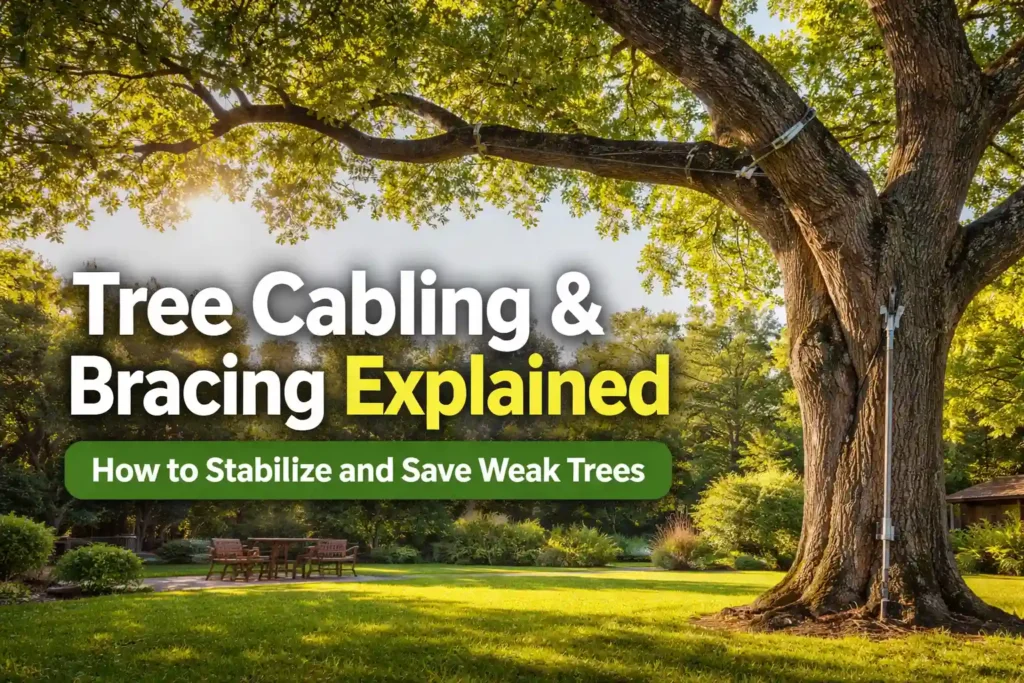
Tree cabling and bracing in action
Tree Problems & Safety

Tree Cabling and Bracing: How It Works and When It’s Needed

A large live oak in your yard develops a split between two co-dominant trunks. A heavy pecan limb has been creaking over your roof since last spring’s storms. A cedar elm with three crowded stems is leaning slightly more every season. Your instinct says removal. But a trained arborist looks at those same trees and sees something different — structural problems that, in many cases, can be corrected without cutting the tree down. That’s what tree cabling and bracing exist to do. These are engineered support systems installed directly into the tree’s structure — cables in the upper canopy, steel rods through compromised unions — designed to redistribute load, limit dangerous movement, and hold failing sections together long enough for the tree to remain safely in place. They don’t fix every problem. But when conditions are right, they’re the difference between keeping a 40-year-old shade tree and grinding its stump. This guide covers everything you need to understand before making that call: how each system works mechanically, what hardware is actually involved, which tree species in Central Texas benefit most, the full installation process, what it costs, and critically — when cabling and bracing will not save a tree and removal is the only safe option. What Tree Cabling Is — And What It Actually Does to the Tree Tree cabling is a supplemental support system installed in the upper canopy of a tree to limit the range of movement between limbs or co-dominant stems. The purpose is not to hold the tree completely rigid — trees need to flex and sway to dissipate wind energy. The purpose is to prevent specific limbs or stems from moving far enough apart to cause a structural failure. A cable installation transfers some of the mechanical load away from a weak union point and spreads it across a larger portion of the canopy structure. When wind pushes heavily on one side of the tree, the cable acts as a tether that limits how far that section can deflect before the stress concentrates dangerously at the attachment point. Without a cable, that stress accumulates entirely at the weakest spot — typically a tight V-shaped union or an area with included bark — until something gives. There are two main cable system types used by professional arborists today: Static Cabling Systems Static systems use high-strength steel cable — typically EHS (Extra High Strength) galvanized wire — installed with no built-in elasticity. Hardware consists of eye bolts or J-lag screws driven into the wood and secured with thimbles, cable clamps, or swaged fittings. These systems provide firm, reliable support at a defined length. They are the traditional standard and remain widely used because of their predictability and cost-effectiveness. The limitation is that they allow no dynamic adjustment — the cable holds at exactly the installed tension, which can create stress concentrations in certain growth patterns over time. Dynamic Cabling Systems Dynamic systems, such as the Cobra system and similar high-strength synthetic rope installations, use flexible materials that allow the tree to move within a larger range before the cable engages. Think of it as a progressive support: at low wind speeds, the tree moves freely. As deflection increases and reaches a threshold, the cable engages and limits further movement. This approach more closely mimics the natural way a tree would be supported by adjacent trees in a forest setting. Dynamic systems require no hardware driven through the wood, which reduces the risk of decay at installation points. They are more expensive than static systems and require specific training to install correctly. The right system depends on the tree’s species, structure, canopy weight, and the nature of the weakness. A mature live oak with one overloaded lateral limb may be well-served by a static cable. A younger multi-stemmed Texas ash with long-term growth considerations may benefit more from a dynamic installation. What Tree Bracing Is — And How It Differs From Cabling Bracing is a rigid reinforcement system applied directly to a crack, split, or weak union point in the tree’s wood. While cabling works at a distance — controlling canopy movement through tension — bracing works at the failure point itself, physically holding the structure together from within. The standard method involves drilling through both sides of a crack or weak union and installing a threaded steel rod with washers and nuts on the exterior. When tightened, the rod compresses the two sections together and prevents further separation. Multiple rods are often used on significant splits, installed in a pattern that distributes the holding force across the full depth and width of the affected area. Bracing is typically applied to: One important distinction: bracing is a corrective measure. It addresses damage that has already occurred or a weakness that is already structurally active. Cabling, by contrast, is primarily preventative — it’s installed to stop a failure from happening before it does. In practice, most professional installations use both systems together because they address different aspects of the same problem. Bracing closes the crack; cabling reduces the dynamic forces that caused the crack in the first place. Which Trees in Austin Typically Need Cabling or Bracing Central Texas has a distinct urban tree canopy, and not all species carry the same structural risk profile. Understanding which trees are most commonly candidates for support systems helps homeowners know what to watch for. Live Oak (Quercus fusiformis) The most common cabling candidate in Austin. Live oaks frequently develop multiple co-dominant stems from a young age, especially when grown in open landscapes without the natural competition that would encourage single-leader development. As they mature, these competing trunks create classic V-shaped unions with included bark — the #1 structural vulnerability in Austin’s tree canopy. A 30-year-old live oak with two trunks growing apart at the base is almost always a cabling conversation. The species is long-lived, highly valued, and worth preserving when structurally supported early. Pecan (Carya illinoinensis) Pecans grow large and fast, which means canopy weight can outpace structural

Damaged tree save or remove
Tree Problems & Safety

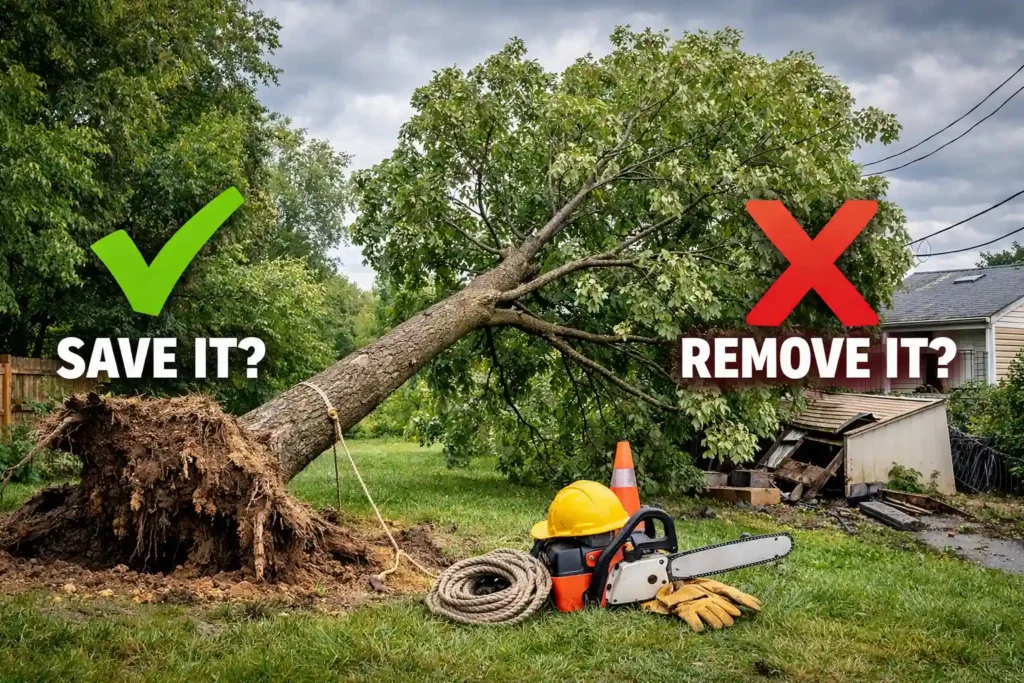
Can a Partially Fallen Tree Be Saved?

A partially fallen tree is not just a yard problem. It is a structural event — one that changes the physics of how a tree stands, how its roots hold, and how long it has before it comes down the rest of the way. The question of whether it can be saved is real and answerable, but it requires more than a quick look from the driveway. This guide covers the full picture: what actually determines survivability, how to read the signs yourself before a professional arrives, what arborists evaluate on-site, which intervention methods work and which ones fail, and when the only honest answer is removal. If you have a tree that has shifted, leaned, or started to uproot after a storm or on its own, this is the decision-making framework you need. What “Partially Fallen” Actually Means — and Why It’s Not One Thing The phrase “partially fallen tree” gets used to describe several very different situations, and the differences matter enormously for what comes next. Grouping them together leads to bad decisions. Here are the four distinct conditions that fall under this label: 1. The Leaning Tree That Was Always Straight This tree was vertical. Now it isn’t. Something changed — a storm, saturated soil, root disease — and the tree has shifted from its original position. The lean may be subtle (5–10 degrees) or pronounced (30+ degrees). The critical variable is whether the lean is new and sudden, or gradual over months or years. Sudden lean after a weather event is almost always a root failure event. Gradual lean over seasons may indicate structural growth adaptation, which is a different concern. 2. The Partially Uprooted Tree The root plate has lifted on one side. You can see soil mounding or cracking around the base, and possibly exposed roots. The tree may still be standing at an angle, held by the roots still embedded in the ground. This is one of the most urgent scenarios because the remaining anchor is under maximum tension and the center of gravity has shifted. Weather events or even a change in soil moisture can complete the fall. 3. The Tree Held Up by Another Structure The tree has fallen far enough to rest against a fence, a structure, another tree, or a power line. It is not standing on its own — it is leaning against something else. This is a false stability situation. The supporting structure is not designed for this load, and when it gives way — or when the leaning tree is moved — the full weight transfers suddenly. These trees are among the most dangerous to work around. 4. The Split-at-the-Crown or Major-Limb-Failure Tree The main trunk has not moved, but a major structural branch or co-dominant stem has split away and is hanging or resting at an angle. The root system may be completely intact. Whether this qualifies as “partially fallen” depends on the severity and location of the split, but it is a structural failure event regardless. Each of these scenarios calls for a different evaluation and a different response. Understanding which one you are dealing with is the first diagnostic step. The Biology Behind Whether a Tree Can Recover Trees do not heal the way animals do. They do not repair damaged tissue — they compartmentalize it and grow around it. This biological reality shapes everything about recovery potential for a partially fallen tree. When a tree is displaced, three biological systems are disrupted simultaneously: The Vascular System Trees move water and nutrients through two transport systems: the xylem (water and minerals upward from roots) and the phloem (sugars downward from the canopy). A tree that has been tilted or partially uprooted has these systems under mechanical stress. If roots are torn, the water supply to the canopy is reduced. If the trunk has internal cracks, vascular continuity is disrupted at the break point. A tree that cannot supply its canopy with adequate water begins to decline, and the rate of decline depends on how much of the vascular system remains intact. The Meristematic Growth Zones The cambium — the thin layer just beneath the bark — is where new wood and bark are produced. When a tree is partially fallen and the trunk is stressed, cracked, or compressed unevenly, the cambium can be damaged at the stress points. Without functional cambium, the tree cannot compartmentalize wounds or produce new wood to strengthen the damaged area. This is why trunk damage is often the deciding factor in salvageability. The Root Regeneration Capacity After root damage, the tree’s ability to regenerate fine feeder roots determines long-term recovery. Fine roots — the hair-like structures responsible for most water and nutrient absorption — can regenerate if the structural roots remain intact. But if the structural roots (the large, woody anchoring roots) are severed or torn, the tree loses both its anchor and its primary water-gathering infrastructure. In Austin’s clay soils, root regeneration is also affected by compaction, drainage patterns, and the season in which the damage occurred. Roots damaged during the Texas summer heat face far more recovery stress than roots damaged in fall or early spring. Recovery is possible when these three systems retain enough functional capacity to sustain the tree through stabilization and re-establishment. When they don’t, the tree’s decline is inevitable regardless of what support measures are applied above ground. The Five Factors That Determine Salvageability Professional arborists evaluate partially fallen trees against a set of interdependent variables. No single factor alone determines the outcome — it’s the combination that matters. Here is how each factor is assessed and what it means for the decision. Factor 1: Root System Integrity This is the primary variable. Everything else is secondary to what is happening below ground. Arborists look for the following during a root assessment of a partially fallen tree: If the root system is mostly intact — meaning the tree was displaced but not deeply uprooted — the path toward saving it remains

Scroll to Top