I’m David Miller, an arborist and the owner of Austin Tree Services Tx. I’ve spent years working hands-on with trees—removing hazardous ones, grinding stubborn stumps, and helping homeowners keep their landscapes safe and looking their best.

In this blog, I share what I’ve learned in the field—the kind of practical, no-nonsense advice you only get by getting your hands dirty. Whether you’re dealing with a risky tree or just planning ahead, I aim to give you straight answers you can rely on.

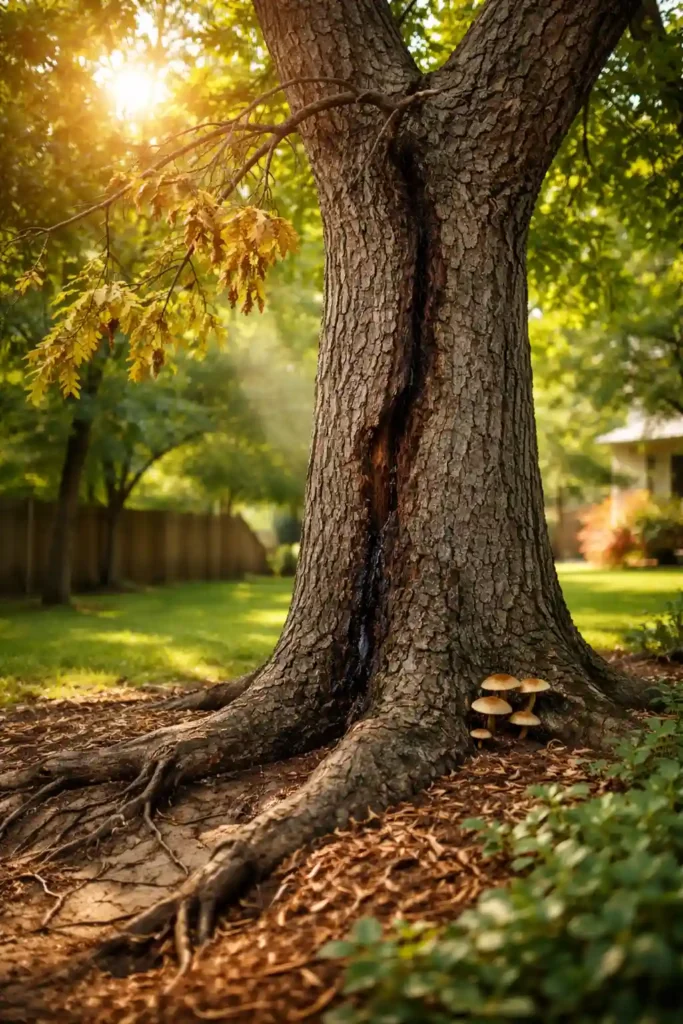
Aged oak in afternoon light
Tree Problems & Safety

Tree Stress Symptoms Homeowners Often Miss

Tree failure is rarely sudden. In most cases, the tree has been communicating distress for months — sometimes years — through signals that are easy to dismiss as normal. This article covers the full picture of tree stress: what causes it, what it looks like at each stage, why Austin’s climate makes it worse, and how to determine whether your tree can still be saved. What Tree Stress Actually Means The word “stress” gets used loosely in tree care, so it’s worth being precise. Tree stress is not a disease, and it is not the same as a tree dying. It is a physiological state in which the tree’s internal systems — water transport, nutrient uptake, photosynthesis, and defense chemistry — are operating below the threshold needed to sustain healthy function. A tree under stress is not simply struggling. It is actively redirecting resources. It may shed leaves to reduce transpiration demand. It may stop investing in root expansion to focus energy on the canopy, or vice versa. These are adaptive responses — but they come at a cost. Each tradeoff weakens the tree’s long-term capacity to resist pests, disease, and structural failure. The critical concept here is cumulative stress loading. A single drought year might not kill a healthy live oak. But a drought year, followed by compacted soil from a driveway install, followed by an insect infestation — each event stacks. The tree that looked fine after year one may fail spectacularly in year three, and without understanding cumulative loading, homeowners are left confused about why “it seemed healthy until now.” Key distinction: A stressed tree is not always a dying tree. The difference is whether the stressor has been removed and whether the tree’s core systems — particularly the root system and vascular tissue — remain functional. That distinction determines the entire care pathway. Acute Stress vs. Chronic Stress — Why the Difference Matters Not all tree stress behaves the same way, and confusing the two types leads to the wrong interventions. Acute stress is caused by a sudden, identifiable event: a late spring freeze, a single severe drought, construction that severs a major root, or a lightning strike. The tree’s response is rapid and the cause is usually traceable. Chronic stress is subtler and far more dangerous. It builds gradually from persistent conditions: consistently poor soil drainage, long-term root zone compaction, repeated over-pruning, or the slow progression of a vascular disease. The tree does not show dramatic symptoms because it adapts incrementally — until it can no longer compensate. Why does this distinction matter practically? Because acute stress often allows for a clear intervention. Remove the stressor, provide supportive care, and the tree frequently recovers. Chronic stress, however, means the tree’s structural and physiological decline has been accumulating over a long period. By the time symptoms are visible, the tree may already be compromised at a level that makes recovery difficult. The diagnostic question to ask is not just “what does the tree look like right now?” but “what has this tree’s environment looked like over the past three to five years?” Soil changes, construction activity, recent drought history, and past pruning decisions all feed into the picture. Chronic stress rarely announces itself — it accumulates silently until a threshold is crossed. Why Austin Trees Face Compounding Stress Factors Austin’s climate creates a specific combination of stressors that most tree care guides — written for temperate climates with moderate summers — simply do not address. Understanding what makes this region different is essential for interpreting stress symptoms correctly. The Austin stress equation: Expansive clay soil + extreme summer heat + periodic drought + rapidly expanding suburban development = a stress environment unlike most of the United States. Trees here are not just dealing with one challenge at a time. Clay soil behavior is perhaps the most underappreciated factor. Austin’s black clay soil, common across much of the metro area and surrounding communities like Round Rock, Cedar Park, and Pflugerville, expands dramatically when wet and contracts and cracks when dry. This cycle physically disrupts root systems over time. It also leads to poor drainage — roots sit in waterlogged conditions after rain, then are suddenly deprived of moisture as the soil contracts and pulls away from root surfaces during dry spells. Summer heat intensity in the Austin area is a genuine physiological stressor. When air temperatures exceed 95–100°F for extended periods, trees close their stomata to conserve water — which also halts photosynthesis and gas exchange. A tree that spends weeks in mid-summer with closed stomata is burning through stored carbohydrates without replenishing them. The result can look like late-season drought stress even when irrigation is adequate. Development pressure is another compounding factor. In rapidly growing communities like Leander, Kyle, and Bee Cave, trees that were established in open land conditions suddenly find themselves in constrained root zones — surrounded by concrete, compacted by construction traffic, and competing with new impervious surfaces for water infiltration. What looks like stress from “unknown causes” is often the delayed response to site changes made years earlier. Finally, oak wilt remains an endemic threat throughout Central Texas. It behaves like a stress multiplier: trees already weakened by heat or drought are more vulnerable to infection through root grafts or fresh wounds, and the disease itself produces stress symptoms — wilting, off-color foliage, leaf drop — that can mask or overlap with environmental stress, complicating diagnosis. The Four Stages of Tree Stress Tree stress does not stay static — it progresses through identifiable stages. Understanding where a tree sits on this continuum determines both urgency and treatment options. Stage 1 Early / Compensating The tree is stressed but actively adapting. Symptoms are subtle. Recovery is highly achievable with stressor removal and supportive care. Stage 2 Moderate / Declining Visible canopy changes, early dieback, or bark abnormalities appear. Tree can still recover, but professional assessment is now needed. Stage 3 Severe / Structural Risk Internal decay, significant deadwood, or root compromise is
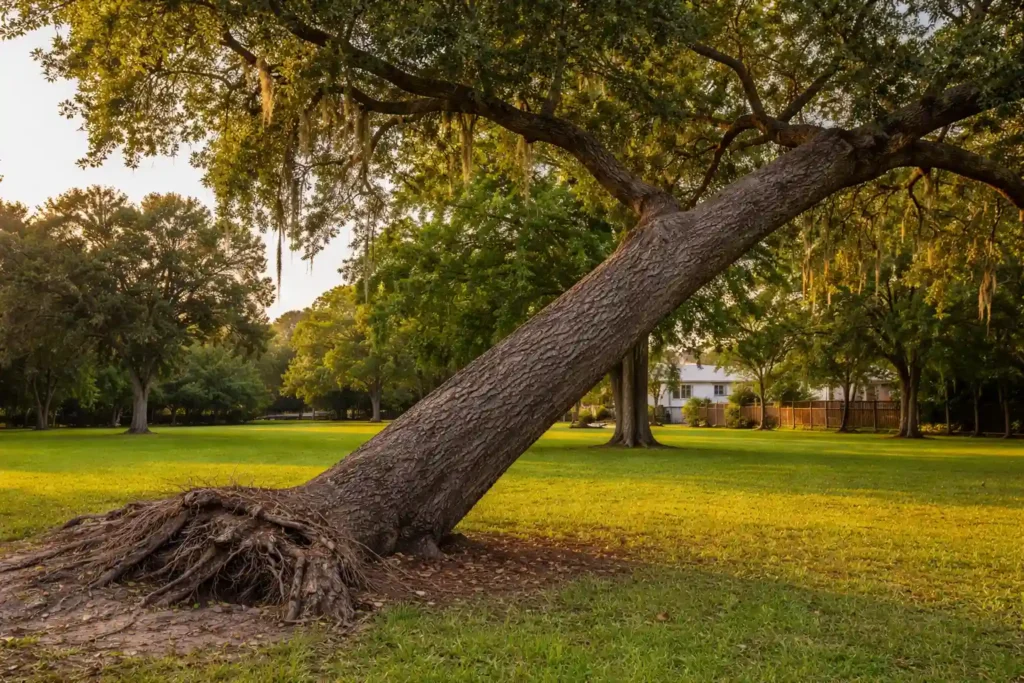
Leaning oak at golden hour
Tree Problems & Safety

Is a Leaning Tree Dangerous or Normal?

A leaning tree is not a problem in itself. It is a signal. What that signal means depends entirely on why the tree is leaning, how long it has been doing so, whether the angle is changing, and what surrounds the base where the roots meet the ground. Two trees can lean at the exact same angle — one is perfectly stable and has been for 40 years, the other is in the early stages of root plate failure and could drop within weeks. Most homeowners look at the visible angle. That is the wrong place to start. The angle is an outcome. The root system, the soil condition, the trunk structure, and the speed of change are the actual story. This article covers all of it — what causes lean, how to read the warning signs, what angle thresholds actually mean, when a leaning tree can be saved, and when removal is the only honest answer. Natural Lean vs. Structural Lean: The Distinction That Changes Everything Before any risk assessment is possible, you need to understand that lean is not a single condition — it is a category that contains two very different situations. Natural lean develops over years, sometimes decades, as a tree responds to its environment. Trees growing near a structure or fence line will angle away from the obstruction. Trees in partial shade will grow toward available light — a process called phototropism. Trees in open fields with consistent prevailing winds often develop a permanent lean in the direction opposite the dominant wind, a shape called wind flagging. All of these are adaptive responses. The root system grows in proportion to the lean, distributing anchor roots asymmetrically to balance the load. The tree is not at higher risk of falling; it has simply grown into its structural equilibrium over time. Structural lean is different in every meaningful way. It develops because something has destabilized a tree that was previously upright, or it develops in a young tree before the root system has the strength to support the growth pattern. The causes include root system failure, soil saturation, root cutting during construction, drought stress that weakens root depth, and storm damage. Unlike natural lean, structural lean is often sudden, and it is frequently progressive — meaning the angle keeps increasing. The single most important diagnostic question is not “how far is the tree leaning?” It is: has this tree always leaned like this, or did something change? Answering that question correctly directs every decision that follows. What Actually Causes a Tree to Lean Understanding the cause of lean determines what you do next. The same visual presentation — a tree tilted 15 degrees off vertical — can come from a dozen different root causes, each with a different risk profile and a different range of solutions. Root System Damage or Failure The root system is what holds a tree in the ground. When roots are cut, diseased, or rotted, the anchor strength of the tree diminishes. This is the most common structural cause of dangerous lean in mature trees. Root damage is often invisible above ground — the tree can look completely healthy right up until the point it tips. In Austin, where Live Oaks dominate many properties, oak wilt can quietly destroy the vascular root system over one or two seasons before any above-ground symptoms appear. A tree that leans suddenly after a wet spring in Central Texas should be evaluated for root system health as a first priority. Soil Conditions and Moisture Austin sits on some of the most variable soil in Texas. The Blackland Prairie clay soils that run through Travis County and Williamson County expand when wet and contract when dry — sometimes dramatically. After heavy rain, clay soil loses much of its compressive strength, which means the root plate can shift even in trees that have been stable for years. The opposite problem — drought — causes soil to crack and pull away from root systems, leaving voids that remove lateral support. Both extremes are regular events in Central Texas, which makes soil-related lean more common here than in regions with more stable precipitation. Wind and Storm Damage A single severe storm event can initiate a lean that continues to worsen for months. When strong winds push a tree beyond its flex tolerance, the windward roots stretch and sometimes tear. The tree may not fall immediately, but the root plate has been loosened. You will often see cracked or raised soil on the windward side — the side the wind came from — after this type of event. Texas storms, including the ice storms and derecho events that hit the Austin metro, are capable of triggering delayed lean failure weeks or months after the weather event. Canopy Imbalance and Uneven Growth A heavy, asymmetric canopy shifts the tree’s center of gravity. Over time, this places disproportionate mechanical stress on one side of the root system. Improper pruning — including tree topping, which causes rapid, dense regrowth on one side — can accelerate this imbalance. Trees with extremely one-sided canopy growth should be monitored because the lean can develop slowly and then accelerate as the canopy weight increases season over season. Root Competition and Construction Activity Nearby excavation, trenching for utilities, and foundation work routinely cut through structural roots without anyone realizing what they have done. A tree can absorb the loss of one major root and remain stable, but lose two or three and the balance point shifts. Construction activity within 10 to 15 feet of a mature tree should be treated as a potential root damage event, and any lean that develops in the 12 to 24 months following nearby construction should be viewed with suspicion. Species-Specific Growth Patterns Some Texas trees lean more than others by nature. Monterey Oaks and Live Oaks regularly grow at angles, particularly near creek beds or limestone outcroppings where root penetration forces the tree toward available water and soil depth. Cedar Elms near structures

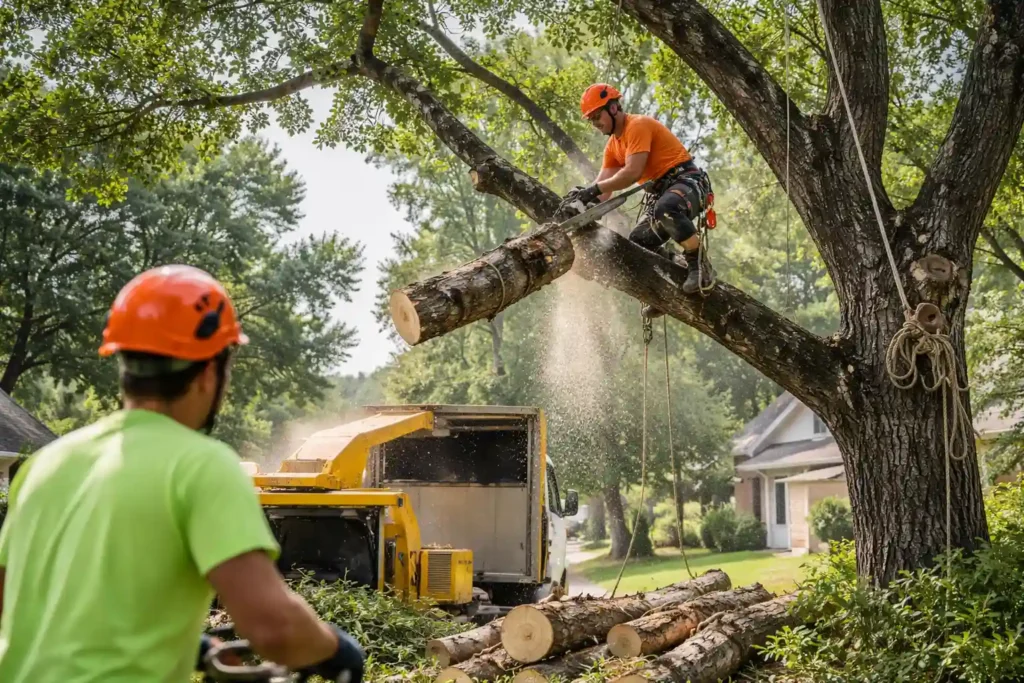
Tree felling in the neighbourhood
Tree Problems & Safety

Is Cheap Tree Service Worth the Risk?

The lowest quote almost always wins. When three companies come out to look at a tree, most homeowners choose the one that charged the least — and most of the time, nothing bad happens. The tree gets cut, the debris gets hauled, and the job looks finished. But “looks finished” and “was done correctly” are two very different outcomes in tree work. What separates a $300 job from a $900 job on the same tree is rarely profit margin. It is insurance coverage, training, equipment, and the kind of knowledge that prevents a 60-foot oak from landing on your roof instead of the drop zone. Understanding what actually drives tree service pricing is the only way to make a decision you won’t regret when something goes wrong. This article covers exactly that — not in vague warnings, but in specific detail about what cheap tree services skip, what the real liability exposure looks like, and how to evaluate any quote before you sign off on it. What Actually Makes a Tree Service Quote “Cheap” Low pricing in tree care is almost always an arithmetic problem. Running a legitimate tree service in Austin costs real money: general liability insurance, workers’ compensation, ISA-certified arborist salaries, proper climbing gear, chainsaws, chippers, cranes for large removals, and vehicle maintenance. When a quote comes in 40–60% below the market rate, one or more of those line items has been removed from the equation. The most common things missing from cheap quotes: None of this means every lower-priced company is a scam. It means you need to know what the price includes before comparing numbers. A $700 quote that includes liability insurance, debris removal, and ISA-certified work is a better deal than a $400 quote that includes none of those things. The Specific Risks of Uninsured Tree Work in Texas Texas does not require tree service companies to be licensed at the state level. Anyone can legally pick up a chainsaw and offer tree removal services in Austin. This makes the insurance question more important here than it would be in states with stricter contractor licensing requirements. Here is what the risk exposure actually looks like: Scenario 1: A worker falls on your property. A crew member climbs your tree without proper harness technique and falls, breaking both legs. The company has no workers’ compensation. Under Texas law, a property owner can be held liable for injuries sustained on their premises. You are now managing a personal injury claim with no coverage. Scenario 2: A section of tree falls on a neighbor’s fence. The crew fails to use a rigging system and a heavy oak limb swings wide, crushing the fence next door. The company has no general liability. Your neighbor files a claim. Your homeowner’s insurance absorbs it — and your premiums increase. Scenario 3: A limb falls on your vehicle. A 300-pound section of a water oak drops on your car in the driveway. The company is unreachable. No insurance. You pay out of pocket for the vehicle damage and the corrective tree work. These are not rare outcomes. They happen regularly with unlicensed and underinsured operators, particularly after storm events when unqualified crews flood the market offering cheap emergency work. If you have ever dealt with emergency tree removal after a severe weather event, you know how quickly desperation can lead to poor hiring decisions. The verification step is simple: ask for a certificate of insurance naming you as an additional insured, and call the insurance company on the certificate to confirm the policy is active. A legitimate company will not hesitate to provide this. What ISA Certification Actually Means — and Why It Matters for Your Trees ISA certification is not a marketing badge. It is a credential that requires a tree care professional to demonstrate knowledge of tree biology, diagnosis, risk assessment, pruning standards, and safe work practices. ISA Certified Arborists are also required to complete ongoing education to maintain their certification. Why does this matter for a homeowner hiring tree work? Because trees are living systems. A cut made in the wrong place does not just look bad — it creates a wound that the tree cannot compartmentalize properly, opening an entry point for decay fungi, bacteria, and insects. In Central Texas, this is particularly consequential because of oak wilt — a lethal fungal disease spread through root grafts and sap-feeding beetles that enter fresh pruning wounds. The Texas A&M Forest Service recommends painting fresh oak cuts with wound sealant between February and July to reduce beetle transmission risk. An uncertified crew that has never heard of oak wilt will not follow this protocol. For a deeper look at what professional tree assessment looks like from a certified arborist’s perspective, see how arborists assess tree health. ISA certification also means familiarity with ANSI A300 pruning standards — the industry standard that defines correct cut placement, maximum removal percentages per visit, and appropriate pruning objectives. Work performed outside these standards can leave trees structurally compromised, aesthetically ruined, or physiologically stressed. This is especially relevant for large, established trees. A mature live oak that has been incorrectly topped — a practice condemned by ISA standards — may look “trimmed” but is actually now subject to rapid, weakly-attached regrowth, interior decay, and significantly reduced lifespan. The homeowner paid to damage their own tree. Tree Topping: The Most Visible Sign of Unprofessional Work Tree topping is the practice of removing large sections of the main trunk and major scaffold branches, leaving flat or stub cuts throughout the canopy. It is offered by cheap crews because it is fast, requires no rigging, and looks dramatic — customers feel they got “a lot done.” It is also one of the most harmful practices in arboriculture. What actually happens when a tree is topped: The irony is that homeowners often pay for topping because they believe it will make the tree safer near their house. In reality, a topped tree is more structurally dangerous than an

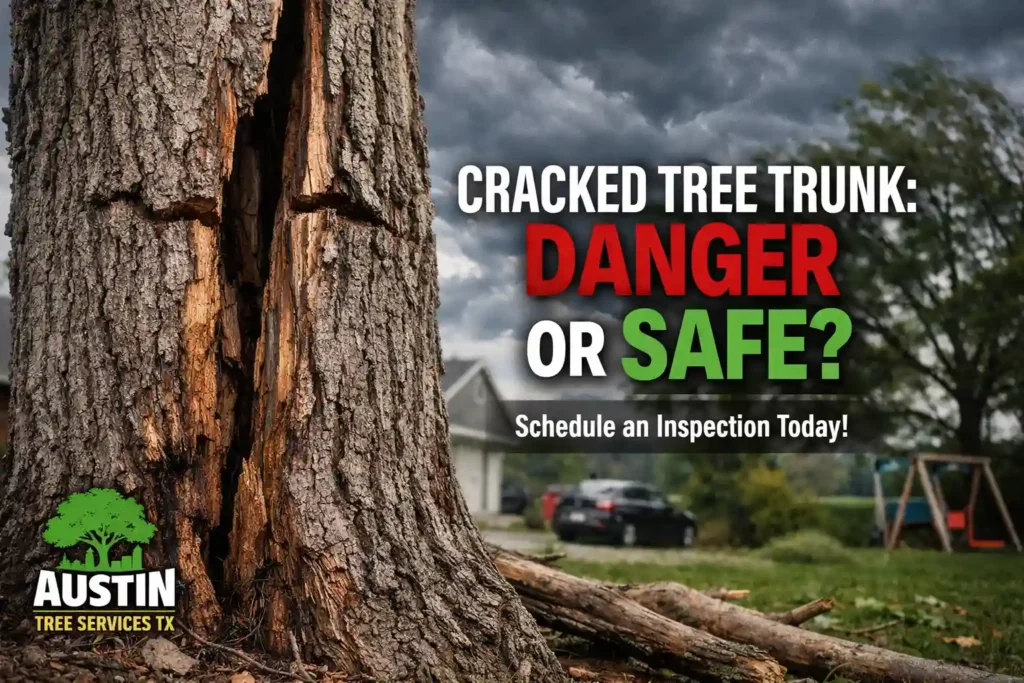
Cracked tree trunk danger or safe
Tree Problems & Safety

Cracked Tree Trunk: What It Means and What to Do

A crack in a tree trunk is not always a death sentence. But it is always a message — and what it says depends entirely on the type of crack, where it sits on the trunk, how deep it runs, and what the tree has been through. The problem is that most homeowners either panic and remove a tree that could have been saved, or they ignore a crack that was silently signaling structural failure. Both mistakes are costly. One costs you a healthy, mature tree. The other can cost you your roof. This guide covers the topic completely: the biology of how trunks crack, every major crack type and what each one actually means, the specific risk factors that turn a cosmetic issue into a hazard, the assessment process a qualified arborist uses, and the full range of responses from monitoring to removal. If you’ve noticed a crack in your tree and want a clear, grounded answer — not a vague “call a professional” deflection — this is it. Why Tree Trunks Crack: The Biology Behind the Damage To understand trunk cracks, you need to understand what a trunk actually does. A tree trunk is not a solid column of dead wood. It is a living system of layers, each with a distinct structural and biological role. The outermost layer is bark — protective, insulating, and largely inert structurally. Beneath it is the cambium, a thin layer of actively dividing cells responsible for the trunk’s radial growth. Inside the cambium is the sapwood (xylem), which carries water and nutrients upward from the roots. At the center is the heartwood — older, denser, and no longer biologically active, but critical to the trunk’s structural rigidity. Cracks form when stress exceeds the wood’s capacity to flex or absorb force. Wood is anisotropic — it behaves differently depending on direction. Along the grain, it is strong. Across the grain, it is far weaker. This is why horizontal cracks are almost always more dangerous than vertical ones: they fracture across the grain, severing the wood fibers responsible for bearing load. When we talk about a “cracked trunk,” we are talking about one of several failure modes, each with a different origin, anatomy, and risk profile. Lumping them together as “trunk cracks” is like calling every chest pain a heart attack — technically related, but diagnostically meaningless without more information. The CODIT Model: How Trees Respond to Cracks and Wounds Before evaluating any crack, it helps to understand how trees defend themselves. The CODIT model — Compartmentalization of Decay in Trees — describes the biological walls a tree builds to contain damage and prevent it from spreading. When a tree is wounded or cracked, it does not heal the way animal tissue does. It cannot regenerate damaged cells. Instead, it compartmentalizes — it chemically isolates the damaged zone and grows new wood around it. This is why you sometimes see a tree that appears to have “swallowed” an old wound or grown around a crack. That is compartmentalization in action. The CODIT model defines four walls of resistance. Wall 1 blocks upward and downward spread through vessels. Wall 2 resists inward spread toward the pith. Wall 3 limits lateral spread between growth rings. Wall 4 — the strongest — is the new wood grown after the injury, which creates a biological barrier between old and new tissue. Why does this matter for cracks? Because a tree’s ability to compartmentalize a crack determines whether the crack is a stable, contained wound or an active, expanding failure. Young, healthy trees with vigorous growth compartmentalize better. Old, stressed, or diseased trees may fail to contain the damage, allowing decay to advance deeper into the trunk. This is one reason why the same type of crack in two different trees can carry very different levels of risk. Types of Tree Trunk Cracks and What Each One Means Crack type is the single most important diagnostic variable. Each type has a different cause, a different structural implication, and a different management path. Frost Cracks (Radial Shakes) Frost cracks are among the most visually dramatic and most commonly misunderstood trunk cracks. They appear as long vertical splits, often running several feet up the trunk, and they typically develop on the south or southwest-facing side of the tree. The mechanism is thermal stress. During cold nights, the outer wood contracts rapidly while the inner wood remains warmer and relatively expanded. This differential contraction generates tension that can exceed the wood’s radial tensile strength, causing a sudden split — sometimes loud enough to hear as a sharp crack on a cold night. In Austin and the wider Central Texas region, frost cracks most often develop during freeze events, particularly the kind of rapid overnight temperature drops that occur in January and February. Live oaks, pecans, and red oaks are the species most commonly affected in this area. Frost cracks have a characteristic behavior: they tend to open during cold weather and partially close as temperatures warm. Over years, they may callus over at the edges and appear healed — only to reopen at the same location during subsequent freeze events. This repeated opening and closing is called a “riband” pattern and is a sign that the crack is chronic rather than acute. A frost crack that has callused over and remains stable across seasons poses a lower immediate risk than it looks. However, one that is actively widening, shows exposed interior wood, or is accompanied by decay warrants professional evaluation. Lightning Scars Lightning strikes produce a distinctive type of trunk damage that is often mistaken for a severe crack. The electrical current travels through the moisture in the sapwood, which can cause the wood to explode outward along a spiral or vertical path, stripping bark in a long, twisted channel down the trunk. The structural outcome of a lightning strike varies widely. Some trees absorb a strike with relatively limited damage; others lose large sections of bark and sapwood. The key

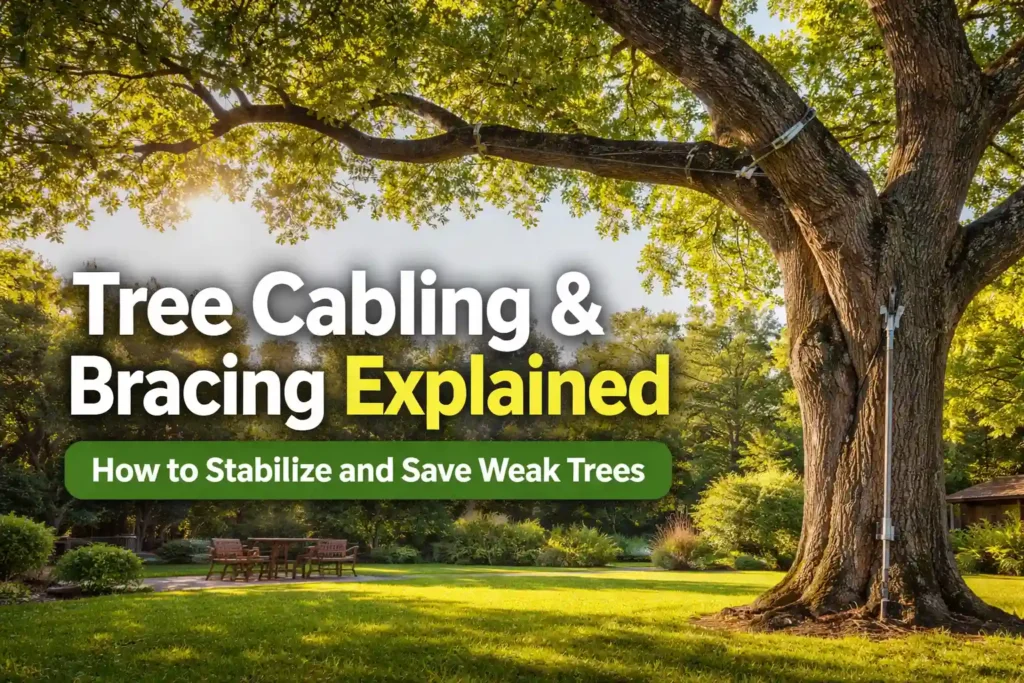
Tree cabling and bracing in action
Tree Problems & Safety

Tree Cabling and Bracing: How It Works and When It’s Needed

A large live oak in your yard develops a split between two co-dominant trunks. A heavy pecan limb has been creaking over your roof since last spring’s storms. A cedar elm with three crowded stems is leaning slightly more every season. Your instinct says removal. But a trained arborist looks at those same trees and sees something different — structural problems that, in many cases, can be corrected without cutting the tree down. That’s what tree cabling and bracing exist to do. These are engineered support systems installed directly into the tree’s structure — cables in the upper canopy, steel rods through compromised unions — designed to redistribute load, limit dangerous movement, and hold failing sections together long enough for the tree to remain safely in place. They don’t fix every problem. But when conditions are right, they’re the difference between keeping a 40-year-old shade tree and grinding its stump. This guide covers everything you need to understand before making that call: how each system works mechanically, what hardware is actually involved, which tree species in Central Texas benefit most, the full installation process, what it costs, and critically — when cabling and bracing will not save a tree and removal is the only safe option. What Tree Cabling Is — And What It Actually Does to the Tree Tree cabling is a supplemental support system installed in the upper canopy of a tree to limit the range of movement between limbs or co-dominant stems. The purpose is not to hold the tree completely rigid — trees need to flex and sway to dissipate wind energy. The purpose is to prevent specific limbs or stems from moving far enough apart to cause a structural failure. A cable installation transfers some of the mechanical load away from a weak union point and spreads it across a larger portion of the canopy structure. When wind pushes heavily on one side of the tree, the cable acts as a tether that limits how far that section can deflect before the stress concentrates dangerously at the attachment point. Without a cable, that stress accumulates entirely at the weakest spot — typically a tight V-shaped union or an area with included bark — until something gives. There are two main cable system types used by professional arborists today: Static Cabling Systems Static systems use high-strength steel cable — typically EHS (Extra High Strength) galvanized wire — installed with no built-in elasticity. Hardware consists of eye bolts or J-lag screws driven into the wood and secured with thimbles, cable clamps, or swaged fittings. These systems provide firm, reliable support at a defined length. They are the traditional standard and remain widely used because of their predictability and cost-effectiveness. The limitation is that they allow no dynamic adjustment — the cable holds at exactly the installed tension, which can create stress concentrations in certain growth patterns over time. Dynamic Cabling Systems Dynamic systems, such as the Cobra system and similar high-strength synthetic rope installations, use flexible materials that allow the tree to move within a larger range before the cable engages. Think of it as a progressive support: at low wind speeds, the tree moves freely. As deflection increases and reaches a threshold, the cable engages and limits further movement. This approach more closely mimics the natural way a tree would be supported by adjacent trees in a forest setting. Dynamic systems require no hardware driven through the wood, which reduces the risk of decay at installation points. They are more expensive than static systems and require specific training to install correctly. The right system depends on the tree’s species, structure, canopy weight, and the nature of the weakness. A mature live oak with one overloaded lateral limb may be well-served by a static cable. A younger multi-stemmed Texas ash with long-term growth considerations may benefit more from a dynamic installation. What Tree Bracing Is — And How It Differs From Cabling Bracing is a rigid reinforcement system applied directly to a crack, split, or weak union point in the tree’s wood. While cabling works at a distance — controlling canopy movement through tension — bracing works at the failure point itself, physically holding the structure together from within. The standard method involves drilling through both sides of a crack or weak union and installing a threaded steel rod with washers and nuts on the exterior. When tightened, the rod compresses the two sections together and prevents further separation. Multiple rods are often used on significant splits, installed in a pattern that distributes the holding force across the full depth and width of the affected area. Bracing is typically applied to: One important distinction: bracing is a corrective measure. It addresses damage that has already occurred or a weakness that is already structurally active. Cabling, by contrast, is primarily preventative — it’s installed to stop a failure from happening before it does. In practice, most professional installations use both systems together because they address different aspects of the same problem. Bracing closes the crack; cabling reduces the dynamic forces that caused the crack in the first place. Which Trees in Austin Typically Need Cabling or Bracing Central Texas has a distinct urban tree canopy, and not all species carry the same structural risk profile. Understanding which trees are most commonly candidates for support systems helps homeowners know what to watch for. Live Oak (Quercus fusiformis) The most common cabling candidate in Austin. Live oaks frequently develop multiple co-dominant stems from a young age, especially when grown in open landscapes without the natural competition that would encourage single-leader development. As they mature, these competing trunks create classic V-shaped unions with included bark — the #1 structural vulnerability in Austin’s tree canopy. A 30-year-old live oak with two trunks growing apart at the base is almost always a cabling conversation. The species is long-lived, highly valued, and worth preserving when structurally supported early. Pecan (Carya illinoinensis) Pecans grow large and fast, which means canopy weight can outpace structural

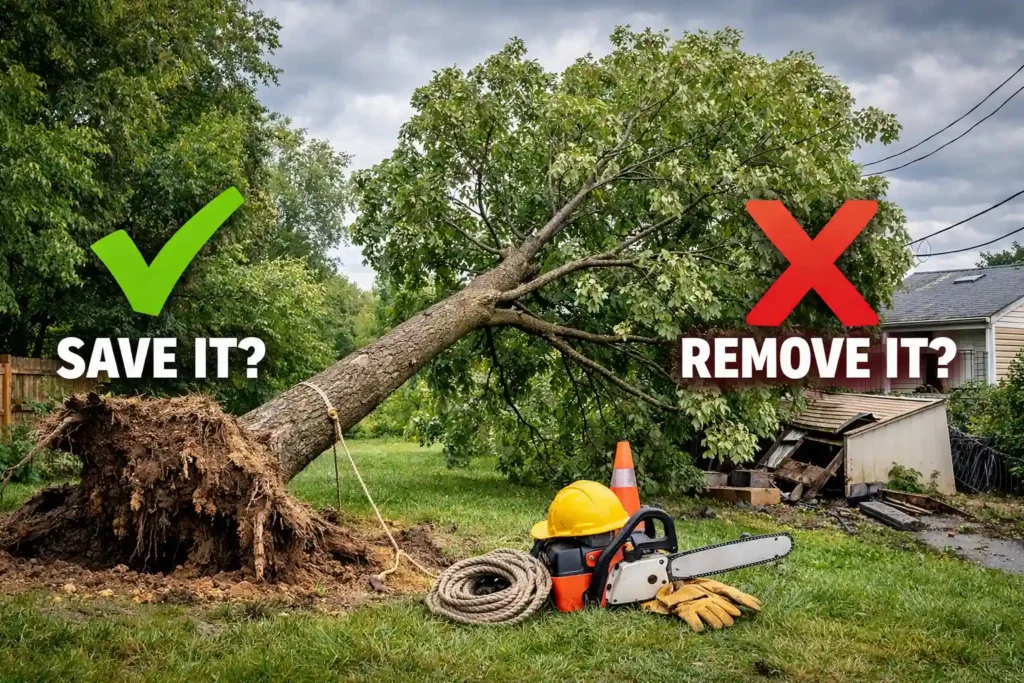
Damaged tree save or remove
Tree Problems & Safety

Can a Partially Fallen Tree Be Saved?

A partially fallen tree is not just a yard problem. It is a structural event — one that changes the physics of how a tree stands, how its roots hold, and how long it has before it comes down the rest of the way. The question of whether it can be saved is real and answerable, but it requires more than a quick look from the driveway. This guide covers the full picture: what actually determines survivability, how to read the signs yourself before a professional arrives, what arborists evaluate on-site, which intervention methods work and which ones fail, and when the only honest answer is removal. If you have a tree that has shifted, leaned, or started to uproot after a storm or on its own, this is the decision-making framework you need. What “Partially Fallen” Actually Means — and Why It’s Not One Thing The phrase “partially fallen tree” gets used to describe several very different situations, and the differences matter enormously for what comes next. Grouping them together leads to bad decisions. Here are the four distinct conditions that fall under this label: 1. The Leaning Tree That Was Always Straight This tree was vertical. Now it isn’t. Something changed — a storm, saturated soil, root disease — and the tree has shifted from its original position. The lean may be subtle (5–10 degrees) or pronounced (30+ degrees). The critical variable is whether the lean is new and sudden, or gradual over months or years. Sudden lean after a weather event is almost always a root failure event. Gradual lean over seasons may indicate structural growth adaptation, which is a different concern. 2. The Partially Uprooted Tree The root plate has lifted on one side. You can see soil mounding or cracking around the base, and possibly exposed roots. The tree may still be standing at an angle, held by the roots still embedded in the ground. This is one of the most urgent scenarios because the remaining anchor is under maximum tension and the center of gravity has shifted. Weather events or even a change in soil moisture can complete the fall. 3. The Tree Held Up by Another Structure The tree has fallen far enough to rest against a fence, a structure, another tree, or a power line. It is not standing on its own — it is leaning against something else. This is a false stability situation. The supporting structure is not designed for this load, and when it gives way — or when the leaning tree is moved — the full weight transfers suddenly. These trees are among the most dangerous to work around. 4. The Split-at-the-Crown or Major-Limb-Failure Tree The main trunk has not moved, but a major structural branch or co-dominant stem has split away and is hanging or resting at an angle. The root system may be completely intact. Whether this qualifies as “partially fallen” depends on the severity and location of the split, but it is a structural failure event regardless. Each of these scenarios calls for a different evaluation and a different response. Understanding which one you are dealing with is the first diagnostic step. The Biology Behind Whether a Tree Can Recover Trees do not heal the way animals do. They do not repair damaged tissue — they compartmentalize it and grow around it. This biological reality shapes everything about recovery potential for a partially fallen tree. When a tree is displaced, three biological systems are disrupted simultaneously: The Vascular System Trees move water and nutrients through two transport systems: the xylem (water and minerals upward from roots) and the phloem (sugars downward from the canopy). A tree that has been tilted or partially uprooted has these systems under mechanical stress. If roots are torn, the water supply to the canopy is reduced. If the trunk has internal cracks, vascular continuity is disrupted at the break point. A tree that cannot supply its canopy with adequate water begins to decline, and the rate of decline depends on how much of the vascular system remains intact. The Meristematic Growth Zones The cambium — the thin layer just beneath the bark — is where new wood and bark are produced. When a tree is partially fallen and the trunk is stressed, cracked, or compressed unevenly, the cambium can be damaged at the stress points. Without functional cambium, the tree cannot compartmentalize wounds or produce new wood to strengthen the damaged area. This is why trunk damage is often the deciding factor in salvageability. The Root Regeneration Capacity After root damage, the tree’s ability to regenerate fine feeder roots determines long-term recovery. Fine roots — the hair-like structures responsible for most water and nutrient absorption — can regenerate if the structural roots remain intact. But if the structural roots (the large, woody anchoring roots) are severed or torn, the tree loses both its anchor and its primary water-gathering infrastructure. In Austin’s clay soils, root regeneration is also affected by compaction, drainage patterns, and the season in which the damage occurred. Roots damaged during the Texas summer heat face far more recovery stress than roots damaged in fall or early spring. Recovery is possible when these three systems retain enough functional capacity to sustain the tree through stabilization and re-establishment. When they don’t, the tree’s decline is inevitable regardless of what support measures are applied above ground. The Five Factors That Determine Salvageability Professional arborists evaluate partially fallen trees against a set of interdependent variables. No single factor alone determines the outcome — it’s the combination that matters. Here is how each factor is assessed and what it means for the decision. Factor 1: Root System Integrity This is the primary variable. Everything else is secondary to what is happening below ground. Arborists look for the following during a root assessment of a partially fallen tree: If the root system is mostly intact — meaning the tree was displaced but not deeply uprooted — the path toward saving it remains

Blog

Tree Services Guide What You Need, When & Cost

If you’ve ever felt like you’re barking up the wrong tree trying to understand what kind of tree services you actually need—you’re not alone. As someone who’s been in the tree business for years, I’ve seen it all: leaning oaks about to tip over, stubborn stumps that just won’t quit, and folks planting trees in all the wrong places. That’s why I created this ultimate guide—to lay it all out on the table, plain and simple. Whether you’re dealing with a hazard tree, planning a landscape revamp, or looking to save a sick tree, I’m here to walk you through what each service involves, when to consider it, and how much it might set you back. No fluff—just solid info, real-world experience, and straight talk. Tree Removal Let me tell you—removing a tree isn’t just about firing up a chainsaw and yelling “timber.” For me, it’s always a last resort. I’ve spent years caring for trees, nurturing them through storms, droughts, and diseases. But sometimes, no matter how much love you give a tree, the writing’s on the wall. When a tree becomes a hazard or a burden, it might be time to bite the bullet and let it go. It’s not always an easy call, but it’s often the right one. Signs It’s Time to Remove a Tree Over the years, I’ve seen trees that looked perfectly fine on the outside but were hollow on the inside—like a house with no foundation. That’s why I always advise folks to keep an eye out for subtle warning signs. If a tree is leaning more than it should or has suddenly shifted position after a storm, that’s not something to sweep under the rug. Leaning trees can indicate root instability, and once that anchor is gone, there’s nothing stopping that tree from crashing down when the wind picks up. You’ll also want to watch for dead branches, peeling bark, or limbs that snap off without warning. If a tree’s shedding more than a golden retriever in summer, that’s a clue it’s not in good shape. Mushrooms or fungus at the base are another red flag—especially if they keep coming back. That usually means the roots are rotting, and when the base goes, the whole tree’s living on borrowed time. Diseases, pests, and internal decay are things I look for during an inspection. Some of these issues can be treated if caught early, but if 50% or more of the tree is damaged, it’s often safer—and cheaper in the long run—to remove it. Like they say, don’t throw good money after bad. Common Reasons for Tree Removal Aside from decay or disease, there are other reasons I get called in for removals. Sometimes a tree is planted too close to a home, driveway, or foundation. As the roots grow, they can crack concrete, clog up pipes, or lift walkways. In other cases, the tree might be blocking sunlight to your garden, interfering with solar panels, or simply dominating a space where something else could thrive. And let’s not forget about storm damage. Here in Texas, our weather can turn on a dime. High winds, lightning strikes, and heavy rain can split trees in two or send massive limbs crashing down. If the damage is extensive or has left the tree unstable, removal is usually the safest choice. I always say, better safe than sorry—because when trees fall, they don’t ask permission first. How Much Does Tree Removal Cost? Now let’s talk turkey. The cost of removing a tree can vary a lot. Small trees in open areas with easy access might run around $300 to $600. On the other hand, a large tree overhanging a house or tangled in power lines can easily run $1,500 to $2,500 or more. Emergency removals—especially after hours—can add to the price, because we have to drop everything and mobilize fast. It’s not just about the labor; it’s about the risk, the equipment, and the care it takes to avoid causing damage during the process. One thing I always make sure of is that the job’s done safely, cleanly, and completely. We don’t leave you with a jagged trunk or a mess to clean up. If you want the stump gone too, we can grind that out while we’re at it. I believe in doing things right the first time—no half-baked jobs on my watch. Final Thoughts At the end of the day, tree removal is about making the smartest call for your property, your safety, and your long-term landscaping goals. I always tell my clients, don’t wait until the tree is hanging by a thread. If you suspect something’s not right—or you’re just not sure—give me a call. I’ll take a look and give you an honest, no-pressure opinion. Sometimes we can save the tree, sometimes we can’t—but either way, you’ll be making the call with a clear head. And once that tree’s down, I’m more than happy to help you choose the right one to plant in its place. Because with the right tree in the right spot, you’re not just cutting down—you’re planning ahead. Stump Grinding & Removal Once a tree comes down, the job’s only half done. What’s left behind is that stubborn stump—just sitting there like an uninvited guest at a backyard barbecue. Some folks leave them, thinking it’ll break down on its own, but here’s the truth: waiting for a stump to rot naturally is like watching paint dry in a snowstorm. It can take years, and in the meantime, you’ve got an eyesore, a tripping hazard, and a magnet for pests all rolled into one. That’s why I always recommend stump grinding or full removal to truly finish the job and give your landscape a clean slate. Why Stumps Need to Go A leftover stump might not seem like a big deal at first glance, but they cause more problems than people expect. For starters, they’re ugly—plain and simple. A beautifully maintained yard with a crusty old stump in

Blog, Tree Planting

How do I choose the right size of tree for my property?

Choosing the right size tree for your property is not a single decision — it is a chain of decisions, each one dependent on conditions specific to your land, your soil, your overhead clearances, and what you actually want the tree to do over the next 20 to 50 years. Plant too large a species in too small a space and you are not just dealing with overcrowding. You are dealing with root intrusion, foundation risk, limb failure over structures, and eventual removal that costs far more than the tree was worth. Plant too small a species on a large open lot and you will wait decades for the shade and privacy you wanted in three years. In Central Texas, these decisions carry extra weight. The combination of expansive clay soils, limestone bedrock close to the surface, recurring drought, and summer heat above 100°F means that many trees commonly sold at nurseries are simply not suited to survive — much less thrive — in Austin and its surrounding communities. Knowing tree size categories is only half the equation. Knowing how specific species behave in this climate is the other half. This guide covers both. What Do Tree Size Categories Actually Mean? Nursery tags and tree guides classify trees as small, medium, or large based on their mature height — the height the tree reaches at full biological development under normal growing conditions. These classifications are not universal; different sources use slightly different thresholds. But for practical property planning in Texas, these ranges hold: Height alone does not tell the full story. A tree’s canopy spread — its lateral reach when fully grown — often determines how much actual space it needs more than its height does. A mature Live Oak in Austin can spread 60 to 80 feet wide while reaching 40 to 60 feet tall. That means the canopy covers more horizontal ground than the tree is tall. On a small urban lot, a single Live Oak can occupy the entire plantable space. Why Canopy Spread Matters More Than Height for Most Residential Properties Most homeowners think vertically when they picture a tree growing. They imagine height clearance — will it hit the roofline, will it reach the power lines. But on typical residential lots in Austin, Cedar Park, Round Rock, and surrounding communities, the lateral spread of a tree’s canopy causes more property conflicts than its height does. A canopy that spreads over a neighbor’s fence, a driveway, a patio, or a structure creates ongoing maintenance obligations, potential liability, and neighbor disputes. Branches that cross property lines belong to the property over which they hang, meaning regular professional trimming becomes a recurring cost you must plan for. When measuring your available space before selecting a species, measure in all four directions from the intended planting point. Give yourself the full mature canopy spread as a buffer — not just the trunk footprint. A Bur Oak that needs 60 feet of canopy spread should not be planted 20 feet from your fence line. How to Assess Your Property Before Choosing a Tree Size Measure Available Space Horizontally and Vertically Start on the ground. Measure the distance in every direction from your intended planting spot to the nearest structure, fence, property line, driveway, and established plant. Then look up. Identify overhead utility lines — both primary distribution lines (the thicker lines at the top of utility poles) and secondary service lines (the lines running from the pole to your house). In Texas, the general guidance from utility companies is that no tree should be planted beneath or within 20 feet of primary lines. Under secondary lines, only small trees under 25 feet should be considered. If you are uncertain what lines run through or near your property, contact Austin Energy or your local provider before you plant. Regretting a tree choice after five years of growth — when branches are encroaching on power lines — is a situation that is entirely avoidable at the planning stage. Identify Underground Obstacles and Utility Lines Tree roots follow water and nutrient availability. In most Central Texas soils, roots spread laterally far beyond what most people expect — typically two to three times the canopy radius, sometimes more in looser soil. Before planting, call 811 (Texas’s “Call Before You Dig” hotline) to have underground utilities marked. This is free and legally required before any ground-disturbing activity. Beyond utility lines, consider: septic tanks and drain fields (roots will seek them), irrigation systems, French drains, pool plumbing, and concrete structures. If you have a foundation concern already, or if your home has a pier-and-beam construction, review how tree roots affect lawns and foundations before selecting a large species with aggressive root systems. Evaluate Your Soil Type Austin and the surrounding Hill Country communities sit on a range of soil profiles — from the dark, expansive Vertisol clay soils common in East Austin and Round Rock, to the rocky, thin soils over limestone bedrock in Lakeway, Bee Cave, and Cedar Park. Soil type affects which tree sizes are realistic on your property, not just which species. In deep clay soils, large trees can anchor well but are highly susceptible to root stress during drought cycles — roots suffocate when saturated clay compacts, and trees that appeared healthy can decline rapidly. In rocky, thin soils over caliche or limestone, deep-rooted large trees often struggle to establish because they simply cannot get adequate root volume. Medium and small native species tend to outperform in these conditions because they evolved with exactly these constraints. If you are unsure of your soil profile, an arborist consultation before planting is far cheaper than removing a tree that failed to thrive after three years. Account for Sun Exposure and Microclimates South- and west-facing planting areas in Austin experience intense afternoon heat — particularly from June through September. Trees planted on the west side of a structure are under significantly more thermal stress than trees on the north or east side. This affects

Blog, Seasonal Tree Care

How often should newly planted trees be watered, especially during hot Texas summers?

A newly planted tree in Austin in July is not just thirsty. It is in active physiological crisis. The root ball you buried holds maybe 10–20% of the root mass the tree had before it was dug up. The canopy, however, is still pulling water through every leaf. That mismatch — full canopy, fractured root system — is the core reason newly planted trees die in Texas summers, and it is the reason watering frequency matters more than almost any other single decision you will make in a tree’s first two years. This article covers every dimension of that problem: how often to water based on tree size, soil type, and species; what Texas heat specifically does to soil moisture; how to read your tree’s stress signals; when to pull back; and the common mistakes that kill trees even when homeowners think they are doing everything right. Why Newly Planted Trees Struggle More Than Established Trees in Texas Heat An established live oak in Austin has roots extending 2–3 times the width of its canopy, often reaching 20 feet or more in every direction. It can access water from deep soil layers. It has years of mycorrhizal relationships built up around those roots. It is, functionally, drought-adapted. A tree you planted three weeks ago has none of that. When a tree is balled and burlapped or grown in a container, it arrives with a severely truncated root system. Research from the International Society of Arboriculture (ISA) shows that a transplanted tree can lose up to 95% of its fine feeder roots during the digging and transplant process. Those are the roots that actually absorb water and nutrients. The structural roots remain, but they cannot do the job of feeder roots. The establishment period — the time it takes for a tree to regenerate a functional root system in its new location — is not a few weeks. The general ISA benchmark is one year of establishment per inch of trunk caliper at breast height. A 2-inch caliper tree needs roughly two years. A 3-inch caliper tree needs three years. During that entire window, the tree depends on you for water. What Texas Summer Heat Does to Soil Moisture Austin’s average July high is around 98°F. But surface soil temperatures in full sun regularly exceed 130°F. At those temperatures, bare soil loses moisture at an extraordinary rate through evaporation. Combined with transpiration from the canopy, a newly planted tree’s root zone can go from adequately moist to critically dry within 24–36 hours during a heat wave. This is not an exaggeration. Texas A&M AgriLife Extension has documented evapotranspiration rates in Central Texas that can reach 0.3–0.4 inches of water equivalent per day during peak summer. For context, a single deep watering of 10 gallons can be almost entirely consumed within two days during extreme heat without mulch protecting the soil surface. If you are planning to plant trees in Austin, understanding this evapotranspiration reality is what separates a tree that establishes successfully from one that slowly declines over the first summer and dies in its second year — often confusing homeowners who thought the tree had made it. How Often to Water Newly Planted Trees: A Practical Schedule There is no single watering frequency that applies universally. The right schedule depends on four variables: time since planting, tree caliper, soil type, and current air temperature. Here is how to think through each one. Watering by Time Since Planting The first two weeks after planting are the most critical window. The root ball has been compressed, moved, and placed into soil with a different structure than it grew in. It cannot yet pull water from surrounding soil — it is entirely dependent on what moisture exists within the root ball itself and what you provide directly. Weeks 1–2 after planting: Water daily. Apply enough water to saturate the root ball completely — not just the surface, but down through the full depth of the root ball. For a 15-gallon container tree, this is typically 10–15 gallons per watering. Do not water the surrounding soil exclusively; concentrate on the root ball. Weeks 3–12 (first three months): Water every 2–3 days during summer heat. As roots begin to extend into surrounding soil, you can start watering slightly beyond the original root ball diameter to encourage outward root growth. This is also when mulch becomes essential — see below. Months 4–12: Water every 3–5 days during summer, weekly in spring and fall, and only when needed in winter unless there is prolonged drought. Monitor soil moisture rather than following a rigid calendar. Year 2 and beyond: Transition to deep, infrequent supplemental irrigation during drought events. By year two, a healthy tree should be developing enough root architecture to handle moderate dry spells, though it still benefits from supplemental water during extended heat events. Watering Volume by Trunk Caliper One of the most reliable frameworks for determining how much water to apply (not just how often) is the ISA trunk caliper formula: apply 1–1.5 gallons of water per week per inch of trunk diameter at breast height, minimum, during the establishment period. During Texas summer heat, lean toward the high end of that range. A 2-inch caliper tree needs at minimum 2–3 gallons per week. But because you are splitting that across 2–3 watering sessions, each individual session should deliver 1–1.5 gallons concentrated at the root zone. Increase this significantly — up to double — during weeks with temperatures above 100°F. Adjusting for Austin’s Soil Types Austin sits across multiple soil types, and they behave very differently under irrigation. Blackland Prairie clay (common in East Austin and Round Rock areas): Clay holds water longer but drains slowly. Overwatering is a genuine risk. Water deeply but allow the clay to partially dry between sessions — checking 4 inches below the surface for moisture before watering again. Clay-rich soils can become anaerobic when waterlogged, which is as damaging to roots as drought. Limestone-based thin soils (common in

Blog, Arborist & Tree Health

Signs of potential tree diseases or pest infestations, and how can I address them?

Most tree care guides are written for temperate climates with moderate humidity, cold winters, and predictable rainfall. Central Texas is none of those things. Austin and the Hill Country sit at a climatic crossroads — brutally hot summers that regularly exceed 100°F, extended drought interrupted by violent flooding, alkaline limestone soils, and mild winters that prevent the hard freezes that would otherwise suppress pest populations. That combination creates a year-round open season for pathogens and insects. Fungal diseases that need warmth and moisture can persist because Austin rarely gets cold enough to interrupt their life cycles. Beetles like the emerald ash borer and bark beetles thrive in heat-stressed trees. And because Central Texas has experienced severe drought cycles over the past two decades, a large percentage of the urban tree canopy is in a state of chronic low-grade stress — which is precisely when diseases and pests move in. Oak wilt, in particular, is more prevalent in the Austin area than almost anywhere else in North America. The Texas A&M Forest Service has documented that Travis County and surrounding counties represent one of the highest-concentration oak wilt zones in existence. Knowing what you are looking for — and acting quickly — is not just good tree stewardship in Austin. It can mean the difference between saving a 60-year-old live oak and losing an entire row of them. Reading the Visual Symptoms: What Your Tree Is Telling You Before you can identify a specific disease or pest, you need to understand what category of problem you are looking at. Trees communicate stress through a predictable set of visual signals. These are the primary categories and what each one typically indicates. Leaf Discoloration Color change in foliage is the most common first signal, but the specific pattern matters enormously. Yellowing across the entire canopy at once (chlorosis) typically points to a nutrient deficiency or soil pH problem — very common in Austin’s alkaline soils. Yellowing that starts at the leaf margins and moves inward is often a sign of potassium deficiency or root damage. When leaves turn brown and stay attached to the branch rather than falling — a condition called “flagging” — oak wilt is a primary suspect in Texas. Brown, scorched-looking leaves on apple or pear-family trees often indicate fire blight. Premature Leaf Drop A tree dropping leaves outside of its normal seasonal window is always a red flag. In spring or summer, this typically indicates a root problem, vascular disease, or severe pest activity. A tree that leafs out in spring and then drops leaves by July has almost certainly been compromised at the root level or through a vascular pathogen. Wilting Without Drought Stress When a tree wilts even after receiving adequate water — especially if one branch wilts while adjacent branches appear healthy — this strongly suggests a vascular blockage. Vascular wilt diseases, including oak wilt and Dutch elm disease, work by colonizing the xylem tissue that carries water up through the tree. The tree wilts not because there is no water in the soil, but because the water cannot move through the plant’s internal plumbing. Unusual Growth Patterns Galls, burls, and abnormal growths on branches or trunks are worth noting but are not always dangerous. Some galls are cosmetic and caused by non-threatening insects. Others — particularly crown gall disease caused by the bacterium Agrobacterium tumefaciens — can indicate serious long-term health problems. Witch’s broom, an abnormal proliferation of shoots from a single point, can indicate fungal infection or eriophyid mite activity. Canopy Dieback When the tips of branches begin dying while the lower canopy remains intact, this is called tip dieback or top dieback. It typically signals either drought stress, root health problems, or early-stage vascular disease. A certified arborist in Austin will look at the pattern — does the dieback progress symmetrically through the canopy, or is it clustered on one side? Asymmetric dieback often points to a localized root or soil problem. Progressive dieback moving from top to bottom typically indicates systemic disease. Common Tree Diseases in Central Texas Fungal Disease Oak Wilt (Bretziella fagacearum) Oak wilt is the most destructive tree disease in Texas, and Austin sits in its epicenter. It is caused by a fungal pathogen that invades and disables the xylem vessels, effectively cutting off water transport. Live oaks and red oaks are the primary victims, though in different ways. How to identify it in live oaks: Look for yellowing leaves with green veins (interveinal chlorosis), followed by leaf browning that starts at the tips and margins. Crucially, affected leaves drop while still partially green or yellow — not fully dead. The disease progresses rapidly, often stripping a live oak of most of its foliage within two to six weeks of first symptoms. How to identify it in red oaks: Red oaks typically die much faster — often within four to six weeks of infection. The leaves wilt and turn brown rapidly. You may also see fungal mats (pressure pads) beneath the bark on recently killed trees, which produce a distinctive fruity odor and are the primary means of surface spread to new trees through sap-feeding beetles. How it spreads: Through two pathways. First, root grafts — live oaks within 50 feet of each other often share root systems, and the fungus travels freely through connected roots. This is how entire neighborhoods lose their trees in succession. Second, sap-feeding beetles carry spores on fresh pruning wounds or storm wounds, which is why it is critical to never prune oak trees between February and June in Central Texas — peak beetle activity season. What you can do: There is no cure for an actively infected tree. However, preventive fungicide injections (propiconazole) administered by a tree surgeon can protect high-value trees adjacent to an infected one. Trenching to sever root connections between infected and healthy trees can also halt underground spread. Fungal Disease Hypoxylon Canker (Biscogniauxia atropunctata) Hypoxylon canker is ubiquitous in the Texas landscape — it exists as a dormant

Blog, Arborist & Tree Health

Pruning techniques to follow for trees planted in Texas

Pruning a tree in Texas is not the same as pruning a tree in Ohio or Oregon. The climate, the dominant species, and one highly destructive pathogen — Ceratocystis fagacearum, the fungus responsible for oak wilt — fundamentally change how, when, and why you cut. Get the timing or the technique wrong on a Live Oak in Central Texas, and you are not just slowing the tree’s growth. You may be introducing a fatal disease that can spread root-to-root to every oak on your street. This guide covers every major pruning technique applicable to trees planted in Texas: the correct cut types, the biological reasoning behind each, the seasonal windows that apply to Texas specifically, and how to approach structurally different tree species. Whether you are working with a newly planted Shumard Red Oak that needs formative pruning or a mature Bald Cypress with crowded interior branches, the approach differs — and the stakes of getting it wrong are real. What Pruning Actually Does to a Tree: The Biology You Need to Understand First Before technique, biology. A tree does not heal a wound the way human skin does. It does not regenerate tissue. Instead, it practices compartmentalization — a process discovered and described by forest pathologist Alex Shigo in the 1970s as CODIT (Compartmentalization of Decay in Trees). When you make a cut, the tree chemically seals off that wound zone and grows new wood around it. The quality of your cut determines how effectively it can do this. A flush cut — where you remove a branch by cutting flat against the trunk — eliminates the branch collar, the slightly raised ring of tissue at the branch’s base. That collar is the tree’s primary defense. It contains specialized cells that produce woundwood (sometimes called callus). Without it, the wound compartmentalizes poorly, and decay can advance into the main stem. This is not a small mistake. It is one of the most common errors in amateur and even some professional pruning, and it permanently compromises the tree’s structural integrity at that junction. A stub cut — leaving several inches of dead branch beyond the collar — creates an entry point for pathogens and insects before the tree can seal the area. Dead stubs cannot compartmentalize. They become decay columns that grow inward. The correct cut removes the branch at the branch collar, angled just slightly away from the trunk, cutting just outside the collar’s ridge. This preserves the defensive tissue while eliminating the dead branch material. Every technique described below is built on this principle. The Three-Cut Method for Removing Large Branches Any branch wider than roughly 1.5 inches requires the three-cut method to prevent bark tearing. When a heavy branch is cut in a single pass, the weight of the falling limb strips bark downward along the trunk before the cut is complete, creating a wound far larger and more ragged than necessary. The three-cut method eliminates this risk entirely. Cut 1 — The undercut: Position your saw 12–18 inches from the trunk on the underside of the branch. Cut upward roughly one-third of the way through. This creates a break point that stops any downward bark tear. Cut 2 — The top cut: Move a few inches further out from the trunk (further than the undercut) and cut downward from the top. The branch will drop cleanly, supported from below by your undercut until the top cut meets it. There is no stripping. Cut 3 — The collar cut: You now have a manageable stub. Locate the branch collar — the wrinkled ring of raised tissue where the branch meets the trunk — and make your final cut just outside it. Angle the saw slightly so the top of the cut is slightly further from the trunk than the bottom, roughly parallel to the collar’s angle. Do not cut into the collar. Do not leave more than a quarter-inch of stub. For branches of 4 inches or more in diameter on mature trees, this work is safer and more precise when carried out by a certified arborist with the equipment to properly control how and where the branch falls. Pruning Cut Types and When to Use Each There are two fundamental cut types in pruning, and they produce entirely different tree responses. Thinning Cuts A thinning cut removes an entire branch back to its point of origin — either the trunk, a main scaffold limb, or another branch. The tree’s growth response is minimal. The remaining branches receive more light and airflow, and the tree’s natural structure is preserved. Thinning cuts are the dominant technique in proper, ISA-standard pruning. They reduce crown density without stimulating the excessive regrowth that causes long-term structural problems. Heading Cuts A heading cut removes only part of a branch, cutting it back to a lateral bud or a smaller side branch. When used correctly and sparingly — removing no more than 25–30% of a branch’s length back to a lateral with a diameter at least one-third the size of the removed portion — heading cuts can redirect growth and encourage lateral branching in young trees. When used incorrectly, heading cuts trigger aggressive, weakly attached water sprout growth directly below the wound, create large wounds that compartmentalize slowly, and permanently disfigure the tree’s architecture. Tree topping is heading taken to an extreme — cutting the main leader and scaffold branches back to stubs with no regard for lateral branches or collars. It is universally condemned by arboricultural standards bodies and causes predictable, serious long-term harm: rapid regrowth of weakly attached epicormic shoots, large open wounds that rot into the core, and a dramatically shortened tree lifespan. If you have seen a tree with a flat, stubbed crown surrounded by a ring of thin vertical sprouts, that is a topped tree. The damage from topping versus proper trimming is significant and often irreversible. Structural Pruning for Young Trees: The First Five Years Matter Most The most cost-effective pruning you will ever do on

Blog, Arborist & Tree Health

Mulching around newly planted trees in Texas?

A newly planted tree in Texas is already fighting on multiple fronts. The root system has been severed, compacted, or balled during transplanting. The soil it now occupies may be alkaline caliche, dense clay, or sandy loam — none of which naturally provide the moisture-retaining, temperature-stable environment roots need to establish. And then there is the Texas climate itself: summers that sustain 100°F for weeks at a stretch, drought cycles that can go months without meaningful rain, and soils that shift between cracked hardpan and flash-flood saturation within the same season. Mulch is the single most impactful intervention available to a homeowner after the tree goes in the ground. Done correctly, it creates an artificial forest floor around the tree — mimicking the decomposed leaf litter that naturally accumulates under trees in healthy woodland ecosystems. Done incorrectly, it introduces moisture-related trunk disease, oxygen deprivation at the root collar, and the very pest infestations it is meant to prevent. This guide covers every dimension of mulching newly planted trees in Texas: what mulch actually does at the soil biology level, which materials work best for Central Texas conditions, how depth and placement interact with tree species and soil type, and what the most common mistakes look like — and why they happen. What Does Mulch Actually Do for a Newly Planted Tree? Mulch is not simply a cosmetic ground covering. It performs several distinct biological and physical functions simultaneously, and understanding those functions explains why the details of application — depth, placement, material — matter more than most homeowners realize. The most critical function in Texas is moisture retention. Bare soil exposed to direct sun loses significant moisture to evaporation within hours of irrigation. A 3-inch layer of organic mulch reduces evaporative water loss dramatically, keeping the root zone consistently moist between watering cycles. For a newly planted tree still developing its root network, that consistency is the difference between successful establishment and transplant failure. Mulch also moderates soil temperature. In Austin and the surrounding Hill Country, soil surface temperatures on exposed ground can exceed 140°F on a hot July afternoon. Feeder roots — the fine hair-like roots responsible for actual water and nutrient uptake — begin dying at sustained temperatures above 104°F. A mulch layer acts as insulation, keeping root zone temperatures 10 to 25 degrees cooler than bare soil under the same conditions. In winter, the same insulation effect protects roots from sudden freezes, which Central Texas experiences more unpredictably than most regions. Weed suppression matters because weeds do not simply look untidy — they directly compete with newly planted trees for water and nitrogen. A tree that is already under transplant stress and allocating energy to root regeneration cannot afford to lose moisture and nutrients to grass or broadleaf weeds within its root zone. A proper mulch layer physically blocks weed germination by denying light to the soil surface. Organic mulches also feed the soil biology that trees depend on. Mycorrhizal fungi — the beneficial fungal networks that extend a tree’s root reach far beyond what roots alone can access — thrive in the cool, moist, biologically active environment that decomposing organic mulch creates. Texas’s highly alkaline soils already suppress some of this microbial activity. Organic mulch creates a buffer zone where soil biology can recover and support the tree’s nutrient uptake systems. Finally, mulch prevents soil compaction. Raindrops striking bare soil cause a process called surface sealing, where fine soil particles are disrupted and re-settled in a way that reduces water infiltration. In clay-heavy Central Texas soils, this compaction can make water run off rather than percolate to roots — precisely the opposite of what a newly planted tree needs after rain or irrigation. How Does Texas Soil Change the Mulching Equation? Texas is not a single soil environment, and the Austin metro area alone spans meaningfully different soil types from north to south and east to west. Understanding the soil you are working with changes how you mulch. The Hill Country and much of western Austin sits on shallow, rocky soil over limestone caliche. This soil is highly alkaline (pH 7.5 to 8.5 in many locations), drains poorly in some areas but rapidly in others depending on fracture patterns in the underlying rock, and has very little organic matter. Trees planted here benefit enormously from organic mulch because it introduces the organic layer that this soil type inherently lacks. It also helps acidify the immediate root zone slightly over time, which improves nutrient availability for many tree species. The thin soil layer also means mulch depth matters — you do not want to add so much depth that you are effectively raising the soil grade and burying the root collar. East Austin and the Blackland Prairie region has deep, expansive clay soils — specifically the Houston Black and Austin series clay soils that swell dramatically when wet and crack deeply when dry. These soils hold water well when saturated but become almost impermeable barriers when dry. Newly planted trees in Blackland clay face a paradoxical challenge: after transplanting, if a dry period follows, the soil can crack and pull away from the root ball, exposing roots to desiccating air. Mulch moderates this by slowing the drying cycle and keeping the soil surface from cracking as aggressively. In clay soils, however, heavy mulch depth can tip toward waterlogging during wet periods, so the upper end of the 2-4 inch recommendation requires more judgment. Sandy soils appear in parts of Bastrop County and some river-adjacent properties, and these require the most aggressive mulching approach — thicker layers, more frequent replenishment — because moisture evaporates through sandy soil rapidly and there is almost no natural water-holding capacity at the soil level. Which Mulch Materials Work Best for Newly Planted Trees in Texas? Not all mulch is equal, and in Texas, material choice has meaningful consequences for tree health. Aged wood chips from arborist operations are widely considered the gold standard for newly planted trees. This material — the

Scroll to Top